
Independence Township voters turned down two public safety proposals on Aug. 4 and see a new, single proposal on the November ballot.
At a special meeting on Monday night, the Independence Township board voted 5-1 for the single millage proposal for township police coverage and school resource officers for Clarkston schools.
Supervisor Chuck Phyle, Treasurer Paul Brown and Trustees David Hayward, Sam Moraco and Jim Tedder voted in favor. Clerk Cari Neubeck voted against.
In the primary election voters turned down a millage for a 0.32-mill property tax for four years to finance the school resource officers in Clarkston schools through December 2029.
It failed 4,893 (43%) yes to 6,430 (57%) no.
Clarkston schools currently has four Oakland County sheriff’s deputies serving as school resource officers. Three positions are jointly funded by “a handshake agreement” for a 50/50 cost split between Independence Township and the school district, while the fourth is shared with Springfield Township.
The millage levy would have generated $778,149 in its first year.
The second proposal was a four-year renewal at 2.82-mills and 0.37-mil increase for a total levy of 3.2-mills for continued police coverage contracted through the Oakland County sheriff’s department.
The millage also failed 5,272 (46.4%) yes to 6,080 (53.6%) no.
After over two hours of discussion the supervisor made a motion to put the four-year, 3.2-mill proposal back on the ballot. The ballot language will include covering the cost for school officers for Clarkston schools from within those funds, but have that money phased out over four years.
POLICE COVERAGE
The board discussed several options on how to move forward with both millages knowing they had to present new ballot language to the county Clerk’s office in less than 24 hours.
Township Supervisor Chuck Phyle explained why they were seeking the public safety millage increase.
“That portion of the millage (0.37 increase) was for the general police fund. The general police fund went from 2.82 to 3.2 to cover the cost that the county increased back to us,” said Phyle. “This was not to build anything up, it was strictly a pass-through to cover the increase that Oakland County increased their cost to us as the township just for contracting with the Oakland County sheriff’s department.”
In November 2024 the county board of commissioners approved a 33.7% increase over the three years for Oakland County sheriff’s department services.
Phyle presented two options to put back on the ballot in 11 weeks.
A status quo renewal of 2.80-mills to fund basic police coverage or put the option of 3.2-mills turned down in the primary election back on the ballot and possibly shortening the duration from four years to two years.
Phyle said even if basic renewal passed, the township police fund would be in danger of being drained quickly in order to cover additional costs.
“There’s about $3.6 million in that (police fund) account. Going with the 2.80 in 4 years, we will burn through all of that, plus an additional $2.15 million of the general fund,” he said. “If we go with the 3.2 millage, which is the one we tried to get through in August to keep everything even from a cost covering standpoint, then the police fund stays at around the $3.6 million and the general fund does not get hit.”
The supervisor said if the millage does not pass in November it would cost over $8 million to pay for it out of the general fund.
“If it goes to zero, with no millage then, then we would probably have to readdress that because we would be out of money in two years,” said Phyle.
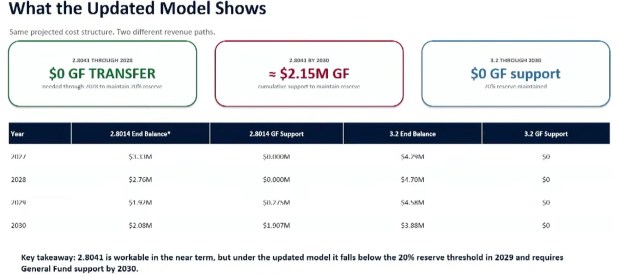 Supervisor Chuck Phyle showed a slide with the difference in general fund (GF) impact between the the options of 2.8-mills worth of funding versus 3.2-mills.
Photo by Matt Fahr
Phyle said the difference between the basic renewal and the renewal covering added costs implemented by the sheriff’s department would have long term effects.
“If we look at the 2.8 (mills), it is viable for the near term. The pressure point really falls in 2029, when everything starts to have a cascading financial cost to lots of the programs that are going on here in the township,” said Phyle. “If we go through the 3.2 (mills) again, just covering the costs as they’ve been projected to go forward, then we have a clear runway to kind of maintain everything stable the way it is.”
Clerk Neubeck, who voted against the motion, explained her position.
“We need to respect the August vote and be mindful that voters will already have other millage questions before them in November, but we also need to recognize that choosing a short-term renewal does not make the larger funding issue go away,” said Neubeck. “I am for bringing back the renewal option, but not the same option that was already before the voters that the voters turned down.”
SCHOOL RESOURCE OFFICERS
The board discussed several options when it came to funding school resource officers for Clarkston schools, including putting a separate millage proposal back on the ballot, but some board members proposed that sometime in the future, the township should pull their contribution to the district.
“I’m probably flexible on that, but we do need to get them off the dole. I think the schools should be picking up their own piece on that,” said Phyle. “I’m not against (school resource officers) in the schools, I just think that it probably should ultimately fall back onto the schools.”
“I don’t like the idea that we’re paying for SROs. I’ve had conversations with (Clarkston Superintendent) John Ryan about it. I think it needs to be paid, but I do have an issue with the township residents paying school taxes and then paying township taxes, and then the township taxes going back to the school resources,” said Moraco.”It’s not that we’re screwing the school out of SRO officers. It’s just a matter of fairness, because we, our taxpayers, are paying the school taxes, too. I think that we could phase that out over a period of a couple years to give the school ample time to get their ducks in a row.”
Ryan Kasak, attorney for the Kelly Firm representing the township, said he would need to further research the legality of using funds from the police fund to separately pay for SRO’s as approved by the board.
“I don’t have a clear answer for that,” he said “I can get an answer for you, part of that being that there may be different layer agreements, whether it’s a legal issue versus a contract issue. I don’t want to speak on that and provide an answer that’s not accurate without looking into it a little bit deeper.”
But Moraco reiterated that no matter what the township offered up for millage options, they need to step away from their agreement with the school district.
“If we went with the two-year (police millage) and the SRO separated the way you guys want to do it, and it fails, we can afford to, in my opinion, subsidize it for those two years to make sure that we have a the school’s lined up with their transition to hopefully have us transition out with them,” he said.