
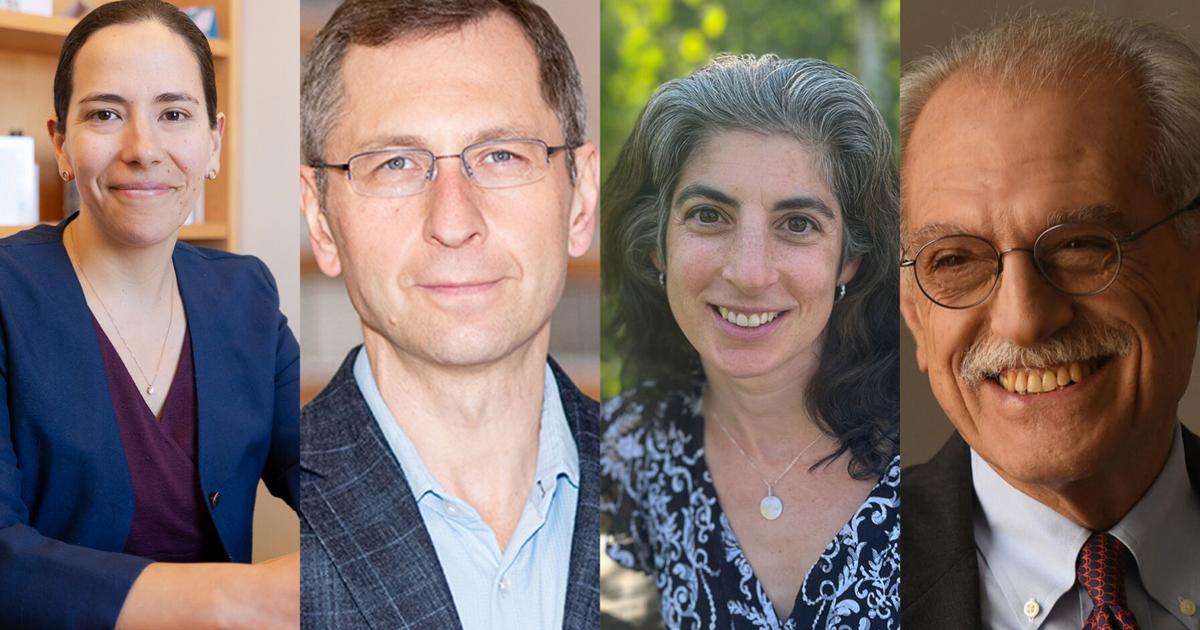
UC Berkeley nominated five individuals for the inaugural UC Regents Innovation Awards, which honors UC system faculty and community members whose innovative work creates a positive impact on society.
Campus nominated four professors and researchers across different disciplines — Fyodor Urnov, Markita del Carpio Landry, Jay Keasling and Alberto Sangiovanni-Vincentelli — and one city of Berkeley employee, Elizabeth Redman Cleveland.
The awards span five different categories: the Gamechanger Award, Disruptive Research Award, Best Startup Award, Community Changemaker Award and Distinguished Lifetime Achievement Award.
Fyodor Urnov, director for technology and translation at the Innovative Genomics Institute, was nominated for the Gamechanger Award, which is awarded to the faculty and researchers with the most impactful product released into the market.
Urnov works on making medicine and treatment available and affordable for kids who have genetic diseases, such as severe combined immune deficiency. Urnov and his team’s mission is to provide equal access to CRISPR – a gene-editing technology that can treat genetic diseases – for every child who needs it.
“I really don’t see this nomination in any way as being for me
personally,” Urnov said in a video statement. “I think it’s a nomination for our campus … It’s a nomination for the Innovative Genomics Institute … And it’s a nomination for the team.”
Markita del Carpio Landry, a professor of chemical and biomolecular engineering and neuroscience, was nominated for the Disruptive Research Award, which is awarded to research with “exceptional novelty” that could be developed into life-improving technology.
“My lab tends to pursue ideas that are technically difficult and sometimes unconventional, with the hope that if they work, they can change what is possible and can be used in contexts in which conventional bioengineering is too challenging, too expensive or unethical,” del Carpio Landry said. “It was wonderful to see that philosophy recognized.”
Del Carpio Landry’s work involves developing new “non-GMO” biotechnologies to study different biological systems without using the typical method of inserting foreign DNA into a genome.
Her research also relates to neuroscience and agriculture, developing nanosensors that can image the chemical communication between different neurons in the brain and designing tools to create a plant IVF platform that allows for quicker crop engineering.
Alberto Sangiovanni-Vincentelli, a professor of electrical engineering and computer science, was nominated for the Distinguished Lifetime Achievement Award, which honors life-long careers yielding various innovations that inspire aspiring UC inventors and entrepreneurs.
Sangiovanni-Vincentelli has taught at UC Berkeley since 1975, and his research focuses on designing mathematical algorithms and software to help with automation and efficiency. He also co-founded Cadence and Synopsys, two major electronic design automation companies.
Now, he’s able to support new companies through UC Berkeley’s startup accelerator, SkyDeck, where he serves as the chair.
“(Winning the award would be) a recognition of my lifetime dedication to research,” Sangiovanni-Vincentelli said.
Jay Keasling, a professor of chemical and biomolecular engineering, was nominated for the Best Startup Award in recognition of his company, ResVita Bio. Keasling co-founded the startup in 2022.
ResVita Bio creates topical treatments for certain severe skin diseases, such as Netherton Syndrome. The treatments release genetically-engineered bacteria that continuously deliver therapeutic proteins directly to the skin. ResVita Bio engineers such bacteria at UC Berkeley’s Bakar Bio Labs.
Elizabeth Redmen Cleveland, chief strategist for sustainable growth with the city of Berkeley, was nominated for the Community Changemaker Award, intended to recognize a private-sector partner or organization promoting the university’s entrepreneurship ecosystem.
As the lead of the Berkeley Startup Cluster, an organization offering resources to up-and-coming businesses, Cleveland works to connect campus to the city and ensure that Berkeley welcomes entrepreneurs.
She fought to implement policies such as “Keep Innovation in Berkeley,” which supported keeping research and development establishments in the city. Cleveland also runs the #DiscoveredinBerkeley marketing campaign that shines a light on local businesses.
“Part of the reason I’ve been in my job so long is that I regularly feel the impact I’m having on the community, which is also rewarding because I live here,” Cleveland said in an email.