
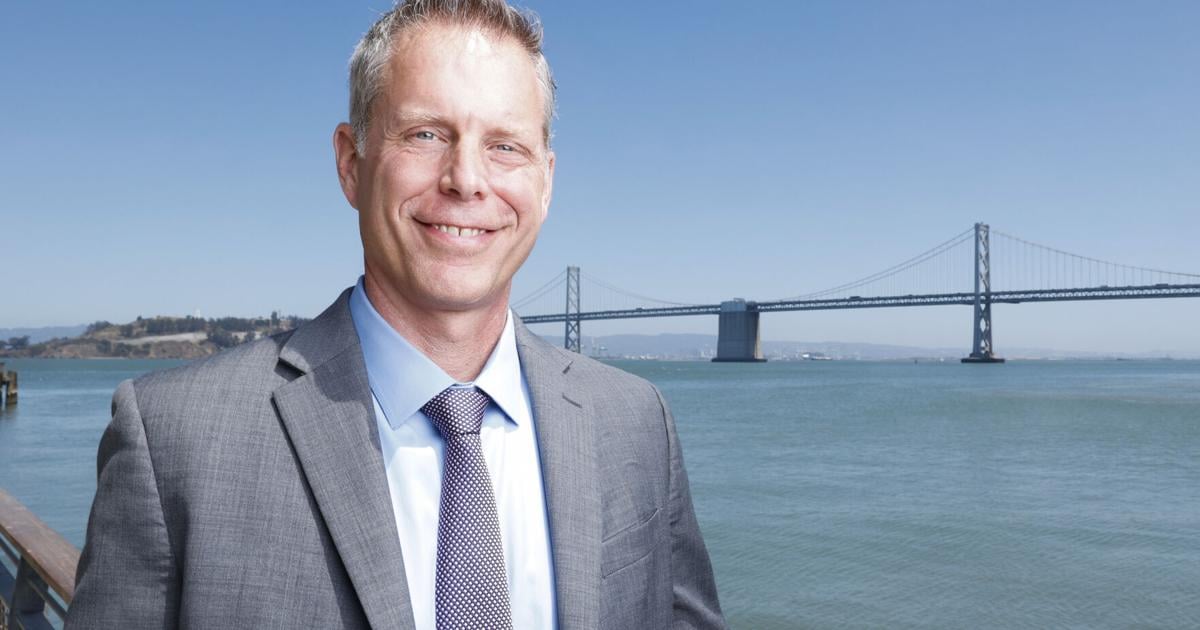
Michael Martin, the new executive director at the Port of San Francisco, has taken the helm of an agency with a dizzying array of priorities that include bolstering iconic tourist destinations and maritime facilities, luring new business tenants, shepherding big real-estate developments, and protecting The City’s waterfront against earthquakes and sea-level rise.
“This is one of the greatest land and water portfolios any public agency manages in the whole country, maybe in the whole world,” said Martin, who was appointed by Mayor Daniel Lurie in July, in a recent interview. “We basically run a city within a city.”
The roughly 300-person port manages a 7.5-mile stretch of waterfront held in public trust that contains some of The City’s most recognizable tourist destinations, vital transportation infrastructure, historic buildings and vestiges of its past as an industrial harbor.
Stretching from Fisherman’s Wharf in the north to India Basin in the south, its jurisdiction features world-famous attractions such as the Ferry Building and Fisherman’s Wharf, a strong commuter-ferry service, cruise-ship docks, fishing boats, office properties, city parks and old industrial lands scheduled for redevelopment into mixed-use neighborhoods.
Martin, who had been in his post on an interim basis since October, started at the port in 2017 as a deputy director managing real estate and development.
He has worked for The City for 24 years since joining as a deputy city attorney, and he has specialized during much of his tenure on real-estate matters, including development of the emerging Mission Rock and Pier 70 mixed-use neighborhoods on port land on the eastern waterfront.
A lawyer by training, Martin said that even in school, he was drawn to urban development.
“I guess I always had this idea of being part of how a city evolves and gets better,” he said.
It was as the mayor’s project director for the 2013 Americas Cup, however, that Martin said he “fell in love” with the [ort as he saw how the public came to the shore to witness the competition.
“Just to be down here frequently and see the way it would draw people for the races — it was just amazing,” he said.
Martin is now charged with managing transformational changes on multiple fronts, from the ongoing renovation of Fisherman’s Wharf with construction of a new plaza to shoreline-resilience work that is estimated to cost $13.5 billion, including federal funding, and take decades to complete.
Martin has taken over at a moment when much of the port’s property is slated for investments aimed at expanding tourism, producing more housing, and increasing resilience while preserving elements of its working character and enhancing its public accessibility.
Putting wind in the sails of those plans is the fact that the port is coming out of a post-COVID-19 lull in a good position financially, driven in part by a strongly rebounding cruise-ship business and ferry ridership that is exceeding pre-pandemic levels.
“The port is in a really good space right now,” Martin said. “We recovered more quickly from the pandemic downturn than we expected. Our revenues now exceed pre-pandemic revenues.”
As an “enterprise agency,” the port does not get money from The City’s general fund and thus must generate its own income. Its fiscal 2026-27 budget projected $148.3 million in operating revenue against $131.2 million in operating expenses.
The port nevertheless has growing bills and extensive deferred maintenance to manage, and it’s actively seeking new forms of revenue, including additions to its roster of 550 commercial tenants, Martin said.
“We have vacant space available of lots of different types,” he said. “We used to be very passive. People would show up and say, ‘Do you have space?’ We would show them space. But now we’re trying to go out and say, ‘Where is that next tenant.’”
The port is also exploring the feasibility of establishing an electrified secondary terminal for cruise ships. Currently, cruise ships dock at Pier 27 and sometimes at Pier 35.
In 2025, nearly 370,000 cruise passengers passed through San Francisco, with almost 90 vessel calls. The record of more than 392,000 passengers was set in 2023.
“Cruise has come back really strong from the pandemic, and it’s been a really great thing not only for our portfolio but for tourism in The City,” Martin said.
“We haven’t gotten to the point where we’re talking to cruise lines, but I see that’s something on the horizon that we’d like to see expand,” he said.
The port recently increased its commitment to offering a welcoming environment for visitors and others, he said. The agency joined the Downtown SF Partnership, a newly expanded community-benefit district that will field ambassadors around the Ferry Building, provide round-the-clock cleaning and security services, and help coordinate entertainment and other activities along the waterfront.
Under the management of Hudson Pacific Properties, the Ferry Building has been a downtown standout for its thriving office and retail.
“This hub is getting better and better, and we want to really double down on that,” Martin said.
Another example of the port’s business-oriented tactics came one day after Martin’s appointment. That’s when the agency launched its Blue Economy Initiative, an incubator program of sorts that offers discounts of up to 50% on waterfront leases for qualifying companies developing sustainable maritime and environmental technologies.
One of the first two applications the port has received is from a company developing technology for remote-controlled crab traps meant to help prevent whales from getting entangled in ropes — a concern that regularly leads to truncated crabbing seasons, which limits boat operators’ income, Martin said.


Muttville and the SF SPCA are participating in a national campaign that removes pet-adoption costs and addresses overcrowding in facilities

Scott Wiener honored the longtime SF Symphony conductor in the Legislature’s upper house; a memorial concert in The City is also on the horizon
The state senator said the chatbot was intended to show his electoral rival as obstructionist, but Rep. Nancy Pelosi and others said it showed ‘willingness to erase wo…
“We’re trying to keep the crab season alive, keep supporting our fishing industry, which is such a critical part of what makes Fisherman’s Wharf Fisherman’s Wharf,” he said.
Martin said that a large part of his mission — in keeping with the public-trust goal of making the waterfront publicly accessible — is to get more people to come to the waterfront, whether they be locals; visitors from afar drawn by restaurants, shops or art installations; or workers at companies leasing port property.
To that end, the Port has its initial phase of its $10 million Fisherman’s Wharf Forward initiative, which seeks to overhaul the popular tourist attraction with a new public plaza and lagoon overlook — replacing a defunct restaurant — as well as new lighting.
Other plans include more events, strengthening dock and pier infrastructure deemed vulnerable to earthquake damage, improving fishing-fleet infrastructure, and developing retail opportunities. The plaza, a new barbeque restaurant and a taproom are expected to open to the public in about a month.
“We are looking at this more from a business perspective,” Martin said. “How do we keep people coming back — not just visitors, but locals — so that our businesses thrive and it lifts all boats, to use an overused nautical metaphor?”
Bri Maughan, executive director of the Fisherman’s Wharf district, issued a statement upon Martin’s appointment saying her members were grateful for his “collaborative approach and understanding of the Port’s vital role in supporting the Wharf’s maritime heritage, visitor economy, and future success.”
The port is also increasingly looking to arts and entertainment as a draw.
Martin said he’s hopeful about a proposal to build a new Teatro ZinZanni dinner theater venue by the bay in connection with a new hotel nearby. The theater previously had a spot on the waterfront but closed to make way for the America’s Cup.
In addition, later this year, Martin said he expects an opening of the much anticipated Art + Water arts campus at Pier 29 that is being developed by the Community Arts Stabilization Trust together with author Dave Eggers and city Arts Commissioner JD Beltran.
“We think it’s a great way to bring people to the waterfront, and we want to see more of it,” Martin said.
On the real-estate development front, there are multiple large-scale projects in various stages of planning.
At Mission Rock, the San Francisco Giants and Tishman Speyer have been developing a block of port land across McCovey Cove just to the south of the club’s baseball park. Included in the first phase were a cluster of four buildings — two residential, two for offices — as well as retail space and the five-acre China Basin Park.
Now, with The City showing stronger signs of economic recovery from the COVID-19 pandemic, the port’s staff in June proposed — and the Port Commission subsequently approved — making a $10 million investment for predevelopment and infrastructure design to jump-start development of more buildings.
“We’re excited to see that starting back up again,” Martin said.
Meanwhile, at Pier 70 in the Dogpatch, the firm BGRE is moving ahead with another mixed-use project on port land. The company recently proposed increasing the planned number of homes at its 28-acre waterfront development from up to 2,150 to as many as 2,750.
Groundbreaking for the next phase of development — involving up to 450,000 square feet of office space and up to 700 residences — is targeted for late 2027.
Renovation of Building 12, a football-field-sized former shipbuilding structure at the site, has already been completed, and it is 90% leased, with tenants including a brewer, a baker, artists, and a padel and pickleball club.
At the same property, development is underway for Elevation Sky Park, an immersive entertainment venue that will offer shows with light projections in domes. The first show is scheduled for September 19.
“That central waterfront is just hopping with leasing interest,” Martin said.
But the biggest investments the port will have to manage will be aimed at increasing the resilience of the waterfront to earthquakes and sea-level rise. Parts of the seawall are more than 100 years old, and some wharves were constructed on landfill. The port recently produced a final plan and is engaging with the public on its recommendations.
A primary area of focus is the Downtown Coastal Resilience Project, estimated to cost roughly $700 million. The project’s aim is to improve flood and earthquake resilience along The Embarcadero between Broadway and Harrison streets.
A stretch south of the Ferry Building already floods periodically in the winter, and a 2024 study of the Ferry Building found it seismically vulnerable.
The project — still in the early design phase — is intended to protect critical infrastructure, including for BART and Muni, while improving public spaces and enhancing coastal habitat, particularly at Rincon Park.
The South Beach Coastal Resilience Project, meanwhile, will address The Embarcadero between Harrison and Townsend streets, strengthening aging seawalls and wharves while improving the public promenade. It includes some of the city’s oldest waterfront structures and piers that are targeted for both residential and commercial development.
Such projects will take many years to complete. But in the near term, Martin said he can feel the action along the waterfront regaining some of the energy so evident before COVID-19.
“I remember the excitement I had coming to work back then, and then it was so hard to watch the pandemic kind of put that to an end,” he said. “But it’s really fun to see the pendulum swinging back and hopefully putting us back in something like that again.”