
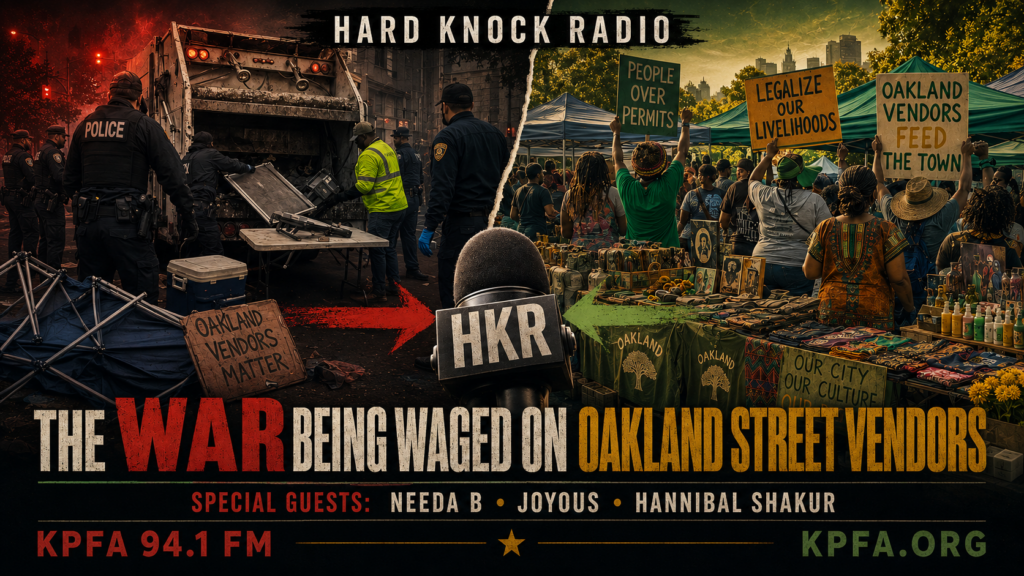
On Hard Knock Radio, host Davey D spoke with Oakland street vendors and organizers Needa B, Joyous and Hannibal Shakur about what they describe as an escalating campaign of harassment, confiscation and criminalization directed at vendors across the city.
Davey opened by emphasizing that street vending has long been part of Oakland’s economic and cultural fabric. Vendors provide affordable food, handmade products and essential income for families, yet city enforcement teams have recently arrived with police, public works employees and equipment commonly used during homeless encampment sweeps.
Needa B said enforcement has targeted people regardless of whether they have permits. “Street vending is part of Oakland’s history. It’s generations deep. It’s part of Oakland’s culture and identity,” she explained. Needa argued that the enforcement is less about public safety than reshaping Oakland for wealthier interests. She warned that traditional vending could be “erased and then repackaged, prepackaged and sanitized” after the people who created the culture are pushed out.
Joyous discussed being handcuffed while filming police confronting another vendor at Lake Merritt. Although she was released, images of her detention circulated online, where she was falsely portrayed as someone selling alcohol. Her personal and employment information was also posted online. Joyous believes she was used as “collateral” because her mother is an organizer.
She pushed back against efforts to portray vendors as dangerous. “We’re not selling drugs. We’re not trying to hurt people,” Joyous said. “It’s just food, it’s camaraderie, it’s building community.” She also connected the crackdown to gentrification and Oakland’s growing affordability crisis.
Hannibal Shakur contrasted the treatment of vendors with the incentives Bay Area cities have extended to wealthy technology companies. “These local micro-businesses are crowdsourcing economic stability,” he said, describing vendors as people investing their wages, labor and creativity into businesses without major loans or corporate support.
Shakur, who has made and sold soap locally since 2012, argued that vendor marketplaces generate business rather than take customers away from established stores. People may arrive to purchase one product but remain to buy food, art and other goods while building relationships.
The guests urged residents to support the newly organized Oakland Street Vendors Collective, patronize vendors and contact city and county officials. Joyous closed with a broader call: “Continue to build with your community, continue to love yourself, and continue to do things that nurture your soul.”
Hard Knock Radio is a drive-time Hip-Hop talk show on KPFA (94.1fm @ 4-5 pm Monday-Friday), a community radio station without corporate underwriting, hosted by Davey D and Anita Johnson.