
This is an edited transcript of Oaklandside 510. You can listen to the episode wherever you get your podcasts.
There’s a stretch of East Oakland that BART just…skips. Right in the middle of that gap sits the San Antonio neighborhood, where trains fly overhead, but nobody gets off.
For years, a group called the San Antonio Station Alliance has been pushing to close that gap. This summer, that campaign got a boost from an unexpected source: a studio class of architecture students at California College of the Arts, who spent a semester imagining what a station there could actually look like.
To talk about it, I’m joined by our road safety reporter, Jose Fermoso, who’s been following the fight for a San Antonio station for a couple of years now.
— Tasneem Raja, editor-in-chief, The Oaklandside
Set the scene for us, Jose. Where exactly are we talking about?
Jose Fermoso, Oaklandside road safety reporter: Look at a map, and there’s a gap between the Lake Merritt station and the Fruitvale station — the longest distance between any two urban stations in the whole system.
It’s the intersection of 14th Avenue and East 8th Street, this strange in-between place. There’s an old Burger King. There’s a hillside of grass nobody really uses. Trains fly right over it, but nobody gets off there.
That gap isn’t an accident, right? It’s tied to how BART was originally built.
Exactly. This neighborhood has for decades been home to Latin American immigrants, more recently with an influx of Asian immigrants too. And the argument residents make is that BART’s original planners in the 1960s designed the system to move commuters from white suburbs into San Francisco, not to actually connect neighborhoods within Oakland. So a dense, working-class part of East Oakland just got left out.
So a group of neighbors decided to do something about it.
Right, this is the San Antonio Station Alliance — everyone calls them SASA. It started with people who already knew each other from the neighborhood realizing they should show up to a regional planning meeting together, and it kind of snowballed from there. They built a website, made flyers, started a YouTube channel. Their outreach has brought in a wave of interested emails from locals.
What’s the pitch? Why should the region spend money building a brand-new station here?
Their argument is really about equity, and about what’s already sitting there waiting to be connected. You’ve got the existing BART tracks. You’ve got Amtrak’s Capitol Corridor line running right nearby. There’s talk of a second BART tunnel under the Bay someday that could also connect through this spot. So the idea is: this is one of the cheapest possible places to add a station, because so much of the infrastructure already exists.
You spoke with one of SASA’s organizers, Sara Rowley, a former teacher at a nearby OUSD school, about what being cut off from BART actually means day to day. Here’s what she said:
Sara Rowley, San Antonio Station Alliance organizer: Passing over this neighborhood has really had some serious consequences for us, in the death-by-a-thousand-cuts sort of way — car maintenance, paying for insurance, driving to the BART station, taking very long bus rides.
I used to work at the elementary school. Attendance was an issue for our students, because a lot of times students were housing insecure, and so maybe they had to spend the night over at a cousin’s house across town. How did they get to school then? Taking a long, slow bus ride is kind of a chore for families. And especially if you’re a middle school– or high school–aged kid, wouldn’t taking BART be like a fun option to get to school? I would think so.
And it’s not just organizers like Sara who are invested in this. You talked to residents too.
Jose Fermoso: Yeah, and that’s the part that stuck with me. I talked to a woman who told me the bus just feels desolate and unsafe, especially early in the morning or late at night — and that a BART station, with its lights and its staff, would feel like a completely different environment. I talked to the co-owner of a laundromat on Foothill who thinks a station would finally bring foot traffic and new customers to a struggling commercial strip.
I should say there’s also real concern from some residents about gentrification — that the people pushing hardest for this station skew newer to the neighborhood, and long-time residents worry about being priced out if the area suddenly gets hot.
That tension is worth naming — this isn’t a story where everybody agrees.
Not at all. There are also just transit-policy skeptics. Some people say adding a station between two existing ones will slow down the whole line. And skeptics point out that BART and Muni are both under real financial strain right now, arguing that’s exactly why you shouldn’t spend money on a brand-new station when the agencies are struggling to keep current service running.
That financial strain is actually its own story we’ve been covering — the regional sales tax measure on the ballot this fall that BART, AC Transit, and Muni are all counting on. It’s the backdrop this whole conversation is happening against. Nobody’s pretending a new station gets built overnight, or even necessarily gets built at all.
So let’s get to the design students. This month, the idea moved from petitions and PowerPoints into something you can actually picture.
There’s a class at California College of the Arts — an architecture studio — where a professor decided this would be the perfect real-world project for his students. Not because anyone hired them to design an actual station, but because it let them dig into a project that actual Oakland residents care deeply about, and imagine it without the constraints of a client or a fixed budget.
What did they come up with?
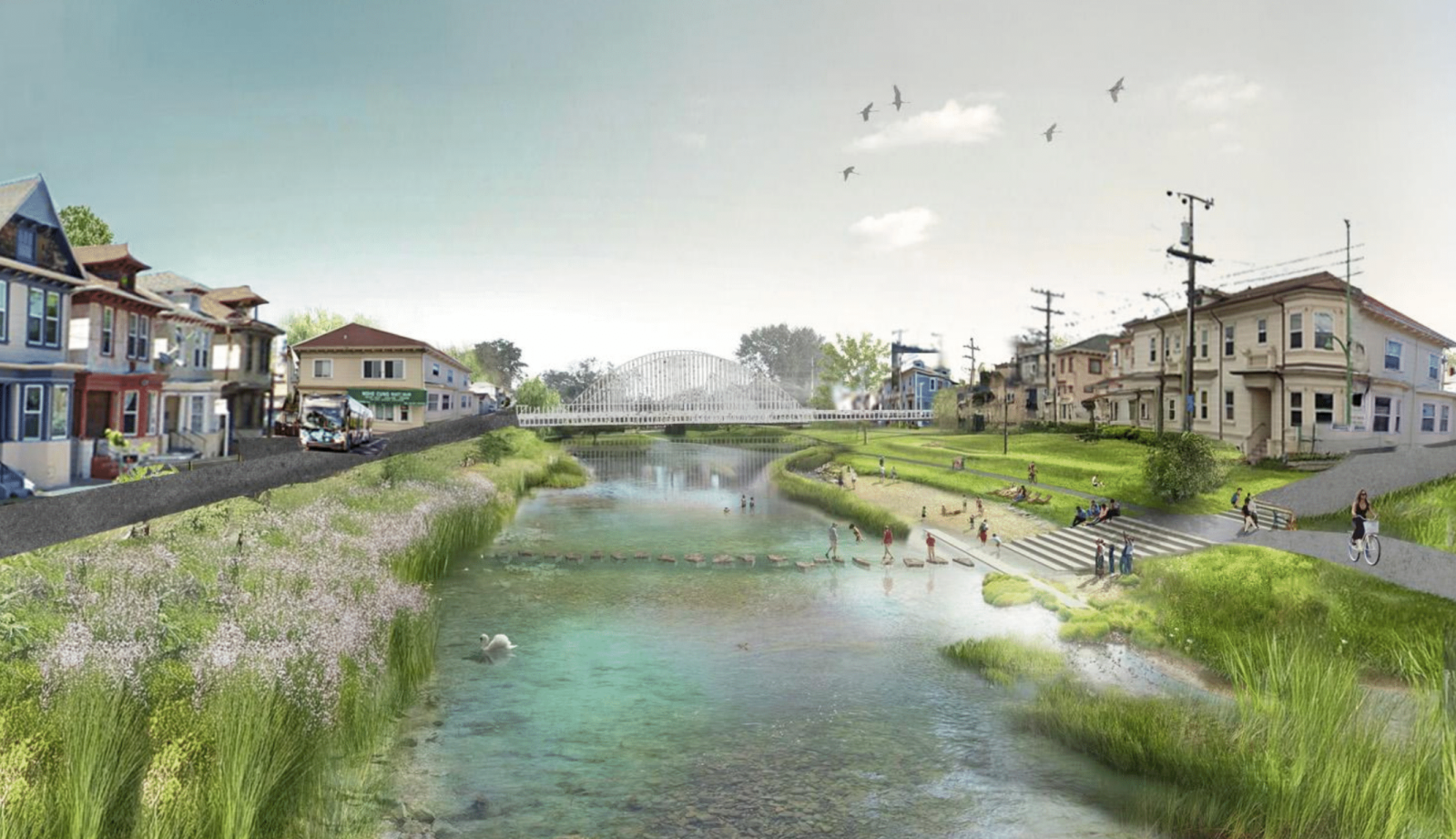
Some genuinely striking stuff. There’s a creek buried underneath 14th Avenue called Brooklyn Creek — it’s culverted, totally hidden, paved over. Some of the students proposed literally tearing up part of the road and daylighting it: bringing the creek back to the surface, giving it room to spread out into a marsh that can absorb floodwater, with little pedestrian bridges crossing over it.
They did serious flood research to get there. They found this area is genuinely at risk — squeezed between a creek that could overflow and rising sea levels from the freeway down toward the water. So their pitch was: don’t just design a station, design the whole neighborhood around it to handle water better. That flood planning is something the city will have to do over the next couple of decades anyway, so why not build a great new neighborhood amenity around it too?
Some of their renderings are genuinely beautiful — a restored creek with grasses, birds, kids playing in it, right in the middle of a neighborhood that isn’t very green right now.
They thought practically, too. Other students designed waterfront housing — long, angled buildings meant to protect the shoreline, which could hold thousands of new residents. And there was a whole vision for the station itself as a community hub, not just a place you pass through: a grocery store, a legal clinic, a childcare center, a food pantry, a digital library. Basically, what if a transit station could also be where you got your everyday needs met.
This is a studio class project, not an actual BART proposal. Is anyone taking it seriously?
Jose: That’s what’s interesting — the neighborhood advocates told me it’s already changing the conversation. The lead organizer said they’ve gotten far more attention on social media thanks to these renderings than they normally get; people respond to seeing an actual picture in a way they don’t respond to a policy memo. And the students didn’t just imagine in a vacuum. They did walking tours of the neighborhood, and SASA organizers came in and presented their own research on the community’s history directly to the class.
Sara Rowley talked about what it meant to see those renderings come together:
Sara Rowley: There was almost a hunger to see a vision for a community like this. It knocked me back on my feet to feel that love for what the students came up with. At the final studio critique, our BART director showed up right at the end. We walked over to the BART station plan and saw the renderings of people playing, food trucks, pop-up vendors — and I swear both he and I got a little misty-eyed. If a grizzled old lady and a BART director can get a tear in their eye, I think that shows how much people are interested in seeing a positive vision of the future.
So where does this leave things? Is a station actually getting built?
Nobody’s promising that just yet, but it has a good chance of happening someday. The idea has picked up some verbal support from regional planners as part of a bigger, longer-term plan for a new Bay Area rail tunnel, but that’s still a plan with a lot of steps left. What you have right now is momentum — a community that organized itself from scratch, a growing base of supporters, and now, literally, pictures of what their neighborhood could look like if this ever happens.
Even the biggest, slowest-moving infrastructure dreams start with somebody drawing on a napkin — or, in this case, rendering a marsh full of birds.
Sara Rowley put it this way, reflecting on what she’s taken from the fight so far:
Sara Rowley: I’m shocked and humbled to learn just how much using your voice as a citizen can do. Nothing in this world was dropped in from a UFO or dropped in from heaven. People had to advocate for it, and people had to build it, and people had to push and work towards building these things. And you, citizen — I’m pointing at you — you can be one of those people.
This episode of Oaklandside 510 was produced by Mark Nieto and hosted by Tasneem Raja.
“*” indicates required fields