
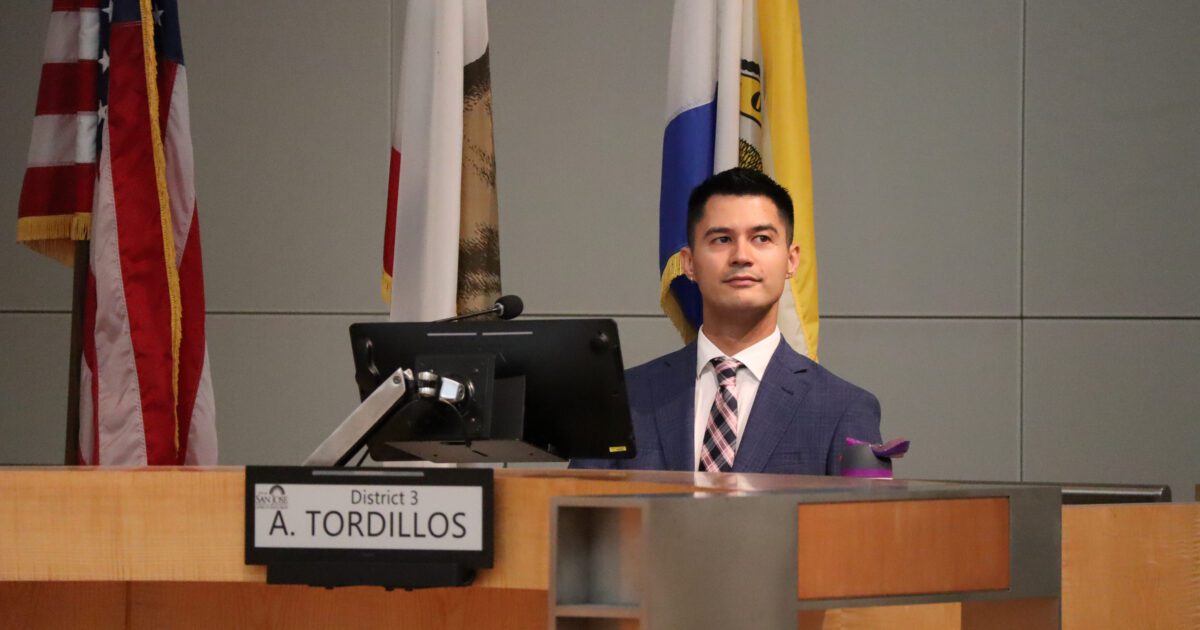
Not long after Anthony Tordillos won the June special election for the District 3 San Jose City Council seat, he had to vacate his role on the Planning Commission. His commission seat has been vacant for nearly three months, leaving downtown without a voice on an influential government body that helps steer the city’s land-use decisions.
As of this week, the process to appoint Tordillos’ replacement appears to be moving forward. The District 3 office, which represents San Jose’s downtown core, received a batch of seven planning commissioner applications Wednesday from the city clerk, according to a Tordillos spokesperson. The spokesperson declined to provide details on the applicants.
The application period closed Sept. 30, after which the City Attorney’s Office vetted applicants to identify any potential conflicts of interest. Now it’s up to Tordillos to select a nominee, who must live in District 3, and then for the city council to make the final decision.
“I know firsthand the important role that the planning commission plays,” Tordillos, who served as chair, told San José Spotlight. “I look forward to moving quickly to appoint a candidate who will serve with the seriousness and diligence this role demands.”
Whoever is appointed to Tordillos’ former seat will get a vote on the 11-member planning commission, with one citywide seat nominated by the mayor and the other 10 representing each district. Commissioners advise the city council on decisions related to San Jose’s built environment, offering recommendations for individual building projects as well as for the city’s long-term strategy for development and economic growth.
Longstanding vacancies
Tordillos officially left the planning commission Aug. 11, the day before his swearing in on the city council. The months-long vacancy for the District 3 seat that has followed is by no means exceptional for the planning commission. Over the past several years, a number of vacancies have extended to six months or even longer, according to a review of recent departures and appointments.
The pattern has led some officials to raise the concern these lengthy vacancies undermine the planning commission’s ability to represent the full scope of San Jose’s population of nearly 1 million residents.
The concern cuts to the heart of a voter-approved reform measure that reorganized the planning commission in 2021. Measure G expanded the body from seven to 11 members and changed most of the seats from city-wide to district representatives.
Supporters of the reform argued it would boost representation of minority ethnic groups and underserved neighborhoods.
“Making sure every district is fully represented is what keeps the planning commission fair and balanced,” Chuck Cantrell, the citywide planning commissioner and a San José Spotlight columnist, told San José Spotlight. “When all parts of the city have a voice, we make better decisions and achieve stronger results for the entire community.”
Only two months prior to the District 3 planning commission seat becoming vacant, the council in June approved two appointees to fill long-vacant seats. Khoi Nguyen became the District 7 commissioner and Lawrence Casey became the District 10 commissioner — with both seats left empty for a full year prior to those appointments.
When the council appointed Tordillos to the District 3 planning commission seat in March 2023, it had been empty for seven months.
Cantrell said it’s unclear to him why vacancies persist for so long.
But City Clerk Toni Taber, whose office helps to facilitate the recruitment process for commission seats, offered one explanation. She said the process often stalls out due to a lack of qualified candidates.
“Sometimes we get people who just check all the boxes and apply for every commission,” Taber told San José Spotlight. “So they may have somebody who doesn’t really know what the planning commission is.”
The recruitment challenge may be especially acute for the planning commission, given the specialized expertise required to sift through local land use policies. The residency requirement brought about by Measure G limits the applicant pool even further.
To help lower the barrier to apply, the City Clerk’s Office recently streamlined the application, making it both shorter and easier to fill out, Taber said. She also said her office accepts applications for commission seats even when no vacancies are available.
The pending District 3 planning commission appointment comes at a time when the city is pressing forward with a number of key development priories. While the local housing construction industry largely stalled out in recent years, several projects — including an affordable 220-apartment tower set to break ground early next year — have lifted hopes for local housing boosters.
The city is also in the early stages of carrying out a once-every-four-years review of its general plan, known as the Envision 2040 General Plan. Over the coming months, officials will update the plan that spells out the city’s long-term strategy for boosting economic growth, revitalizing downtown and building new housing. Not everyone is convinced the planning commission vacancies have made a meaningful difference in how it has functioned.
“It’s been business as usual on the planning commission,” District 6 Commissioner Pierluigi Oliverio told San José Spotlight. “Vacancies do not change any of the outcomes for the planning commission to make its recommendations to city council.”
A bevy of recent state housing laws and the city’s own zoning plans tend to place narrow bounds on the commission’s decisions, making project disapprovals or split decisions a rare occurrence, Oliverio said.
“The city’s planning commissioners are to look at aspects of the entire city so that any particular development in any particular district or neighborhood is judged equally,” he said.
Contact Keith Menconi at [email protected] or @KeithMenconi on X.