
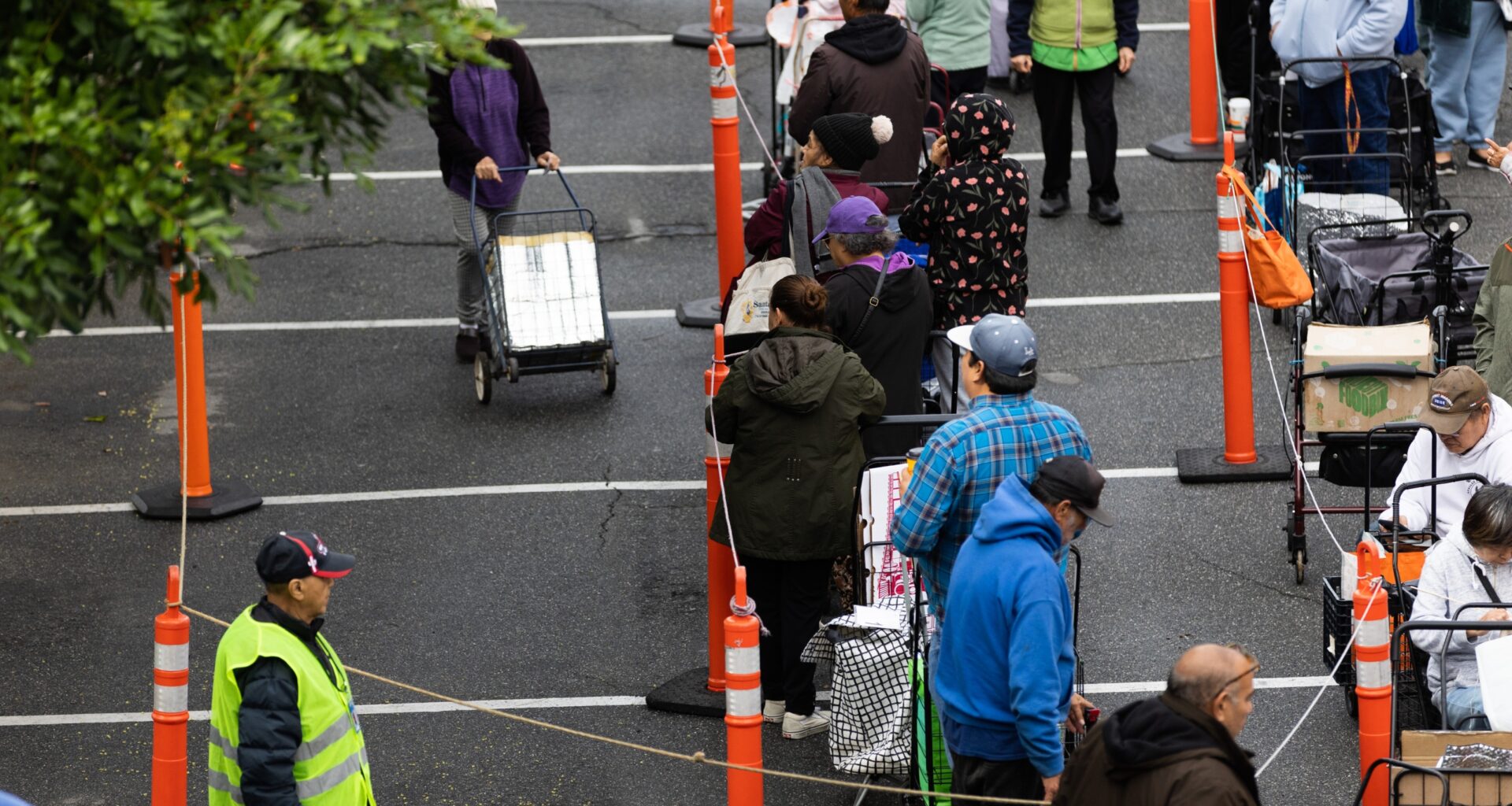
Orange County Hunger Alliance leaders are warning hunger continues skyrocketing across OC as the region feels the impacts of changes to the CalFresh food stamp program which they say caused tens of thousands of residents to lose their food assistance benefits.
A new report by Feeding America, a nationwide network of food banks, found over 387,000 people or roughly 12% of Orange County residents experienced food insecurity in 2024 – increasing from over 267,000 food insecure residents in 2021 or 8.4% of the population.
That’s a 44% increase in OC residents experiencing food insecurity – well before any federal cuts to assistance programs.
Local food bank leaders only expect that trend to get worse as President Donald Trump’s “Big Beautiful Bill” or H.R.1. – signed into law last year which includes $4.5 billion worth of cuts annually to the food assistance program – goes in full effect.
“Those numbers don’t reflect the changes of H.R.1 so what that tells us is that between the time lag and what has happened since the end of last summer, that the situation on the ground is probably worse,” said Second Harvest Food Bank of OC CEO Claudia Bonilla Keller about the data in the new report.
“We can extrapolate what we know is happening – real-time policy with the federal safety net, with the economy and compare it to what we see happening in the charitable food network and ascertain from that triangulation that it is getting worse and will probably get worse in the next 18 months.”
For food assistance options, visit 211 OC.
The warnings from the alliance – a group of food banks, nonprofits, faith-based organizations and public agencies tackling the root causes of hunger – comes as changes to eligibility requirements for the program under H.R.1 are being implemented gradually.
[Read: OC’s Poorest Brace For Cuts to Food Stamps and Health Insurance This Thanksgiving]
Some of the changes that have taken effect this year include stripping eligibility for certain immigrants – like refugees – as well as a host of new work requirements for able-bodied adults to be eligible to receive benefits for more than three months in a three-year period.
OC Food Bank Director Mark Lowry said residents impacted by H.R.1 won’t be kicked off the benefits all at once even as the changes go into effect, but will find out if they’re no longer eligible for assistance or will receive less assistance when they go to recertify for food stamps.
“It will literally take from October of 2025 through October of 2027 – nearly two full years before Orange County sees the full impact of these cuts,” Lowry said. “It has a dramatic effect on these families but you don’t see it all at once. It’s only going to get worse.”
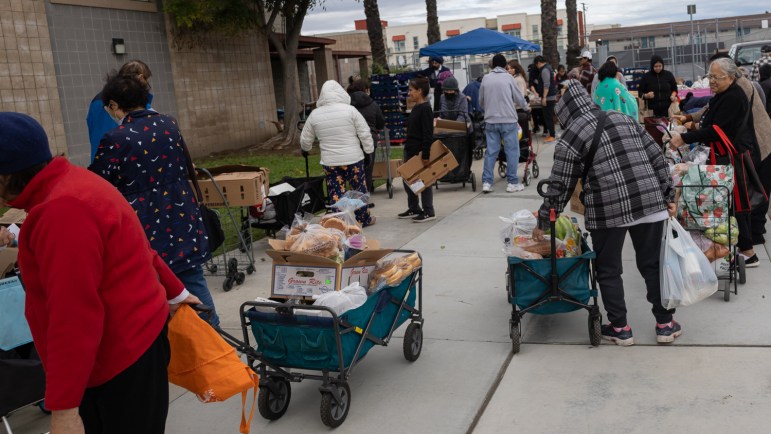 People wait in line at the Seva Collective Food Distribution on Nov. 22, 2025. Credit: ERIKA TAYLOR, Voice of OC
Hunger alliance leaders say the changes have resulted in a decrease of people enrolled in CalFresh – a program they have long hailed as being able to feed significantly more people than the county’s emergency food distribution system run through local pantries and dependent on donations.
Lowry said the latest reports from the social service agency are that 40,000 Orange County residents have lost CalFresh benefits since H.R.1 went into effect last Fall– a loss of millions of dollars used to help feed families.
“We already know there’s $10 million fewer dollars of governmental food benefits available to vulnerable families and that means that those 40,000 people need to turn elsewhere to help feed their families. That’s the big generational change. I mean, at a minimum, we haven’t seen anything like this since welfare reform in 1996, 30 years ago,” he said in an interview.
In August 2025, over 309,000 people in Orange County – roughly 10% of the population – were enrolled in the CalFresh food assistance program, according to the California Department of Social Services.
Around the time the new work requirements for CalFresh took effect in June this year, over 282,000 people were enrolled for food stamps in OC, according to the department.
Prior to H.R.1, OC Social Services Agency and food bank leaders for years were focused on getting more residents enrolled for food stamps due to its wider impact on addressing hunger than food distributions.
Alliance leaders say they’re not giving up on that approach despite more expected changes – even as Lowry said the county is estimating losing 4,000 participants in the food assistance program each month and while they expect to sign up 10-30 people each month.
Hallie Stohler-Plaza, director of the OC Hunger Alliance, said the benefits can still be a lifeline for eligible residents.
“At this point, CalFresh is still a wonderful benefit and it still does much more. Our public benefits are critical to food insecurity in terms of monetary coverage,” Stohler-Plaza said.
“Our goal is to ensure that folks that are eligible for CalFresh are able to access CalFresh. We just know that with all the changes, we have to do a lot more to ensure that people are educated about how to comply with the changes. That’s the mission at this point.”
Funding changes are also expected to impact CalFresh this Fall.
Currently, the federal government and states split the cost of administering the program 50/50.
In California, the state splits its portion with the counties, which pay 15% of the total costs.
In October, the federal government will only pay 25% to cover the administration of the program.
Hunger Increases in OC Ahead of CalFresh Changes
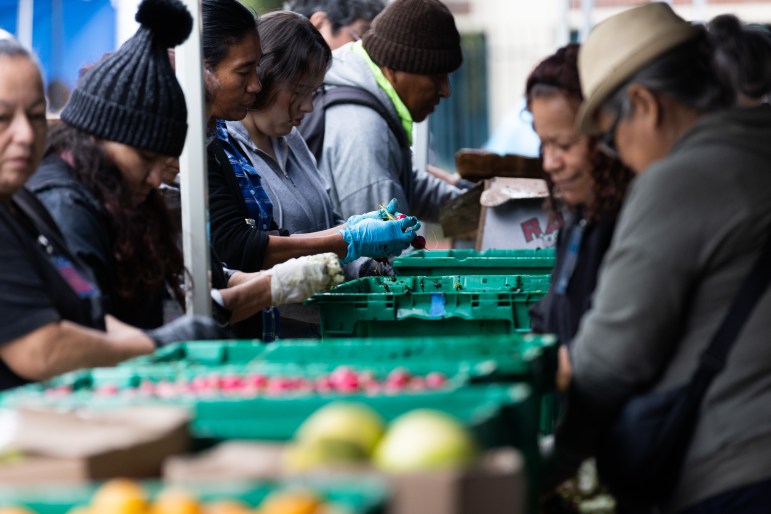 Latino Health Access food drive volunteers prep radishes for distribution. Credit: JULIE LEOPO, Voice of OC
A report dubbed “Map the Meal Gap” found that over 112,000 children or roughly 17% of OC kids under the age of 18 didn’t know if they would have access to three healthy meals on any given day in 2024.
In 2021, nearly 64,500 children or 9.2% of OC kids younger than 18 were food insecure, according to the data.
Alliance leaders said hunger impacts children’s development.
“Hungry children cannot learn. Children that come to school hungry, we know from research, are more apt to be inattentive to their studies. They’re more apt to have disciplinary issues and less likely to stay at grade level than their peers that have access to constant nutrition,” said Keller, CEO of Second Harvest Food Bank OC.
The data also shows food insecurity disproportionately affecting the Black and Latino communities, with the highest rates among African Americans at 29% in 2024 despite making up about only 2% of Orange County’s residents.
About 18% of Latinos, 195,000 residents, in OC faced food insecurity in 2024 – the largest number of people experiencing food insecurity in the county.
“Food insecurity is hitting our populations of color differently and harder,” Keller said.
Stohler-Plaza, director of the OC Hunger Alliance, said the data from the Map the Meal Gap study, while important, has gaps and acknowledged the data was two years old and did not tell the full story of hunger in OC.
She added the alliance has a working group focused on getting data on current services aimed at tackling poverty and food insecurity in order to improve those services and make them more efficient and effective.
“With that data collection, it will enable us to really look locally at some of our systemic efforts and where we are really meeting the mark, where we are missing it and how we can really meet the moment with everything that’s going on,” Stohler-Plaza said in an interview.
 Credit: JULIE LEOPO, Voice of OC
Lowry said this is the worst food insecurity has been in OC since the COVID-19 pandemic, noting that during the pandemic philanthropists as well as government agencies really stepped in to address hunger.
“There was a generous and right-sized response. That is not the case today. Not only is there no help coming from the federal government, the federal government is the cause of these reductions in service,” Lowry said.
At the same time, he said state officials have stepped up amid a budget deficit to give food banks across California over $100 million to buy food and local food banks are aggressively stepping up their efforts to address the growing need even if they can’t match the aid lost.
Keller said the charitable food network is being strained with the changes.
“It’s a much harder logistical feat to get food out to 200, 300 pantries, which is roughly what each food bank serves. Any stress you put on the system is felt very deeply. We learned that during the shutdown last fall. It was scary to realize that people weren’t going to get (food stamps),” she said.
Lowry adds low-income families probably won’t starve to death in OC, but without food stamps, many may skip paying household bills to put food on the table.
“What is going to be sacrificed?” he said. “These costs don’t go away. They just manifest elsewhere.”
Hosam Elattar is a Voice of OC reporter. Contact him at helattar@voiceofoc.org or on Twitter @ElattarHosam.
Related