
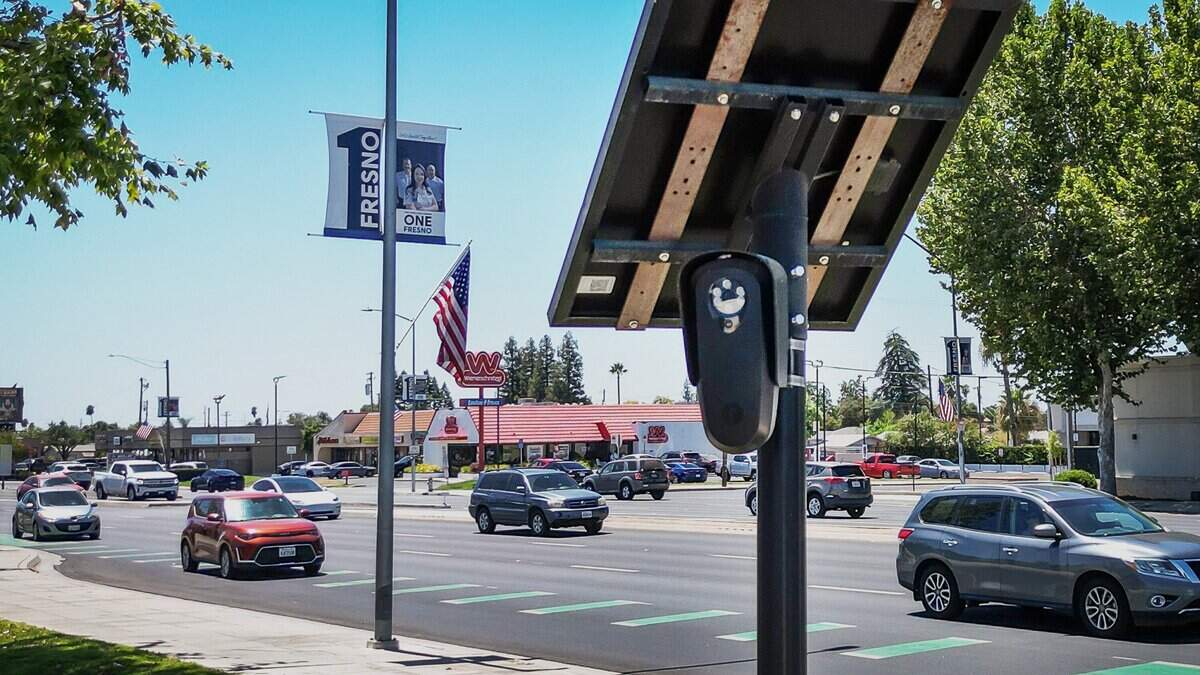
The use of Flock Safety and other cameras have been in recent months met with hostility as communities rethink their use, but the use of such surveillance could expand in the city of Fresno as a new voluntary community program is in the works.
Fresno police have said they use the city’s Flock cameras to read license plates, and Chief Mindy Casto has argued the cameras, about 70 total, are useful tools for investigators as police say they strive to balance safety with privacy.
The new community program offers individual homeowners or a consortium of neighbors — like members of a Neighborhood Watch — the option to put up their own cameras and volunteer to allow access to what it sees to police.
Fresno police say it’s unclear when the community program will be ready to roll out but it’s already available under the city’s contract, and communities like Modesto — where there are more than 400 community cameras — already allow the access to local police. The planned program would potentially expand the number of surveillance cameras available to the eyes of Fresno law enforcement as the cameras continue to be a flashpoint for residents skeptical of police power and the creep of technological observation.
Chief Mindy Casto touts community camera program
Casto mentioned it in June in a City Council meeting when Councilmember Brandon Vang asked about curbing theft at mailboxes in his district.
“It’s a community connect program. So people, perhaps the neighborhood, wants to put their own camera up, or a resident does, they can choose to share that with us,” she said on June 10. “It’s completely voluntary, if they would like to, and that would be a way for us to help.”
She noted while answering that sometimes police ask for video from homeowners and the footage they are seeking has been overwritten, or recorded over before police get to it.
The Fresno police contract for community cameras is not through Flock, but rather Axon, the same company the department uses for body-worn cameras on officers and the artificial intelligence used in drafting police reports. Axon began offering the voluntary option after acquiring Fusus, a Georgia-based company that developed camera networks.
The Axon cameras are linked to police only in public areas around City Hall, FAX bus stops and state Department of Transportation land, according to Lt. Larry Bowlan, the department spokesperson.
The service is offered for free to the city, according to the Fresno contract.
Fresno police could be given 24-hour access to cameras
Axon allows residents or neighborhoods to register their cameras so police know where they are when they want to ask for footage, or the cameras can be allowed to offer free access to police around the clock, according to Axon’s website.
The program is available in cities around the country, including places in the San Joaquin Valley like Merced, Modesto, Turlock and Stockton, according to Axon.
The company says there are 290 registered cameras in Merced and 105 that are already integrated for 24-hour access, the Axon website says. Modesto has 424 integrated cameras and 88 that are simply registered.
Axon’s website includes links to each city’s community program, which features much of the same language. A resident’s camera can link into the system and “all you need is a small Axon FususCORE device that plugs into your camera system,” the community program website says.
“You set your preferences,” the website says. “Sharing your feed can improve response time and help keep you safer by providing advanced details of the situation.”
Some of the equipment offered by Axon uses artificial intelligence, but the website says it does not use facial-recognition software.
Problems with Flock and other cameras in the news
Flock cameras have been a topic of debate in many cities after seemingly flying under the radar before drawing the ire of residents, who argue the cameras are an invasion of privacy.
Police in many communities have touted the network of cameras as a great crime-fighting tool, including Fresno’s Chief Casto, who has said the police use it in specific situations and who accesses them is tracked in an effort to stop its abuse.
That kind of safeguard has not proven to be full proof in communities using public cameras like Flock. Some cities have even backed out of the initial plans.
The Los Angeles City Council decided in early July to renegotiate its contract with Flock after residents pushed back over privacy concerns.
The cameras can often draw protests and vandalism from detractors of such surveillance. A Pismo man was arrested after vandalizing a camera by striking it with a truck, according to a San Luis Obispo County Sheriff’s Office news release from July 28. Similar headlines have made the news in several states.
At the same time, police officers have also been arrested for misuse of the cameras, which is the kind of reason many residents are skeptical of the cameras. A North Carolina officer illegally accessed the cameras for “non-law enforcement purposes,” law enforcement officials there said July 30.
At least 50 officers have been charged with or accused of misuse related to stalking a partner, former partner or a woman they were interested in, according to a report from the Washington Post.
Fresno police intend to offer the community program, but the timeline is murky.
“It’s in the queue of tech projects. First up is a major radio upgrade for the department and Axon Standards (Internal Affairs administrative tracking) integrations before this reaches the top of the priority list,” Bowlan said in an email. “No start date yet.”
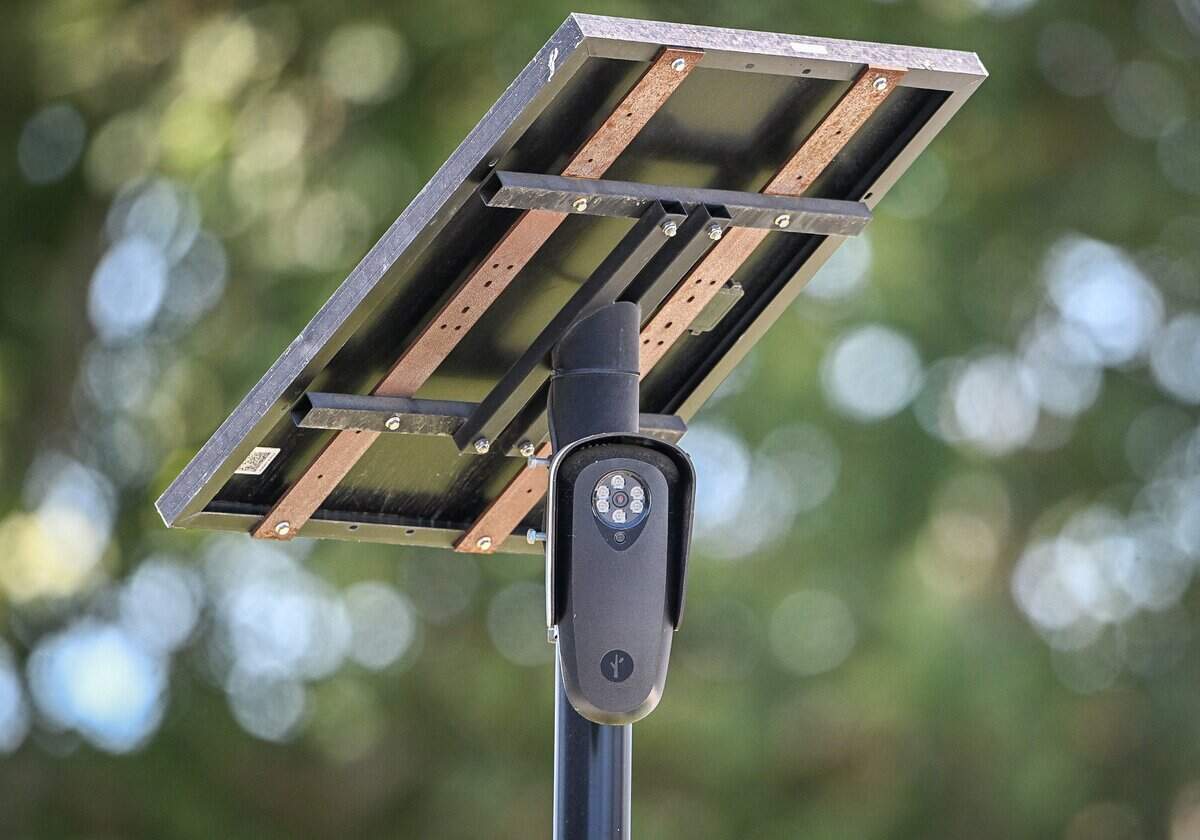 One of Fresno’s Flock cameras is shown on Blackstone Avenue near River Park Shopping Center on Wednesday, July 29, 2026. Police say the cameras are used to capture license plates. CRAIG KOHLRUSS ckohrluss@fresnobee.com
  One of Fresno’s Flock cameras is shown on Blackstone Avenue near River Park Shopping Center on Wednesday, July 29, 2026. Police say the cameras are used to capture license plates. Craig Kohlruss
Related Stories from Fresno Bee

Merced Sun-Star
Reporter Thaddeus Miller has covered cities in the central San Joaquin Valley since 2010, writing about everything from breaking news to government and police accountability. A native of Fresno, he joined The Fresno Bee in 2019 after time in Merced and Los Banos.