
The city has been paying for generations of neglect.
That’s the conclusion The Oaklandside has reached after reviewing 16 years of data on all lawsuits and legal claims filed against Oakland by people whose bodies or property were injured by poorly maintained sidewalks, potholes, or dangerous road designs that encouraged speeding and reckless driving.
When added up, the payout numbers from Jan. 1, 2010, to May 15, 2026, are staggering. The data also reveals a city law office that has successfully defended the city in a significant number of cases:
Oakland paid $54 million to settle 352 lawsuits.
The city settled another 1,269 administrative claims — before they escalated into lawsuits — for a total of $1.3 million.
The city successfully defended itself against 213 lawsuits and 4,016 administrative claims, with no taxpayer payout.
Of the 5,850 total claims, Oakland paid settlements on roughly a quarter of them.
The data illustrate how highly vulnerable Oakland has been to lawsuits because of its extremely poor road and sidewalk conditions.
As The Oaklandside has reported, the city went decades without meaningfully investing in its nearly 850 miles of roads. Only in the last eight years has it spent a significant amount of money redesigning them, adding car-slowing infrastructure, filling potholes, and repaving roads. About 230 miles of Oakland roads were paved from June 2019 to June 2025. The three largest settlements date back to a period before much of that repair work was done: $7 million over a pothole on Skyline Boulevard that caused a bike accident in 2017; $6.5 million over a pothole on Grizzly Peak Boulevard that caused a bike accident in 2018; and a $6.5 million settlement over a pothole on MacArthur Boulevard that caused a bike accident in early 2020.
In a statement to The Oaklandside, the City Attorney’s Office said Oakland was “committed to maintaining its streets and sidewalks in safe condition, free of defects.”
“If a person is injured or their property damaged by an alleged defect with the City’s infrastructure, the City will reasonably try to resolve the claim,” the office said. “However, where the evidence does not support a claim, the City will defend itself vigorously.”
Lawsuit payouts surged starting in 2017, only dropping recently
Based on our analysis of nearly 16 years of data from the City Attorney’s Office, 2011 was among the costliest years for Oakland due to crumbling roads and sidewalks. Oakland paid out roughly $5.8 million in settlements due to crashes, trips, and collisions that happened that year. The average annual payout for the period between 2010 and 2026 was $3.6 million.
The six-year sequence from 2017 through 2022 was even worse, with consecutive multi-million-dollar settlements paid out for infrastructure-related injuries sustained in all but one of those years. The most expensive year during that stretch was 2018, with incidents from that year costing the city $9.3 million.
For infrastructure-related injuries and property damage that occurred in 2023, the city has so far paid about $1.3 million in settlements, and for 2024 incidents, the city has so far paid only $658,000, the lowest amount in 14 years. Those numbers will likely rise, as the larger settlements typically took a few years to resolve.
Poor road conditions are Oakland’s biggest infrastructure liability
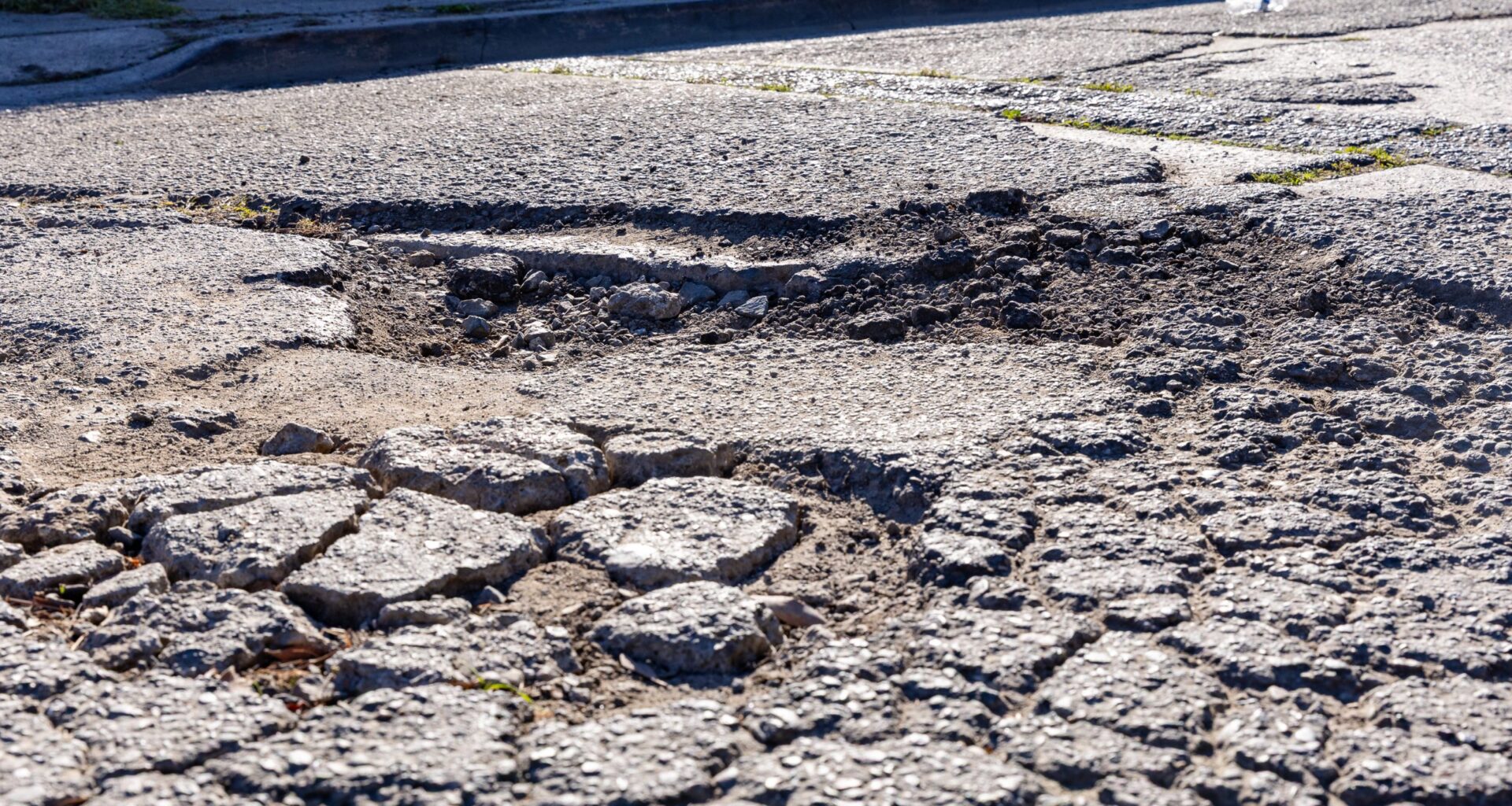
From a legal perspective, roads with potholes, jutting asphalt seams, and alligator cracks are Oakland’s most expensive transportation infrastructure problem, costing the city about $31.9 million in settlements from 130 lawsuits. Lawsuits over potholes resulted in an average payout of nearly $246,000 by the city, and lawsuits over bad road design, signs, or lights resulted in an average payout of $135,000.
The Oaklandside has reported on how potholes and poor road conditions are one of the most serious problems facing Oakland’s Department of Transportation.
“Because the City of Oakland failed to repave its roads for decades, its streets have been in poor condition for a long time,” an Alameda County grand jury noted in a February report. “Poorly maintained streets present serious liability issues for the city. In many cases, potholes and poor pavement conditions caused accidents that resulted in catastrophic injury, particularly to bicyclists. Even just a few of those cases resulted in substantial payouts by the city.”
Josh Rowan, head of the city’s Department of Transportation, has often called for more resources to go into road repair. “We certainly don’t want those injuries to take place,” he has said, calling some of Oakland’s worst potholes “catastrophic failures.”
We found that poor road conditions have led to more costly settlements than sidewalk and curb problems, perhaps because drivers and bicycle riders tend to travel faster on them, increasing the chance of a more severe injury. The consequence of speed in a collision is, of course, a major element of personal injury law; the faster a vehicle driver hits a person on the road, the less likely the victim is to survive.
Problems the city knew about led to the most expensive lawsuits
Some of the most expensive lawsuits over Oakland’s roads resulted from situations in which the city was aware that conditions had deteriorated badly but hadn’t done enough to address the problem before someone was badly hurt or killed. Sometimes, especially before the passage of Measure U, an infrastructure bond measure, the budget just wasn’t there.Even after the measure was approved in 2022, the city had to delay critical paving projects when the city was blocked for months from selling bonds to pay for them.
A case in point was the death of Dmitry Putilov. The young father was struck and killed on June 16, 2022, by a speeding driver on 14th Street near Jefferson Street in front of his two children while they were riding their bikes.
A lawyer for Putilov’s family and members of the street safety advocacy community pointed out that the city knew about the speeding problem on 14th Street and had developed a plan to alter the road’s design to slow cars before the tragedy occurred. But objections from the fire department, which had opposed narrowing the road because it would make it harder to maneuver the department’s large trucks, slowed the project. Putilov’s family sued and received a $2.4 million settlement in 2024.
The city then moved quickly to approve the road redesign, and now, in 2026, the narrowed road with concrete-protected bike lanes is complete.
The family of Allan Lee received a $3 million settlement in 2015 to end a lawsuit over Lee’s deadly crash on Grizzly Peak Boulevard around three years earlier. According to the database, Lee’s family said he “flipped over the handlebars of his bicycle and into an oncoming car after his front wheel got stuck in a rut.” The family argued that the city had multiple prior notices of poor conditions on the popular cycling road, since at least 2005, when then-councilmember Jane Brunner, according to the Daily Journal, forwarded a complaint from a civil engineer about the danger its conditions posed to “hundreds of cyclists.” Another complaint in 2007 led the city to acknowledge the need for road repairs.
As we previously reported, the city’s prior knowledge of a problem is critical in determining fault in these cases. Known as “constructive notice,” this legal principle means that a city’s liability is greater if it knew a road or sidewalk was dangerous and had a reasonable amount of time to fix it, but failed to do so. Thanks to this standard, the city’s years of low infrastructure investment have proved incredibly costly, with a large share of money, about $23.5 million, dating to incidents that occurred before 2018, when the city announced a renewed commitment to consistent paving, with a five-year paving plan, to fix nearly 100 miles. (Another $9.3 million in settlements date to incidents in 2018, when the paving had just begun.) Up to that year, the city averaged about six miles of paving per cycle.
Anthony Label, a lawyer in another Oakland infrastructure case where a cyclist hit a pothole and then hit his head, leading to a $7 million payout, told us previously that cities that expose people to hazards over a long period of time are at greater risk of lawsuits.
Oakland paid out on 62% of infrastructure lawsuits
The vast majority of lawsuits over Oakland’s hazardous roads never reached trial. Of the 352 lawsuits in which the city eventually paid out, settlements were reached in the vast majority of the cases — 295, or about 84%. This resolution would typically have allowed the city to avoid admitting fault in the case or becoming vulnerable to a jury awarding much bigger monetary damages.
For example, Catherine Looper was riding her scooter on Golf Links Road, east of Elysian Fields Drive in 2013, when she crashed into a pothole and was thrown, hitting a guardrail. Looper said in her lawsuit that she suffered road rash, severe headaches, bruised ribs, and injuries to her face and elbows. She also claimed that she lost income and was hit with medical bills. The City Council settled the case the following year, saying it was “in the best interests of the city” to pay $75,000 rather than go to trial.
Sometimes, settlements involve much larger payouts, including in 16 cases with payouts above half a million dollars. Lynne McDonald, who fell and suffered serious injuries due to a pothole on Grizzly Peak Boulevard in 2018, won nearly $3 million six years later, while Francisco Salinas, who suffered brain damage and hearing loss after a car collision at the intersection of Hegenberger Road and Hamilton Street in 2015, settled for more than $800,000 five years later.
Across all 585 infrastructure lawsuits, the city paid the plaintiff 62% of the time, with 213 cases, or 38%, resulting in no payment.
In litigated cases where the city doesn’t pay, the City Attorney’s Office sometimes files a motion with the court for dismissal or summary judgment based on the evidence, after depositions. Sometimes plaintiffs’ attorneys recommend that their clients back out.
The data shows that Oakland took 24 lawsuits to trial. In 17 of these cases, the city and the plaintiffs settled during the trial, meaning one or both parties thought it was a good idea to make a deal before reaching a verdict.
Dulcey Bower sued Oakland after a 2011 solo bike fall allegedly caused by “large, deep potholes” on Mountain Boulevard, causing major injuries. During her 2014 trial, she and Oakland agreed to dismiss the case with the city paying her $3 million.
Karen Davis sued the city in 2012 after she allegedly tripped over a “metal protrusion sticking out of the sidewalk” on Oak Street. Some sidewalk corners use metal, steel, or cast iron on their edges to maintain form and to protect them for long-term use. In Davis’ case, she agreed to a $4,500 payment to resolve her case as trial was underway in 2014. And Barbara Gorsuch received a $5,000 settlement during a trial that same year over allegations she tripped on a cracked sidewalk and broke her wrist.
Of the cases that ended up moving to small claims court, 16 resulted in judgments against the city, including a case brought by Edwin Winston, who alleged injury and damage to his wheelchair from a pole that was sticking out of the sidewalk on 69th Avenue in 2010. Small claims court has a $12,500 payout limit in California; some of these 16 claimants may have decided it was not worth the time and money to pursue a costly trial. In legal terms, deciding to take a smaller amount in a case is sometimes called a nuisance-value strategy.
Seven lawsuits over the past 16 years went to trial and were decided by a jury: the city lost all of them.
None of the judgments, though, were for large amounts. The biggest was a $25,000 judgment on behalf of Mildred Pegues from a trip and fall in 2018 on an uneven sidewalk at 67th Street and San Pablo Avenue. Other cases involved a man who stepped on a utility box and fell and someone who tripped on a pothole.
Why does the city pay for sidewalk claims if it requires property owners to make repairs?
Oakland requires that property owners, both residential and commercial, maintain and repair the sidewalks abutting their property, sometimes at a cost of thousands of dollars. Yet Oakland paid out nearly $9 million in 231 sidewalk-related lawsuits over the 16 years for which we received data. That’s because, under state law, the city can still be held liable for injuries or property damage on public property, especially if it’s been made aware of an infrastructure problem in advance, such as through a report to Oak311.
According to the city, its attorneys can and do negotiate with plaintiff’s and homeowners’ attorneys over responsibility for sidewalk problems, leading to cases in which the city and the homeowners split a settlement.
When sidewalks fall into disrepair, the city often sends a notice to repair to the adjacent property owner. Or, if the city chooses, it can retain the right to repair the sidewalk and then bill the property owner.
In recent years, to reduce the city’s financial liability, Oakland city attorneys have sometimes filed claims against contractors who botched jobs that later led to lawsuits over injuries. When a contractor signs a contract with the city, the company signs an indemnity obligation document stating it is responsible if anyone is injured due to the quality of the completed job.
The City Attorney’s Office did not provide The Oaklandside with data on how many times the office has sued contractors or property owners who failed to maintain or properly repair sidewalks.
Last year, the city settled a class-action lawsuit brought by Nicole Brown-Booker and Michael Curran, Oakland residents and disability advocates who claimed the city had violated the Americans with Disabilities Act by allowing its sidewalks to remain in “a condition not suitable or sufficient for use.” The city announced, as part of the settlement, that it would fix tens of thousands of sidewalks over the next 25 years, making them easier to use for people with walkers, strollers, and wheelchairs.
Those repairs could potentially save the city millions of dollars by avoiding future legal claims.
“*” indicates required fields