
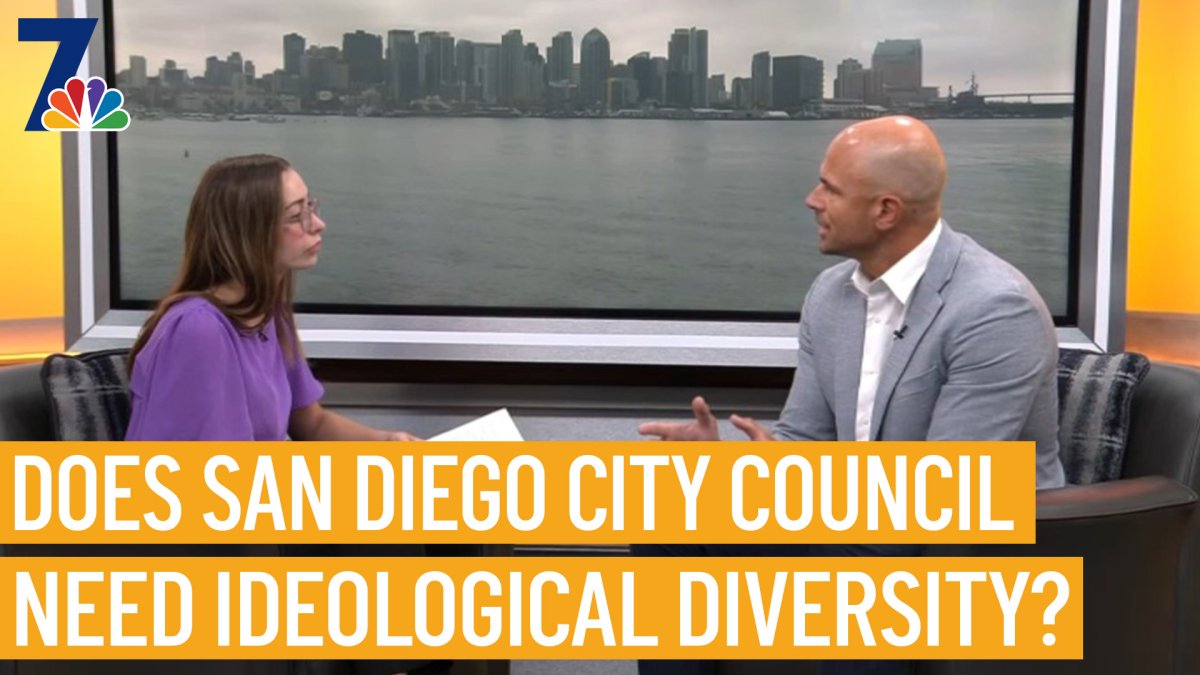
The San Diego City Council races were especially expensive this primary season, and the one garnering the most attention heading into the general is the race to replace Jen Campbell in District 2. Richard Bailey, the former mayor of Coronado, is running for the seat as an independent. He spoke with NBC 7 Political Reporter Joey Safchik on Politically Speaking this week.
A transcript of that interview is below:
Safchik: This year, business leaders, unions and other entities spent unprecedented dollars on primary council races across America’s eighth largest city. The most expensive of all was district two. The race to replace termed out council member Jen Campbell. It could be the first time a non Democrat is seated on the council in years. That would be Richard Bailey, former mayor of Coronado, who’s here with me now. Thanks for being here.
Bailey: My pleasure.
Safchik: You spent 12 years in Coronado City Hall. What did you learn? What do you hope to bring across the bridge?
Bailey: Yeah. So I spent 12 years at Coronado City Hall, for years as a city council member and then eight years as mayor. And what I learned there, more than anything else, is that good governance is nonpartisan. At the local level. Voters expect you to fill the potholes, maintain the parks, and keep the public safe. And I think that’s something that’s sorely lacking at City Hall in San Diego right now. A focus on good governance, accountability and fiscal responsibility. And I think that’s something I can bring to the table.
Safchik: You seem to think the city of San Diego is plagued with quite a few issues, especially fiscally. Why would you want to move here?
Bailey: Yeah, well, I have several businesses in the district, and of course, I love living in San Diego. Like everyone else that lives here. But unfortunately, for as great as San Diego is, the city, unfortunately, is a city in decline. And that’s not just my personal opinion. That’s according to the city’s own data. So when I saw the other candidate that was running represents, you know, the same policies and the same direction of the mayor and the current city council, I felt a sense of civic responsibility to step up and offer voters an alternative.
Safchik: Did you move to Point Loma just to run for the seat?
No, actually, I moved to Point Loma because I love to be near the water. I have a business nearby and also wanted to own a place I was previously renting in Coronado, and now I’m a proud San Diego homeowner.
Safchik: Do you feel like you have lived in district 2 long enough to know what the challenges it faces really are, and to be the spokesperson speaking for the solutions?
Bailey: I really do because like I mentioned, I’m a homeowner in the district. I’ve owned a business in the district for several years and I’ve paid very close attention. I guess as the former mayor of Coronado I’m very aware of the policies that were happening in San Diego because as the city of San Diego goes, so goes the rest of the region. So I’m very familiar with the policies in the city of San Diego, and I think I can offer an alternative to help turn the city in a different direction.
Safchik: What do you think is the biggest issue facing the city of San Diego and specifically district two?
Bailey: Yeah, so the biggest issue is, without a question, the city’s budget, because all other policy decisions are downstream of the budget and a couple of fundamentals. You know, when you look out over the last ten years, the city’s population has only increased by roughly 1.5% or so, but the city staff has increased by about 27%. Much of that fueled by middle management growth in excess of 400%. So when you hear the city of San Diego say, hey, we have a revenue problem, we need increased taxes. We need to increase fees. I look at that and say, wait a second here. Spending is at an all time high. Last fiscal year was a record amount of tax revenue collected. Staffing is at an all time high. And yet, despite record high spending and record high staffing performance across the board in nearly every single department is orders of magnitude worse today than it was ten years ago. That, to me, is not a revenue problem. That is a spending and management problem. And until we get spending and management under control, it’s going to be very difficult to address all of the other challenges facing the city.
Safchik: Are you saying the city staff is bloated?
Bailey: There’s no question about it.
Safchik: What do you do about it?
Bailey: Well, so first of all, if you want the new baseline to 2015 staffing levels, right. Because in 2015 we had relatively the same population. And yet performance was significantly better. For example, in 2015, the average response time for a priority one call was about 12 to 15 minutes. Today, that same priority one call doesn’t have a response time for about 35 plus minutes. In 2015, when your street light went out in your neighborhood. The average response time to repair that streetlight was about two weeks. Today is over 500 days. Back in 2015, only 6% of streets were rated as poor or failing. Throughout the entire city. Today, that number is over 30%. So if we are able to do so much more back in 2015 with 27% fewer or less staff, then there’s no reason why today we couldn’t do even better with less staff. So I think we need to rightsize City Hall. I think we need to change the model of delivering services from an operational standpoint to more of an oversight capacity for the city.
Safchik: Prior to the primary, you really distinguished yourself leading the crusade against Balboa, parking fees and the trash fee. Why did you want the name Richard Bailey to become synonymous with fighting against those issues?
Bailey: Well, it’s less about the name Richard Bailey becoming synonymous with those issues, and just more about taking a strong position about what good governance is and here’s what bad governance is. And so when you have a city council that is just recklessly spending money, taking their eyes off of fixing the basics, focusing on the basics of what local government should be focused on, and then relying on trying to bail themselves out on the backs of, you know, everyday San Diegans that are just trying to enjoy some time at the park, which had been forever free to access. To me, that’s just a really a bad sign of bad governance. And so someone had to step up and try to take the lead to reverse that.
Safchik: If you are elected to this seat, certainly you’re going to have to make some tough decisions. If you’re not seeking to increase revenue, you’re going to have to cut services. What would those be?
Bailey: I actually disagree with that premise. So as I previously said, service levels were significantly higher across the board in every single department back in 2015 with significantly fewer staff members. So if we had better management and were able to do so much more with so much less back just ten years ago, there’s no reason why we couldn’t do that today. So if we were to rightsize City Hall back to 2015 staffing levels when we are performing better, that would immediately take us from an operating deficit of roughly $100 million to an operating surplus of roughly $200 million.
Safchik: Do you think you’d be able to solve the city’s budget woes simply by addressing staffing?
Bailey: Rightsizing staffing back to 2015 levels would immediately take us from an operational deficit of $100 million to an operational surplus of $200 million. It also bends the city’s pension obligations, bends that cost curve by another $100 million annually. So it really puts us in a position of a $300 million annual surplus just by going back to 2015 staffing levels. And that’s not my opinion. I mean, that’s just the math that’s in the city’s budget.
Safchik: I’ve spoken to the independent budget analyst time and time again, who says it’s going to be impossible to solve this budget crisis without trimming fat, without cutting services? You disagree with that?
Bailey: I fully disagree with that, because that’s based on the premise that they’re not going to touch staffing at all necessarily. Well, unless they’re actually willing to go back to 2015 staffing levels. And yes, we will continue to be a city in decline. And I just don’t accept that. You know, in 2026, when every other organization is able to do so much more, with so much less that the city of San Diego has to be the outlier and continue to do so much less, with so much more. I think to me that’s simply a management problem.
Safchik: Obviously, you’re operating with a much smaller budget and core, sure, but you still feel adequately prepared to tackle the city of San Diego’s budget.
Bailey: Absolutely. Because the same principles of good governance applies. And I also think one of the challenges that’s facing the city council right now is that there is no diversity of professional experience. When you look at the current city council and the mayor’s office, everyone by and large, is simply a former government staffer or a former community organizer. And there’s nothing wrong with being a former government.
Safchik: Lawyers.
Bailey: From the city attorney’s office.
Safchik: On the city council.
Bailey: Correct. Yeah. So there’s nothing wrong with being a former government staffer or community activist. That’s all. Well, and great, but you would expect in a city of 1.3 million residents that if we were really a, you know, had a representative city council, that we would have someone on there with a professional experience in the private sector, whether that was, you know, as working in corporate finance or working, you know, in the restaurant industry, the hotel industry as, as a banker, as someone that could offer a different perspective, that would hopefully help balance out the city’s decision making.
Safchik: Speaking of diversity, let’s talk ideological diversity. You would be the first non Democrat on this council as long as I’ve been here at least. How do you think that would shift the dynamic on that dais?
Bailey: Well I think it would be really helpful. Right. Because, you know, right now we see there’s a lot of groupthink happening at the city council, right? This has been going in a very strong direction to the left, which I think even many of our Democrat friends would agree that they are opposed to some of these measures that are coming out. I think the decisions that are being made are less reflective of everyday San Diegan. For example, the majority of San Diegans do not support increasing parking fees at Balboa Park. The majority of San Diegans do not support closing down the Mission Bay restrooms. Right? These are just basic decisions that are sorely out of touch with everyday San Diegan, regardless of party affiliation. And so I think having someone on there to offer a different perspective, will force the other council members to actually answer questions that are today not even being asked.
Safchik: You switched your party affiliation from Republican to no party preference right before the primary. Was that because winning this seat as a Republican would be a very tall order?
Bailey: No, actually. So during my eight years as the mayor of Coronado, I always focus exclusively on policy, not politics. And the reason for that is because ultimately, one’s political affiliation does not determine the outcome of the services being rendered. It’s really the policies that are being voted on that determines the quality of life residents get to experience. So, running as an independent was more aligned with how I’ve always conducted myself. And I also think that in today’s political climate being, you know, more hyperpartisan than ever before, with the political theater going on in Washington and even here in San Diego, I think voters now more than ever before want to see a return to normalcy. They want to see competent leadership regardless of party affiliation.
Safchik: Are you worried at all about how that decision is going to be perceived by voters? Do you think they might see it as a ploy?
Bailey: You know it, to me, I’m just focused on discussing the policies, and the voters want to read into that one way or the other. That’s certainly up to them. My guess, though, based on talking to thousands of voters over the past couple of months, is that voters want change at City Hall, and I’m representing any of that change.
Safchik: I know the old axiom says all politics are local, but I do think you could make the case that that’s kind of been flipped on its head recently, and that all politics are national and those trickle down to impact the local. I’m thinking about tariffs and oil prices and immigration. Do you disagree with that premise?
Bailey: Historically, I would say that’s generally accurate. And I think that’s because more people tend to pay attention to what’s happening nationally than locally, but unfortunately, because of how poorly governed the city of San Diego has been over the past several years, I think a lot of voters are making a very strong distinction between what’s happening nationally and what’s happening locally. It wasn’t the president that passed these irresponsible budgets here at the local level. Wasn’t the president that shut down the restrooms at Mission Bay or shut down the pier in Ocean Beach. Those are local decisions. And so I think voters here can make that distinction, and they’re looking for change locally.
Safchik: When talking to Voice of San Diego, a few months ago, you refused to affiliate yourself or associate yourself with the Trump administration. You said you want to focus solely on these local issues. I do think that’s noble, but do you think voters have a right to know where you land on the political spectrum?
Bailey: Yeah, so I definitely appreciate the question. I’ve always found it kind of, you know, a bit odd that that’s a qualifier for, for some at the local level. Because what I make my decisions on which, you know, candidates cast a ballot for, I make that decision based on what, in my opinion, is the, you know, which candidate represents the best policies. And so like the majority of Americans, I did vote for the president based on the distinction between the two candidates at that time. But once again, the reason I think that’s kind of an odd qualifier is because it wasn’t the president that put the city of San Diego in the position it’s in today. So I think a more fair question would be, you know, do you support the current policies of the Gloria administration? You know, what grade would you give? Mayor Gloria and the current city council, how well run do you think the city of San Diego is right now? And that’s getting back to the distinction I think voters are able to make.
Safchik: But on an issue like immigration, do you support the president’s current immigration policies, or do you support where the city Council has taken a stand?
Bailey: Well, I think back to President Obama’s quote, that although we are a nation of immigrants, we’re also a nation of laws and having and enforcing immigration laws both at the border and in the interior of a nation is not unique to the United States. That’s something that every country does. But what is unique to the United States is how heavily politicized immigration enforcement has become. And I do think that the president was heavy handed with immigration enforcement in a way that really undermined legitimate immigration enforcement efforts that were supported more broadly by most Americans. And so I’m happy to see that that’s been dialed back. But, you know, ultimately it’s the Supremacy Clause, regardless of what I or any other council member think, ultimately, it’s the Supremacy Clause that allows the federal government to enforce immigration laws throughout the nation, including here in California and the city of San Diego.
Safchik: And obviously, a city council is limited in the scope of what it can do to address immigration.
Bailey: That’s correct.
Safchik: But if the city council, we’re going to take in a symbolic vote to reinforce California’s sanctuary state policy. Do you know how you would vote on that?
Bailey: Yeah. I am not in favor of symbolic votes. Just across the board, because oftentimes symbolic votes, what ends up happening with symbolic votes is they end up taking the City council’s attention off of focusing on the basics of local government and instead focusing on issues that they have no direct control over. That’s something in the city.
Safchik: I’ve spoken to a lot of voters who say, I appreciate this. I want to know where my elected leaders fall. So on an issue like that, on sanctuary policy, reinforcing California’s stance. Do you know how you would vote?
Bailey: So on reinforcing California’s stance regarding enforcement of immigration policies, what that state law does is that it restricts cooperation between local and local officers. And, excuse me, local law enforcement and federal immigration resource officers. I think that what’s missing in that law is that when you think back once again, going back to the Obama administration, it was common practice under the Obama administration to actually have Ice officers within county jails. Why? So that the immigration enforcement efforts didn’t have to happen in neighborhoods. I don’t think anyone wants to see that, but it was for the safe release and turn over and custody to immigration officials, like from a controlled environment. That’s why the Obama administration did that. And so I think California’s laws actually set up a situation where we’re more likely to have conflict. So I think we can get back to a return to normalcy if, you know, simply going back to the Obama administration’s approach.
Safchik: I do want to know you went to the GOP election night party back in June. Why is that where you wanted to show face?
Bailey: Respectfully, it actually wasn’t the GOP election night party. It was an election night party that was put on by several different organizations, including the Lincoln Club. To my knowledge, the county Republican Party did not participate financially in that party.
Safchik: It is where all the Republican candidates went on election night. It’s where my colleagues spoke to the likes of Jim Desmond. You wanted to be there because of the business support?
Bailey: Well, I was invited to participate in the election night activities there. And, you know, the Democrat Party didn’t invite me over to their election night party. So, I went to where I was invited to, and we also had a separate election night party, as well as some of our supporters, too, in the district.
Safchik: I want to talk about making San Diego cheaper. I think that is chief priority for most voters. So what would you do that you haven’t seen this current city council doing?
Bailey: Yeah. So great question. The city council of course, has a limited ability to actually affect prices. And, you know, obviously the city council doesn’t set prices for housing. They don’t set prices for foods and services. So I think the question really needs to be refined to within what the city council can control. Where is the city council making the cost of living works?
Safchik: What do you see as the city council’s job?
Bailey: Well, I think the City council’s job, as I previously said, is to focus on delivering public safety, focusing on maintaining the streets and other infrastructure, focus on maintaining the parks. And right now, according to the city’s own data, they’re falling short on those basics. So where is the city council actually increasing the cost of living where it shouldn’t be. Obviously, when we talk about the Balboa Park parking fees, that was an issue that has since been taken off the board because of, you know, leadership from many in the community that push back on that. We also have, if you look at just basic street repair, if you’re driving your car and you’re hitting pothole after pothole after pothole, well, then you’re going to need to get in alignment, quicker than you otherwise would. You’re going to need to replace your tires quicker than you otherwise would. Now those little things add up over time. And so and also, when you consider just the current financial mismanagement of the city and until they restructure City hall and bend that cost curve down, you’re going to continue to see city council members push for increasing, say, a sales tax, which will likely be on the ballot, in 2028 for, you know, another 1% increase in sales tax for the city of San Diego. So these are areas where the city can actually make a difference in the day to day lives of San Diegans. And if they had better governance, they could actually lower the cost that San Diegans are experiencing.
Safchik: What about housing, the city does have some control there, right? They implement state laws. They can make zoning easier. Remove some of that red tape. Do you think the city should be making it easier to build more?
Bailey: Well, well, certainly when it comes to removing red tape, like here’s a quick example. Mayor Gloria, I think it was back in 2023, made an executive order to streamline approval for site plans for 100% affordable housing projects. Now, oftentimes, these approvals would take, you know, 9 to 18 months to happen, but for 100% affordable projects, the mayor said, we’re going to get this done in 30 days or less. Well, I looked at that and asked myself what the vast majority of housing being built today in San Diego isn’t, quote unquote, affordable housing. The vast majority is market rate housing. So if you can apply that same streamlined approach and cutting that red tape for those projects, why can’t you apply that for all other housing project types? So I think that’s something the city should certainly work towards.
Safchik: Speaking of development, you don’t support the current proposal for Midway Rising. What would you like to see?
Bailey: Well, so just to be clear on this one, I really do, I strongly support redeveloping the Sports Arena site. Why? Because it’s blighted and the city deserves, and that area deserves a transformative project that includes residential, commercial, and a new arena. But what I don’t support is the flawed approach that got us there. And that was a flawed approach by the city of San Diego. And that approach included two ballot measures that were rushed, an inadequate environmental analysis, multiple court failures. And now, you have the city petition the state of California to give preferential treatment to the Midway Rising project. And so when I look at this and I think to myself, you know, as a public agency, when you are selling or leasing public land, everything needs to be aboveboard, right? You shouldn’t have preferential treatment for certain projects over other projects. Everything has to be transparent and follow a prescriptive process that the public can believe in. And I think the city has fumbled the ball on this so many times that it really has created a perception that something, something wrong, is occurring here. I also think in addition to this flawed process that the city implemented, and when you look at the traffic mitigation measures, right, so everyone knows that, Rosecrans, you’re not in and out of Rosecrans or anywhere in Point Loma. It doesn’t matter if it’s 3:00 in the afternoon or 3:00 in the morning, it’s a bit of a cluster. And so adding 4500 new units there, is going to only exacerbate what’s already a pretty bad traffic situation. And the mitigations that are put in place include, you know, a shuttle from Midway to Old Town. They include subsidies on transit. They expect many people to switch their mode of transportation from car to bike. I think a lot of people look at that and they say, hey, I want this site to be redeveloped. It needs to be redeveloped. But these traffic mitigation measures don’t actually go the full way of actually mitigating the traffic impact.
Safchik: Let’s talk homelessness. Have those conversations as of late been obscured by things like parking fees and trash fees?
Bailey: When we talk to voters, homelessness still ranks very, very high in their everyday concern.
Safchik: I hear the same thing.
Bailey: Yeah, because, you know, they see that, right? If they’re playing in the park and their kids go into the bathroom, you never know what you’re going to expect there. I play beach volleyball pretty often down at Ocean Beach. We got it. There’s a restroom down there. And when you go in there, Saturday, Sunday morning, almost every single weekend, there’s at least one, sometimes 2 or 3 homeless individuals that are actually living there. You see the same thing over in Mission Beach around Mission Bay, of course, is a huge impact. And so this is an issue, another issue where I think the city has really fallen short on, despite the hundreds of millions of dollars that have been spent.
Safchik: Where do you land on the treatment-first versus housing-first debate?
Bailey: Well I land where the data lands. And the data certainly shows that the current approach of Housing First has been an abject failure, within the city of San Diego. And I think more broadly the state of California, which is why the state of California has the highest rates of homelessness in the entire nation. In addition to. So I would certainly switch to treatment first. Right. Right. Now we have this we have basically we’re dangling this carrot. This says, hey, please get help. You know, help is available if you want it, but there is no accountability for those that refuse help. And my approach to homelessness as as the mayor of Coronado continued on my predecessor’s approach, which was we want to make saying yes to getting help and off the streets the only acceptable answer. And so if someone you know is setting up a tent encampment and a police officer makes contact with that individual, refusing to accept help from the officer and transporting them to a homeless service provider should not give them the right to continue violating the laws that all other San Diego guests would be subject to if they were not homeless people.
Safchik: People definitely see the City of San Diego as a bit dysfunctional right now. Certainly you do, if I have gleaned anything from this conversation, and I think they’re a bit disillusioned. What are you going to have to say to them to regain their trust and get them to show up and vote for this seat? And then what are you going to have to do to deliver on those promises?
Bailey: Yeah, I think it’s a very consistent message of a return to normalcy, a return to common sense. We don’t need to promise everything in the world to voters. I think we simply need to promise voters, look, we’re going to fill your potholes. We’re going to make sure the parks where your kids play are clean and safe. We’re going to make sure that we’re going to balance the budget in a way that doesn’t require us to come to you in two years and say, oh, you know what? Sorry, we got the calculation wrong again. We’re going to increase your sales taxes or we’re going to shut down the bathrooms in Mission Bay. Again, you know, just a return to basics. That’s not this performative political theater, but more just about, hey, here’s what competent, good governance leadership looks like.
Safchik: Should you be the only non-Democrat on this city council, what would you do to ensure that you’re able to collaborate and work with people whose ideas might be different than yours?
Bailey: Well, I think having that, I think we’d have healthy disagreement. And I think when you have healthy disagreement based on different perspectives. Right. So not only would I be the only non Democrat on the city council, but I’d be the only one that brings any type of real private sector experience. I, you know, previously worked in corporate finance. I was an adjunct professor of economics at the University of San Diego, and I’m currently a business owner with two businesses that operate in the district. And I think that perspective is sorely lacking on the city council. So being able to offer perspective from a different viewpoint, is something that I think will help shape the discussion on the city council. And, you know, I’m always a big believer in mutual trust and respect and so I think the other council members would extend me the, you know, good faith discussions and be willing to take my perspective into consideration. And I don’t expect to get my way all the time. But I do think to help shape those conversations and ultimately produce better policy for San Diego’s.
Safchik: I want to ask you, I see you commenting on my social media posts very frequently. Engaging directly with people online. Is that strategic? Is that the new door knocking?
Bailey: Is that the new door knocking? Yeah, I would say so. And I think it’s because that’s just the way voters are receiving information now, and it’s also the way they expect to be able to communicate with their elected officials. You know, they don’t want to have to go through 2 or 3 different staff members to try to get an email to the person that represents them. They expect that if they hear that if you make a social media post and they comment on it, they want to see you respond directly back. And I always think the best ideas come from those that are closest to the ground, right. Come from those that are more closely impacted by these policies that they were discussing. So it’s a two way street. You know, I can share an idea on social media, and I really appreciate hearing the perspectives from everyone. That’s commenting on them. And that helps shape my future policy decisions.
Safchik: And how do you maintain civility in that sphere, which can sometimes devolve very quickly into fighting and chaos?
Bailey: Yeah. I have a general rule that if someone is engaging in name calling, that’s not a comment I’m going to respond to. If someone has a good faith policy disagreement with my position, that’s a comment that I want to make sure I respond to thoroughly to help. I try to encourage that type of civic dialog, because I think that’s something that, you know, it’s really missing today, not just here in San Diego, but across our state and across our nation. And, you know, if I’m running for office and I need to be one to set an example of the standard for dialogue that we should all expect, as you know, residents of San Diego that care about the future of our city.
Safchik: Thank you so much for being here today.
Bailey: Thanks for having me on.