
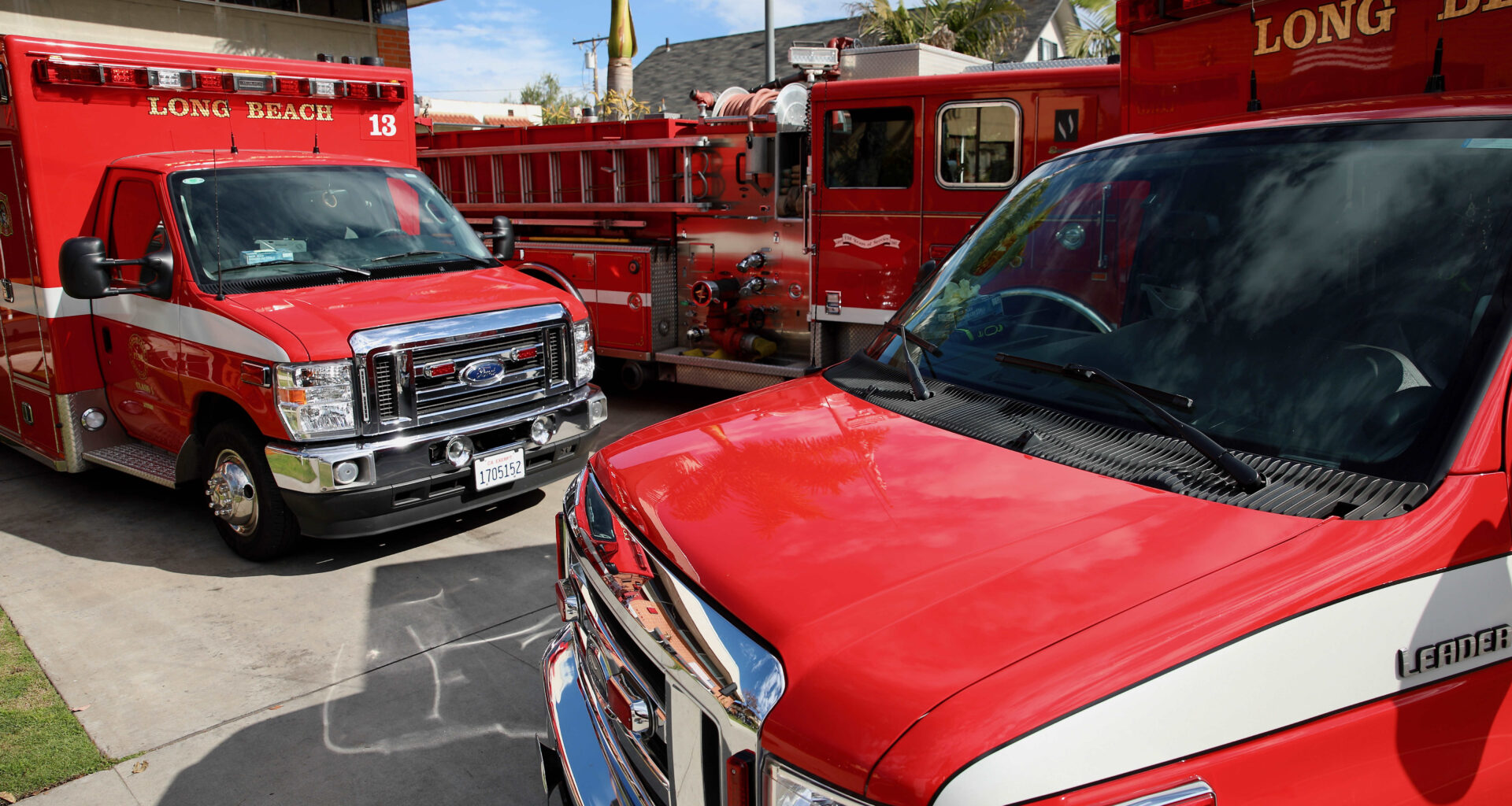
While the Long Beach Fire Department remains committed to preserving its core public safety mission and prioritizing services essential to residents, cuts in the agency’s proposed budget for the upcoming fiscal year could potentially result in increased response times for emergencies, Chief Dennis Buchanan said this week.
During this week’s City Council discussion about the 2026-27 fiscal year budget, the Fire Department requested $201 million – despite having to make about $11.1 million in reductions due to Long Beach’s budget deficit.
This year, Long Beach is facing budget cuts to ensure fiscal responsibility. Its proposed $4 billion budget includes several service and staffing cuts across every city department – including the Fire Department. The process for the City Council to ultimately approve a budget before the fiscal year begins on Oct. 1 involves each department presenting its specific proposals.
The head of the Fire Department, as well as the Human Resources, and Disaster Preparedness and Emergency Communications departments, did so during the Tuesday, Aug. 11, council meeting.
Buchanan began by highlighting the key services that first responders across the department provide and accomplishments during the past year, but also emphasized the impact reductions to fire engines and staff would have on services.
“This interconnected system is important as we discuss Fire Department reductions,” Buchanan said during the Tuesday council presentation. “We never know what combination of emergencies will occur on a day-to-day basis, and reductions in personnel and apparatus have a direct tie to responding quickly with the appropriate resources for the situation.
“Removing one resource does not affect only one station or one neighborhood,” he added. “It changes how the entire system must reposition, adapt, and support emergency calls throughout the whole city.”
In FY25, the Fire Department received more than 67,000 9-1-1 calls in Long Beach, according to the presentation — or about 185 calls every day. Of those calls, about 80% required multiple units to respond because of the complexity of the emergency. Around 85% of those calls were medical calls, 11% were related to fire emergencies, and 4% were general public assistance requests.
Long Beach fire engines and trucks mitigated more than 2,200 structure fires, according to the presentation, while paramedic ambulance units treated and transported more than 31,000 patients per year to local area hospitals, averaging around 89 patient transports per day.
Currently, the percentage of first responders arriving on scene within six minutes and 20 seconds for structure fires is a critical measure of performance and a direct measure of the response capability of first responders, according to the staff report.
“The department’s workload volume demonstrates why our budget decisions must be grounded in assessing operational risk,” Buchanan said. “Even a modest adjustment to our resources can affect the way we respond to thousands of 9-1-1 calls.”
Some of the accomplishments that happened this past year include LBFD containing 81% of structure fires to the room of origin, demonstrating effective emergency response ,and limiting fire damage to homes and businesses; the arson team secured multiple successful arson convictions and recently arrested seven serial arsonists responsible for more than 50 fires; and expanded EMS response capabilities through deployment enhancements, including full-time Rescue 2, daily Peak Load Rescue 13, and Paramedic Assessment Unit Engine 11. This reduced out-of-rescue events from 152 to 31 and improved emergency service availability for the community, Buchanan said.
Another accomplishment is that the department has selected 24 candidates for its upcoming 2026A Fire Recruit Class, which will kick off on Aug. 24. Twenty of the 24 selected candidates have participated in LBFD pathway programs, attend school in Long Beach or live in the city. The class also includes five women, the highest level of gender diversity in any recruit class, Buchanan said.
In making reductions for FY27, the department evaluated each option based on four operational principles, Buchanan said. They assessed system redundancy, whether a reduction posed a risk of eliminating or creating a single point of failure; considered fire suppression threats and the differing risks that exist throughout the city based on geography, building composition, density and access; incorporated a community equity lens to avoid concentrating reductions in any one area of the city; and finally, prioritized keeping all fire stations open and preserving EMS ambulance units.
As a result, some of the service changes and reductions to LBFD will include eliminating Fire Engine 14, resulting in a reduction of 12 sworn full-time equivalent employees; eliminating another fire engine and rotating the closure through permanent rolling blackouts throughout the city, resulting in a reduction of 12 fire sworn FTEs; converting a fire engine to an overtime model, resulting in another dozen sworn position reductions and the creation of 1,406 overtime shifts to be filled in FY27; and eliminating 4.5 professional staff clerical FTEs and five administrative fire sworn positions; among other reductions.
“I want to be candid with the City Council: reducing fire engines and transitioning fire engines into an overtime model will reduce the number of units and personnel immediately available for simultaneous fire and rescue incidents,” Buchanan said. “Remaining engines will absorb additional calls, and there may be times when the unit responds from further away, which will result in increased response times.
“These are not the reductions the department would recommend under ordinary circumstances,” he added. “They are measures developed in response to the seriousness of the city’s fiscal challenge.”
Reductions will have operational and community impacts, Buchanan said. Eliminating Fire Engine 14 will require its call load of about 2,200 calls to be distributed to other fire engines. If the rolling blackout engine is implemented and not restored, about 6,000 annual calls will be transferred to all remaining fire engines in the city and 1,406 overtime shifts will be required to be staffed on an annual basis, according to the presentation.
As part of the FY27 budget process, the department also identified opportunities to reallocate funding toward unavoidable operational needs, including equipment maintenance, investigative expenses, obsolete communications equipment, and limited backfill for duties associated with eliminated positions, according to the presentation.
Through Mayor Rex Richardson’s recommendations, the Fire Department would be able to restore some of its proposed cuts, according to the presentation. Enhanced and elevated negotiations with the Port of Long Beach would result in anticipated full cost recovery for LBFD’s 63 FTEs and staffing of four fire stations housed in the port complex. This would increase the department’s cost recovery from $22 million in FY26 to $30 million in FY27 for the port and LBFD’s fire suppression deal.
The mayor’s recommendations also include increasing the budget to operate Engine 17 with permanently assigned fire-sworn staff through Long Beach’s Measure A, and restoring $3.8 million and 12 FTEs to eliminate a second fire engine rotating closure.
“Even in a difficult budget year, the department must continue planning for the future,” Buchanan said. “Financial difficulties across multiple agencies mean that we must work closer together to pull resources and streamline efforts that benefit the fire service across the region.”
LBFD plans to collaborate with Long Beach City College to explore developing a shared Fire and Emergency Services Education and Training Center, leveraging shared resources and expanding workforce development opportunities for local students and future employees, according to the presentation. There are also new opportunities to pursue alternative EMS service delivery pilots through the Los Angeles EMS Agency.
The Fire Department proposed and is leading a statewide fire engine specification and procurement standardization through the California Metropolitan Fire Chiefs Association, and is strengthening regional preparedness through a joint request with the Los Angeles County Fire Department and the Los Angeles city Fire Department to the California Office of Emergency Services for additional mutual aid resources in support of the 2028 Olympic Games, according to the presentation.
The department will continue working with federal, state, county, regional and city partners to develop operational plans designed to maintain public safety, emergency response capabilities, and effective incident management during periods of heightened event activity and increased demand for services.
Estimated total revenues in the financial summary are about $67.7 million and total expenditures are about $ 201 million.
“As we face a significant year of structural reductions, we must be candid; the proposed reductions are severe,” Buchanan said. “They will reduce fire engine capacity, place additional workload on remaining personnel, and limit some of the department’s administrative and community service functions.
“At the same time, the public should know that this department has approached the challenge carefully,” the fire chief added. “We prioritize preserving fire stations and ambulance services. We evaluate risk, system redundancy, and equity. We pursue additional revenue and cost recovery, and will continue seeking operational improvements and partnerships.”