
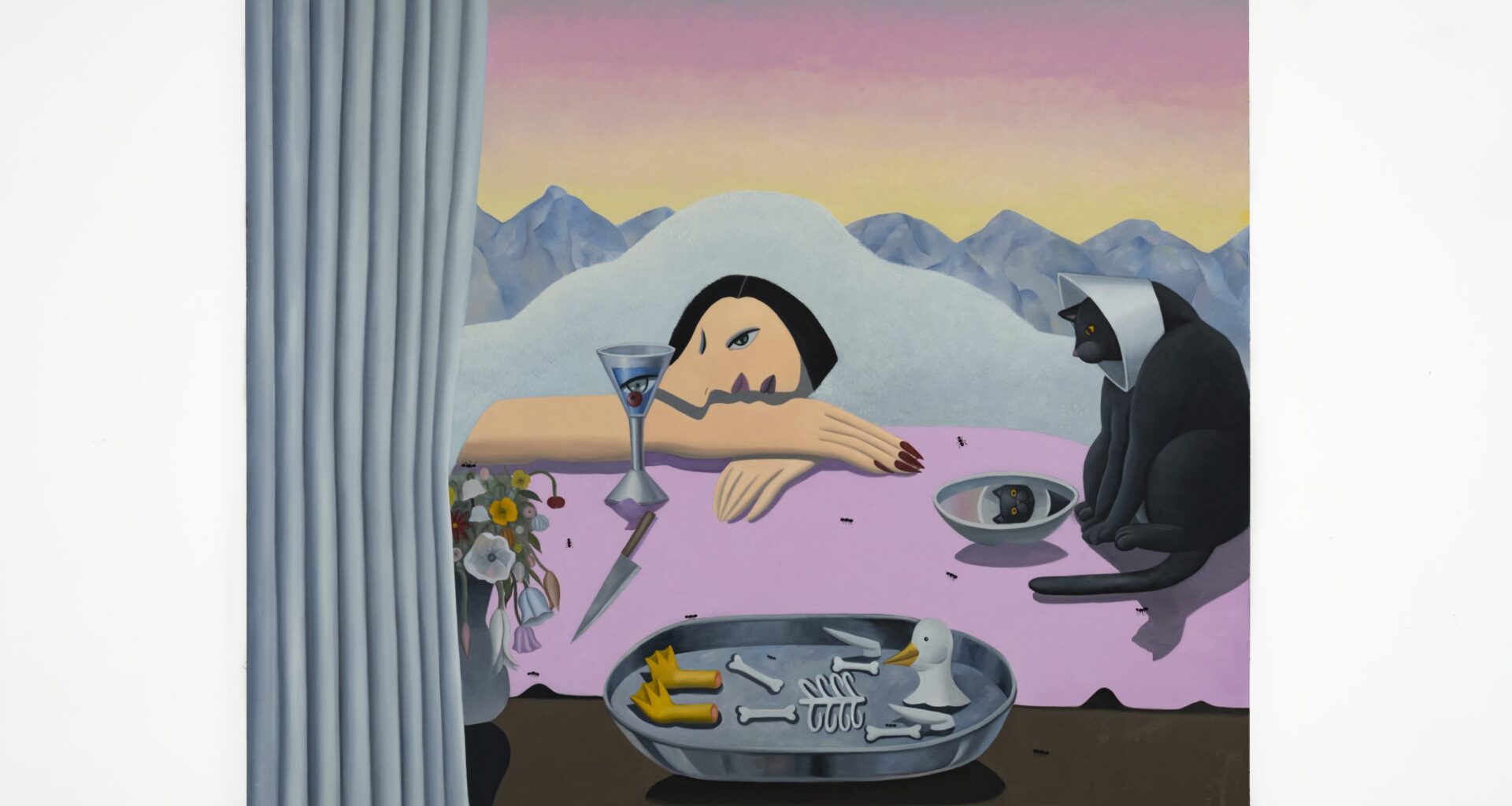
Korean-born GaHee Park’s paintings seem almost to be a direct response to some of the most revered paintings in the Western world. Her first U.S. museum show, “Behind the Curtain,” at the Yerba Buena Center for the Arts, reveals clear influences of Spaniards Salvador Dalí and Pablo Picasso. What separates Park’s works from theirs is a subversion of the male gaze.
Such allusions should come as no surprise, as the intended purpose of “Behind the Curtain” is for Park to lay her influences bare. The show occupies one of YBCA’s upstairs gallery spaces. Down the hall is the Center’s screening room, which will be hosting a parallel film series, “Through an Open Window,” co-curated by Park and filmmaker Michael Vass.
Films screened will include Hitchcock’s “Rear Window,” Ernst Lubitsch’s “Trouble in Paradise,” and Michael Powell’s “The Red Shoes.” Looking over the roster of eleven features and three shorts, one becomes aware of these films’ contradictory depictions of femininity. How does one even write about Hitchcock these days without discussing the often-horrendous ways women were treated on (and off-) camera?
That’s what makes a piece like Park’s “Fish and Ants” (2024) seem to wear its commentary openly.
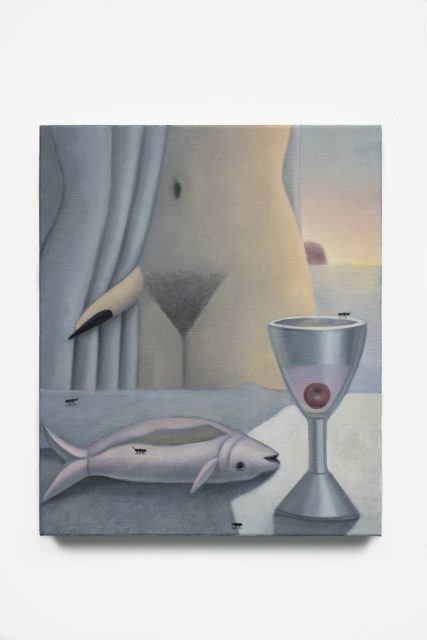 GaHee Park, Fish and Ants on a Table, 2024, Photo by Paul Litherland
As its title suggests, the oil-on-linen piece features a dead fish on a dining room table as ants crawl toward it and a nearby cocktail glass. Behind the table is a nude femme body, visible only from the hips to above the navel, standing in front of an open window on a sunny day. . Park’s piece presents objectification while suggesting a natural cycle–both the fish and the body inevitably being “consumed” in one way or another. Yet, objectification doesn’t always mean the removal of power. As burlesque star Dita von Teese is fond of saying, “We all have a right to be objectified if that’s what we want.”
Indeed, the theme carries over into “Table at Dusk,” from the same 2024 series, in which the fish, cocktail glass, and ants make another dinner-ruining appearance. The femme subject is revealed more in this one, right breast casually exposed as she seems to be carrying the entire table like a cocktail tray. The awkward placement of her eyes makes for the most blatant Picasso influence.
Surrealism becomes more pronounced with pieces like 2022’s “Dream with Still Life” and 2021’s “Woman with Dragonfly.”
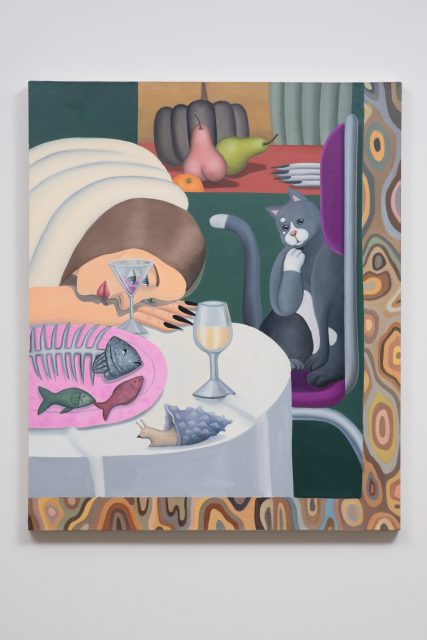 GaHee Park, Dream with Still Life, 2022, Photo by Eric Ruby
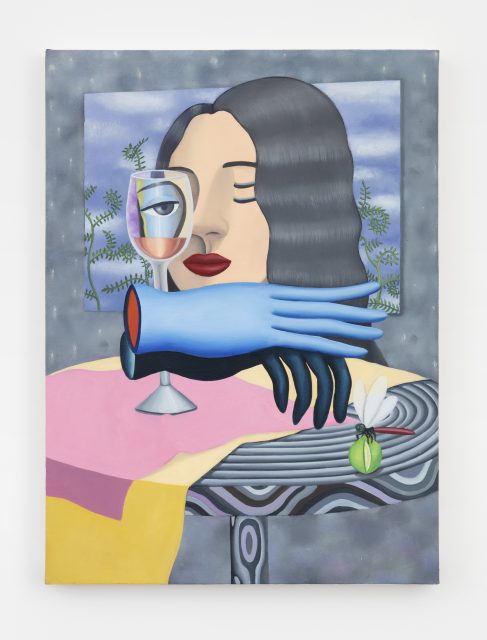 GaHee Park, Woman with Dragonfly, 2021, Photo by Tanguy Beurdeley
The former depicts a woman seemingly falling asleep at a restaurant with a gray cat curiously observing her, the remains of a devoured fish on the plate in front of her. Though her face is expressionless, there’s an air of contentment surrounding her. She’s less “lonely cat lady” so much as “satisfied cat lady.” The subject of the latter painting also seems to be mid-dream, with her eyes closed, save for the one (she seems to have at least three) reflected in the beverage glass on her table. The titular dragonfly is carrying a sliced-open lime, as if retrieving it for the subject’s drink. Excellent service at this place.
By Park’s own admission, being a woman “caught between sea and land, dawn and twilight, eroticism and abstraction, concealment and exposure” is a motivating force in much of her work. Women are constantly told they must be only one thing, but whatever the “one thing” is, it’s rife with contradictions. It’s as if Park has bucked the odds to find her own happy medium between those contradictions.
The show’s de facto “thesis statement” may show best in the largest painting of the collection: 2024’s “Thoughts on Dusk.” Like a contemporary remix of Dalí’s “The Persistence of Memory,” “Thoughts on Dusk” collects nearly all the motifs of the other pictures into one: the ants; the devoured animal (this time a seagull); the eye in the cocktail glass; and even another cat, hypnotized by its own reflection. All flank the subject, resting her asymmetrical head on the table. There’s a deathly subtext with the bird’s remains and crawling ants, with the cat’s reflecting and subject’s placid expression suggesting a disappointment akin to Peggy Lee singing “Is that all there is?”
That’s not for us mere mortals to say, but GaHee Park clearly enjoys asking the question.
“GaHee Park: Behind the Curtain” runs through Jan. 3, 2027 at the Yerba Buena Center for the Arts, 701 Mission St.