
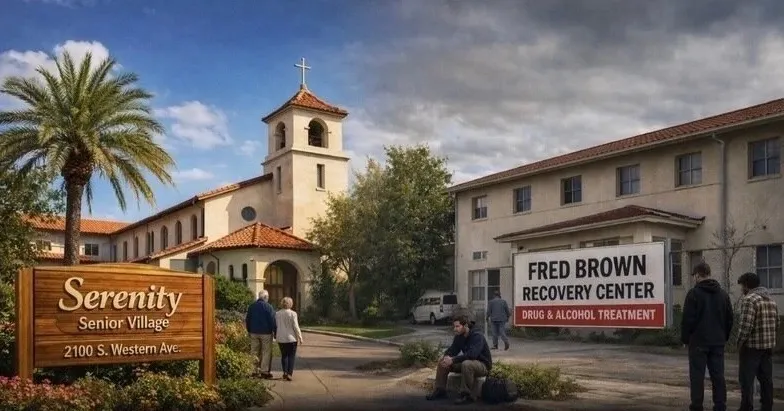
courtesy image
SACRAMENTO, Calif. — As California struggles with homelessness, overdose deaths and a shortage of behavioral health treatment capacity, a statewide association representing substance use disorder providers is warning cities that neighborhood opposition to treatment facilities can do more than block desperately needed care — it can potentially violate federal civil rights protections.
The California Association of Alcohol and Drug Program Executives, or CAADPE, which represents more than 400 substance use disorder treatment sites across California, said it has sent letters to cities warning that local governments could face liability under the Americans with Disabilities Act when they use zoning, permitting or other governmental powers to discriminate against treatment programs or the people they serve.
The warning comes amid opposition to treatment facilities in communities including San Mateo, Burlingame and San Pedro, where Fred Brown’s Recovery Services proposed the Serenity Recovery Campus with funding through California’s Behavioral Health Continuum Infrastructure Program.
CAADPE Executive Director Robb Layne said the disputes expose a fundamental contradiction in California’s response to homelessness and substance use: Communities demand that people receive treatment while simultaneously opposing the facilities where treatment would occur.
“If you don’t support treatment in your community, you don’t support treatment,” Layne told the Vanguard. “Substance use disorder treatment is a medical issue that we all need to understand as a medical issue.”
Layne said CAADPE represents providers throughout California offering a continuum of services, including programs serving people on Medi-Cal, unhoused people, pregnant people and young people seeking substance use disorder treatment.
“Homelessness and treatment in the news and in the press are inextricable,” Layne said.
He argued that stigma surrounding substance use disorders contributes directly to housing instability. Someone experiencing a substance use disorder may lose employment, encounter the criminal legal system or become disconnected from other supports, he said, creating conditions that make homelessness more likely.
“If somebody doesn’t have a job, they don’t have the money and they don’t have the house,” Layne said.
CAADPE said its letters remind cities that people receiving treatment or recovering from substance use disorders can qualify as people with disabilities under Title II of the ADA. The association argues local governments cannot use zoning, permitting or licensing procedures to accomplish discriminatory outcomes that would be unlawful if undertaken directly.
The association also points to protections under the Fair Housing Act for sober living facilities and recovery residences and Section 504 of the Rehabilitation Act for federally funded programs, along with protections under California law.
“We have watched this same story play out for years. The language changes, the city changes, but the outcome is always the same: people who need treatment cannot get it because of where they live. A person’s zip code should not determine whether they live or die,” Layne said in CAADPE’s statement. “We are putting every jurisdiction in this state on notice that the law agrees with us.”
In San Pedro, Fred Brown’s Recovery Services had proposed the Serenity Recovery Campus as an expansion of behavioral health services through the state’s Behavioral Health Continuum Infrastructure Program.
According to a June 1 letter from Fred Brown’s Recovery Services to Los Angeles City Councilmember Tim McOsker, the organization has operated in San Pedro for more than 40 years and remains subject to county and state accreditation and licensing oversight.
Fred Brown’s challenged assertions that it was incapable of operating a facility of the proposed size, arguing that elected officials do not determine whether behavioral health providers are qualified to operate facilities.
“The evaluation of behavioral health providers is not determined by elected officials — it is determined by the professional licensing, accreditation, and oversight agencies specifically charged with assessing provider qualifications, operational readiness, staffing, safety, and compliance,” the organization wrote.
Fred Brown’s also disputed allegations that it had failed to adequately involve the community. The organization said it informed McOsker’s office in October 2025 of its plans, briefed the South Shores Community Association leadership in January and subsequently participated in a town hall, neighborhood council meetings and other community events.
“Reasonable people can disagree about the appropriate timing and scope of outreach surrounding a conditional State award that remains years away from operation,” Fred Brown’s wrote. “The suggestion that FBRS has somehow refused engagement with the community is simply not accurate.”
Layne said the proposed project ultimately became an example of the power organized neighborhood opposition can wield over behavioral health infrastructure.
“The unfortunate thing about this project is that the council member sent actually an official correspondence to the department and essentially said, ‘We need you to unfund this program,’” Layne said.
According to Layne, the resulting political pressure prevented the project from satisfying the financial requirements necessary to proceed.
“The project has stopped. The project is no longer available,” Layne said. “This is a good example of a community who’s rich and able to do these types of things, exerting pressure and control over a treatment provider. Instead of us trying to find a common solution, the solution for them was just to eject us from their community.”
The impact, Layne argued, extends beyond one project.
People who would have used the program must now either seek treatment elsewhere or potentially go without it.
“The consequences are the individuals won’t have access to recovery, which means that their journey of recovery will be significantly delayed,” Layne said. “An individual who is seeking services, because this is not a homeless shelter. This is a group of people who are looking to seek services so they can continue their journey of recovery.”
“Those individuals will have two choices now,” he continued. “They will either have to seek services outside of the community they live in, or they just won’t be able to access those services and they’ll go at it alone or they won’t be able to do it.”
Layne said the implications extend statewide because other communities can observe successful campaigns against treatment facilities and attempt to replicate them.
“The other part that’s a really frightening thing is other communities are watching this and now they know it’s possible,” Layne said.
CAADPE argues that such opposition is frequently presented through concerns about traffic, parking, neighborhood compatibility, public safety or property values rather than explicit objections to people with substance use disorders.
Layne said those arguments often mask deeper stigma toward addiction, homelessness and behavioral health treatment.
“The only reason that we’re talking about these kinds of things is because people have the ability to feel like, oh, it’s totally fine. We’re actually going to just say we don’t want that in our neighborhood because we don’t want homeless people, we don’t want addicts, we don’t want people to steal our stuff and break our windows,” Layne said. “That really is surrounded in stigma.”
CAADPE maintains that research does not substantiate many of the fears used to oppose treatment programs. The association cited research finding no evidence that treatment centers reduce nearby residential property values, as well as studies finding no evidence that sober living homes and recovery residences increase crime.
Al Senella, CAADPE board president and chief executive officer of Tarzana Treatment Centers, said providers licensed and certified by the state are nevertheless encountering barriers created by fear and misinformation.
“Treatment providers across California licensed and certified by the state and under county contracts are doing everything right and still getting blocked at every turn by fear and misinformation. NIMBY is alive and well and standing in the way of care for those in need,” Senella said.
“As operators, we follow the rules. We serve our neighbors. We strengthen our communities. The law protects our right to provide substance use treatment in the community to do that work, and CAADPE is making sure local governments know the resources available to them,” Senella added.
The stakes are especially high because treatment facilities can provide an alternative to leaving people with serious substance use disorders on the street.
Layne rejected the idea that treatment centers attract people experiencing homelessness into communities. Instead, he said people needing services already live throughout California, whether communities acknowledge them or not.
“If you say, ‘I’m actually not doing this in my neighborhood,’ those people don’t go away. They just end up living on the streets,” Layne said.
The choice, he said, is often between providing people with structured treatment, housing and progressively lower levels of care or allowing them to remain without adequate services.
“Nobody wants to be homeless. Nobody wants to be unable to have a bathroom or to have a kitchen or not have the services they need,” Layne said. “The more barriers we put in front of people, the less we can be surprised that they’re continuing to not access recovery services.”
The connection between treatment capacity and homelessness is central to CAADPE’s argument. Layne said behavioral health providers work with people at multiple stages, ranging from those in crisis and experiencing chaotic substance use to people moving through residential care and eventually into outpatient services, sober living or other lower levels of care.
“We as providers try to help people on their journey of recovery, everything from individuals who are in the depths of chaotic use,” Layne said.
The state’s infrastructure program is intended in part to increase the number of treatment spaces rather than merely directing additional money toward existing capacity, Layne said.
“We’re trying to build more spots,” Layne said. “The problem that we’re engaging with is we want to put these facilities in places where we’re seeing overdoses, need for care, and for demand for services.”
That objective runs directly into neighborhood resistance when communities acknowledge homelessness, overdoses and emergency medical needs while opposing facilities designed to address those problems, he said.
“The NIMBYism of it all really butts heads when we have a place that essentially says we know that there are services because there’s homelessness individuals and there’s overdoses and people are ending up in emergency departments and needing medication and needing services, but we actually don’t want to live with people. We don’t want to live with these treatment centers,” Layne said.
Fred Brown’s made a similar argument in defending its San Pedro proposal, saying disagreement over land use should be based on factual information rather than inaccurate characterizations.
“We understand and respect that you oppose this project. We also understand that many members of the community may continue to oppose it regardless of the information provided,” the organization wrote to McOsker.
“Public opposition should still be grounded in accurate and complete information,” Fred Brown’s added.
CAADPE said it has made an ADA advocacy resource publicly available to providers, offering guidance on legal protections, documentation and procedures for challenging discriminatory actions.
The organization said its objective is not simply litigation, but ensuring that cities understand their obligations and that communities reconsider how they view behavioral health programs.
Layne said CAADPE wants to move the discussion beyond labeling people as “addicts” or “junkies” and toward understanding substance use disorder as a health issue and treatment facilities as part of the infrastructure needed to address it.
“We’re not the person that’s saying you are bad and we’re good,” Layne said. “We’re the person saying there’s an opportunity for us to educate and for us to work together.”
He said that broader discussion has become more urgent because of the dangers associated with the illicit drug supply, including fentanyl contamination and the risk that people may consume substances without knowing what they contain.
“Our drug supply is poisoned. Many people don’t understand that,” Layne said. “Every single day, teenagers and adults, people die thinking that they’re taking this drug, but they’re taking a large dose of a really dangerous drug that they had no idea it was even involved in.”
For Layne, that reality makes access to treatment not simply a question of land-use policy, but one of whether communities are willing to provide people with a path toward recovery before substance use, homelessness or an increasingly dangerous drug supply proves fatal.
“The punishment for drug use should not be death,” Layne said. “I think we all can agree that if somebody does drugs, they should not have to die as a punishment.”
To comment please go to one of these social media platforms:
Facebook: https://www.facebook.com/DavisVanguard
LinkedIn: https://www.linkedin.com/company/peoples-vanguard-of-davis-inc/
Instagram: https://www.instagram.com/davisvanguard/
X: https://x.com/davisvanguard
Bluesky: https://bsky.app/profile/vanguardnewsgroup.bsky.social
Subscribe to the Vanguard News letters. To make a tax-deductible donation, please visit davisvanguard.org/donate or give directly through ActBlue. Your support will ensure that the vital work of the Vanguard continues.
Categories: Breaking News Homeless State of California Tags: Americans with Disabilities Act Behavioral Health CAADPE Homelessness NIMBYISM Substance Use Disorder Treatment