
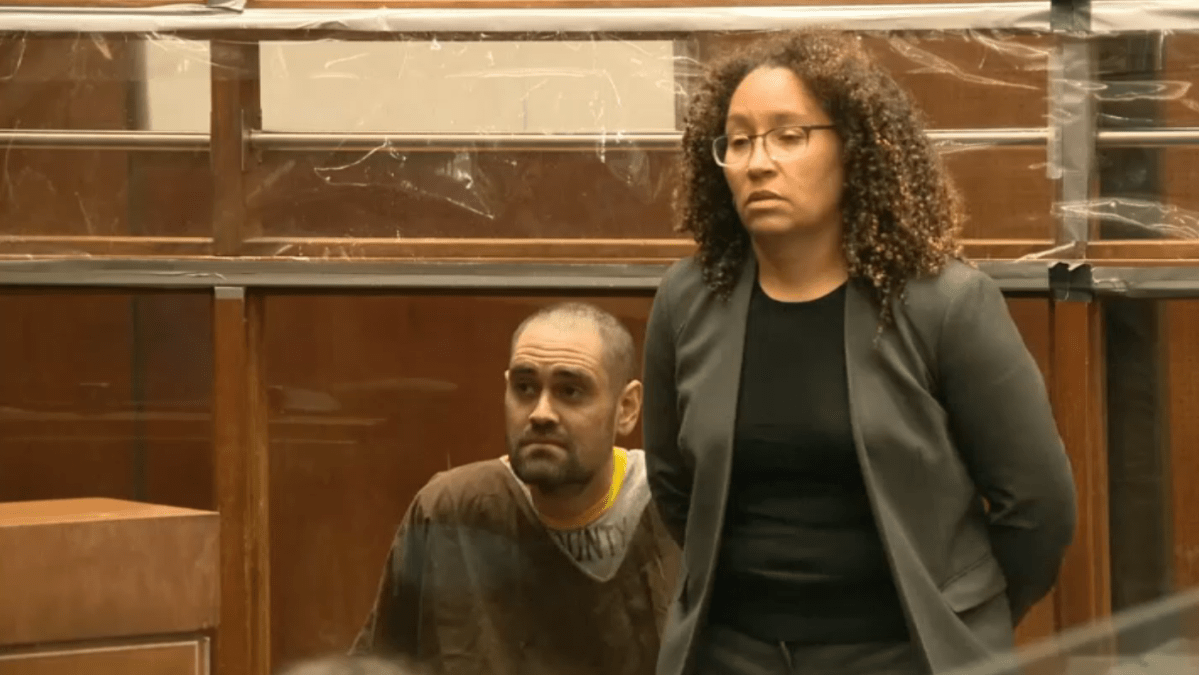
The dispute over Nick Reiner’s demand for access to a portion of a trust fund established by his parents, who he’s accused of murdering, may focus on the ‘Slayer Statute,’ a California law that bars a person from receiving the benefits of a trust – if that person intentionally kills another person who created the trust.
Reiner pleaded not guilty last week to a newly unsealed grand jury indictment that charges him with the December, 2025 murders of Rob and Michele Reiner, and further alleges Nick Reiner was ‘lying in wait’ to carry out the stabbing attack at the family’s home in Brentwood.
A judge in LA probate court is set to hear argument on the trust challenge Monday, and new legal filings from the trust attorneys argue Nick Reiner should not receive the money while the murder case is proceeding.
The trust attorney invoked the “Slayer Statute” in a response to Reiner’s demand, and said because there are now, “conflicting claims,” to the trust fund, the money should be withheld until they’re resolved, a clear reference to Reiner’s guilt or innocence yet to be established by a criminal court.
Nick Reiner filed suit against the trust earlier this year, and demanded the first of two payments from the fund, which both sides agree was due to him when he turned 30 years old, on September 14, 2023 – 2 years before the murders occurred – but was never distributed to him.
According to Reiner’s filing he needs the money to re-hire defense attorney Alan Jackson, who initially represented Reiner but withdrew from the case in January.
“Nick loved his parents, and he is devastated by their deaths. But the facts about what did and did not happen to them are not at issue in this Trust litigation,” Reiner’s court filing said.
“Like anyone accused of a crime, Nick is presumed innocent, and he is entitled to mount his defense with the resources that are lawfully his own,” it said.
California Probate Code section 250 says, “A person who feloniously and intentionally kills the decedent is not entitled to” property, interests, or benefits under a will, trust, intestate succession, and certain other transfers.”
The Code specifically describes a trust, “created by…the decedent, or in which the decedent has an interest,” like the one established by Rob and Michele Reiner for the benefit of Nick, his brother Jake, and his sister Romy, according to the court filings.
Should the probate court agree to delay a decision on distributions to Nick Reiner, a future acquittal in criminal court would still not guarantee his receipt of the money.
The Code also says while a criminal conviction would be conclusive proof of ineligibility, the probate court may still reach an independent determination of whether he, “feloniously and intentionally killed the decedent under a preponderance of the evidence standard,” which is somewhat less stringent than proof beyond a reasonable doubt in criminal court.
Reiner’s petition for access to the trust argued the age 30 distribution was mandatory, that it was due 2 years before the murders, and that he’s never been found to be ‘incompetent’ or incapable of receiving the money.
The attorney for the trust also argued that because Reiner didn’t explicitly demand his age 30 distribution he ‘consented’ to not receiving the money.
The amount of money in the trust isn’t publicly known, but Reiner’s petition said it had at least $1.5-million in value.