
Any time his children want to watch a movie, Scott Keller stands next to the television in the family room to translate what they’re watching into American Sign Language.
“I have the subtitles on for myself to understand, and I sign the content real-time. My children get the benefit of the movie’s content in American Sign Language and English, simultaneously,” he said via email. “Deaf people are naturally bilingual, and I know that what I am doing for my children, not many other children have the same opportunity.”
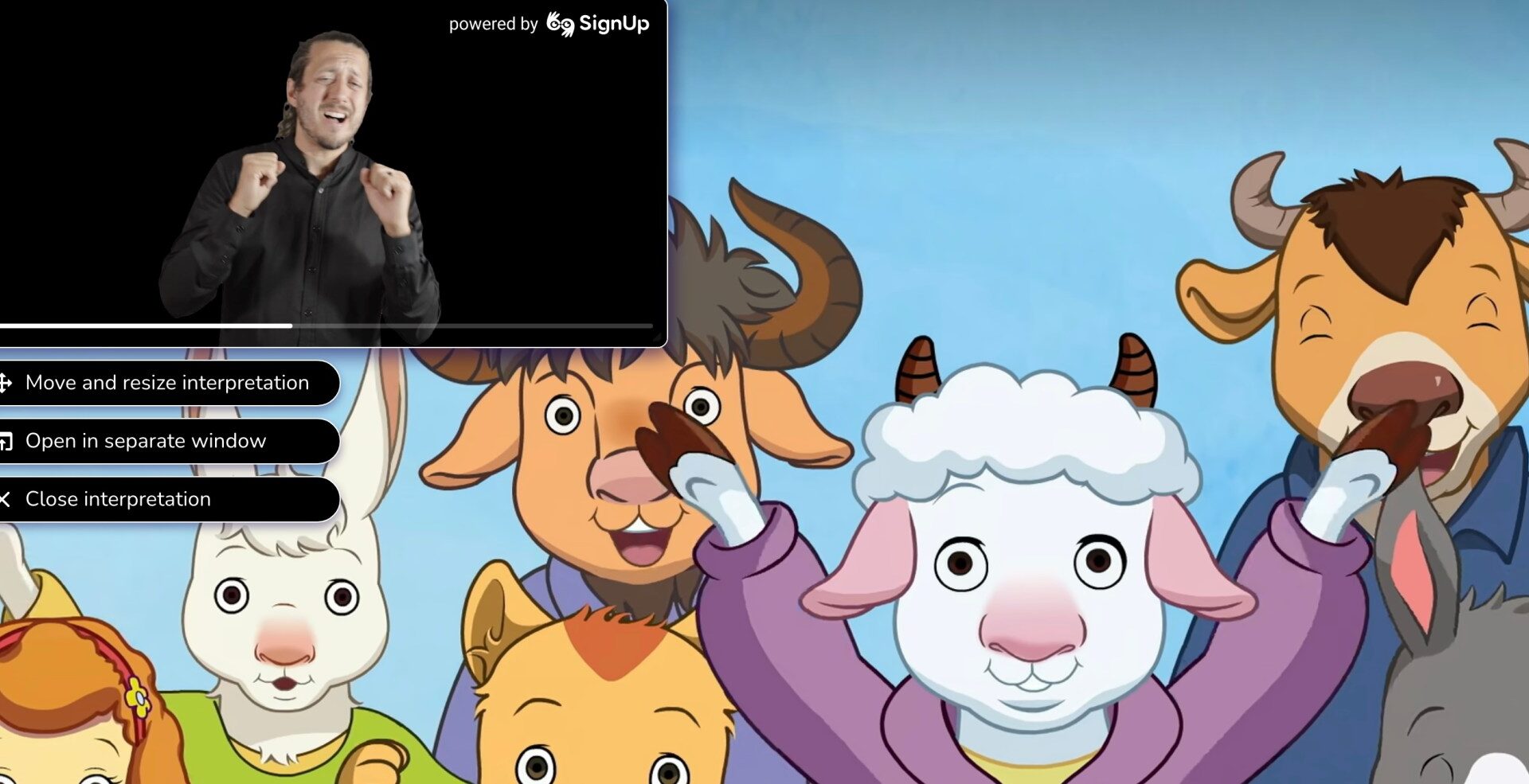
Keller is a Certified Deaf Interpreter through the Registry of Interpreters for the Deaf, a nationwide licensing body. He, his wife, and their three children (a fourth is on the way) are all deaf, and his kids attend the Texas School for the Deaf in Austin. His work includes translating entertainment content into ASL through SignUp Media, an entertainment company focused on accessibility for the Deaf community. They have a global network of hundreds of Deaf interpreters who translate hundreds of hours of content into multiple sign languages. Recently, Keller was among a number of interpreters involved in SignUp Media’s partnership with Netflix to do this work on dozens of the streaming platform’s original programming for kids and families, and licensed titles, available through SignUp. The ASL translations by the interpreters is overlaid directly onto the streaming content, and viewers can resize or reposition it next to the video as they wish. Titles include “Pokemon Horizons,” “The Magic School Bus Rides Again,” “Cocomelon,” and “Stranger Things: Tales from ’85,” and interpreters are all Deaf and native signers, and were matched by language, character, and lived experience—a Cuban Deaf interpreter worked on “Vivo,” while an Asian Deaf interpreter worked on “Wish Dragon,” keeping the translations culturally relevant and accurate.
Keller, who lived in San Diego and Alpine before moving to Austin, Texas, in 2023, previously worked at Deaf Community Services of San Diego. He’s currently working toward a Ph.D. from the University of San Diego in leadership and organizational management, with plans to establish a nonprofit advocacy center.
“As a disabled individual, specifically with my Deafness, I constantly have to prove myself. To represent myself and my community well, I feel that a doctoral degree in the area I have a passion for will be able to shine a light to my community,” he says. “I chose organizational management because my passion has always been helping others in my community and the nonprofit field opens doors to that.”
(This interview has been edited for length and clarity. )
Q: You’re one of the Deaf interpreters in SignUp’s partnership with Netflix to translate dozens of children’s programs to American Sign Language. Which programs did you translate and how long did it take you to complete the translations?
A: I have done “Hotel Transylvania 3,” “Train Dreams,” “Frankenstein” (Guillermo Del Toro’s version), among others. The time it takes me to translate the content is equivalent to the duration of the film. If the film is 60 minutes long, I translate 60 minutes of content in real time. Although, there are more hours invested in the project such as prep time (watching the film beforehand, especially if it’s the type of film to win an Oscar), my home studio setup and break down (I have my studio set up in the kids’ playroom, so you can imagine the extra time it takes me to clear out their mess every time). I have post-production time that includes ensuring the data I record gets transferred to the laptop and then to the cloud. I would say anywhere from 60 to 90 more minutes extra, on top of the duration of the film.
Q: Walk us through your process for this kind of ASL translation work. How did you prepare and execute this project? What were some of the challenges, or tricky spots?
A: When I am assigned a project, I can choose to take or pass on it. While I have yet to pass on a project, I will review the content and see if it’s something I need to research, perhaps specific jargon that will require more time translating. Then, I set up the studio when my kids go to bed, and I begin translating in real time with my camera recording myself, and my laptop running the content. The challenges vary; sometimes it’s the content, sometimes it’s the mess my kids leave, and sometimes I’m just really tired! I would say the challenges are in translating characters. I mean, I’m an individual translating the entire movie’s content that could range anywhere from two, to five, to maybe 10 different characters. Sometimes more than several characters are displayed on the same screen, and it gets hard to differentiate between which character is speaking a message. I address this by shifting my shoulders to the left and the right, matching the position of characters on the screen. If one character is on the left, and another character is on the right, I will translate while leaning to the left and then to the right. In a perfect world, I would like to see one interpreter for each character! That would be amazing.
Q: Are you comfortable talking a bit about your background and how you became deaf?
A: Absolutely! I was born proudly genetically Deaf! Deafness spans four generations in my family, and that equates to about 100 years. My children are the fifth in the generation, being naturally, genetically Deaf. We carry the gene Connexin 26, which is known to cause deafness. Connexin 26 is a protein produced by the GJB2 gene. Variants in GJB2 are among the most common genetic causes of congenital, nonsyndromic, sensorineural hearing loss. Although, this is not the case for many other Deaf kids; research has it that between 90% to 95% of Deaf kids are born to hearing families, which means they are the only family member that’s Deaf and, more often than not, the only person left out linguistically and culturally. My family has no issues with communication as each member is Deaf.
Q: How has your lived experience shaped your approach to this work?
A: My mother used to do this for me when I was growing up. She did not have the same educational opportunities as I did, but she made sure that her kids would get better access. She would attempt to translate what she knew when watching TV/movies, and as little kids, that was enough. While growing up, my mother would fight for our accessibility rights at school, after school, even at the doctor’s office. She would not give up until each of us had equal access. I think that played a big role in the reason why I continue to do community work, and ensuring accessibility is not an afterthought for the Deaf community.
Q: Can you talk about what’s missing from closed captioning, and why it’s not the fix that other people might assume it would be?
A: With subtitles and closed captioning, a lot of things get missed. Sometimes, it’s a technical glitch, sometimes it’s a grammar error, and most of the time it is simply a written representation of the spoken words. To accurately understand the captions, it takes understanding the spoken word, understanding the innuendos, tone, rhythm, sarcasm, and a lot of other things that are hidden in the message. Basically, captioning provides access to words, while interpreting provides access to the message’s linguistic, cultural, emotional, and contextual meaning.
Q: What’s most exciting or gratifying for you about this project, and having these programs include ASL now?
A: I’m excited and grateful that Netflix is on board, because I think each title in Netflix’s database should be accessible in American Sign Language, or at least just those titles that already offer subtitles in other languages. American Sign Language is often overlooked, missed, or simply never accounted for. To include ASL, it takes extra time in locating the right talent (interpreters, actors, performers, what have you) and it takes technical time (recording, editing, set up/break down, uploading, etc.). Although we live in a tech-paced environment in America, and it’s 2026, I think it’s time that movies and TV shows are automatically accessible.