
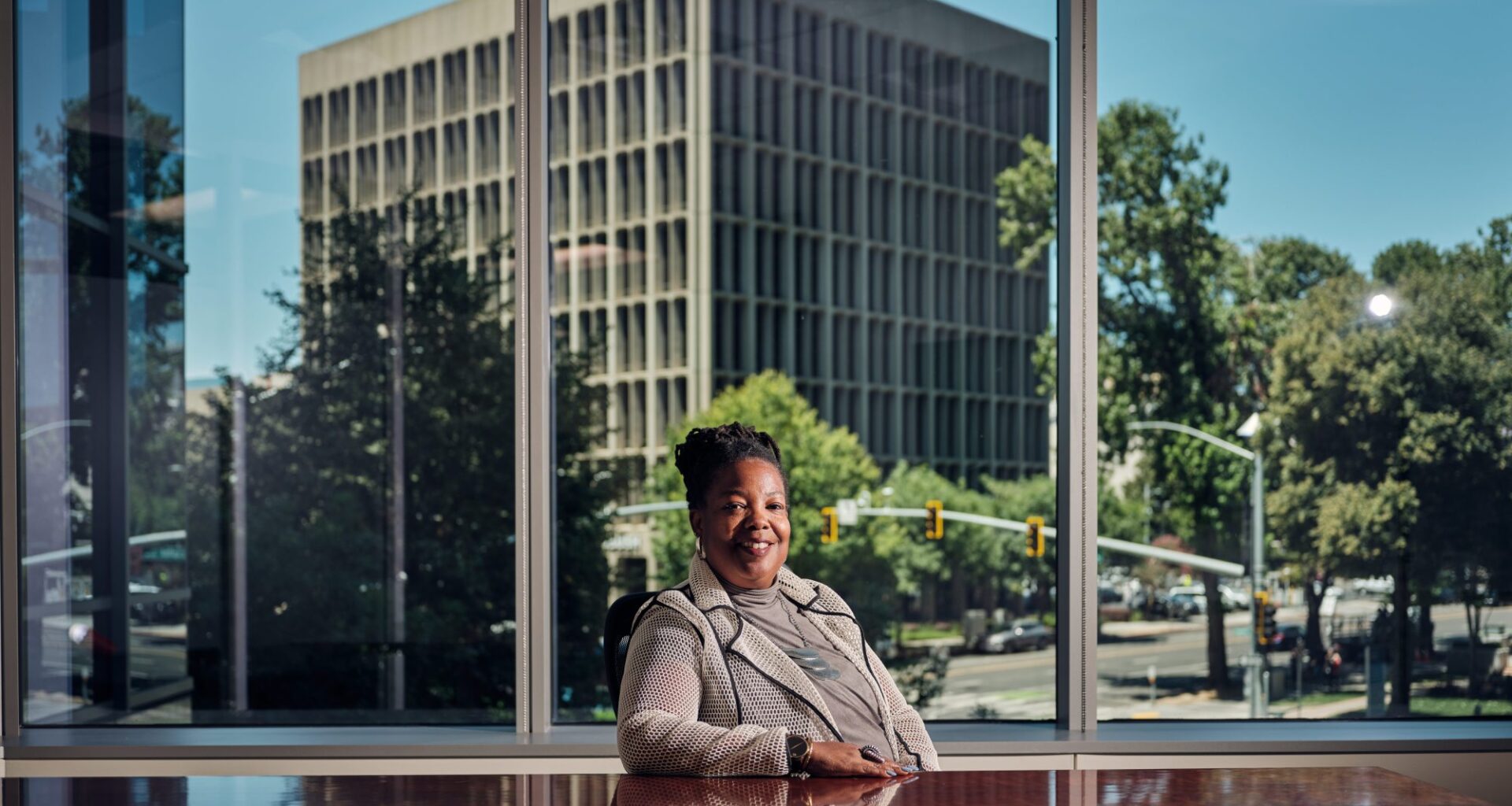
Even though 182,000 homeless people live in California — one-third of the unhoused population in the U.S. — no state agency was solely focused on the daunting challenge of solving homelessness until July.
Heeding calls of experts who said the state’s housing and homelessness programs were scattered across too many different departments, Gov. Gavin Newsom created a fresh agency in his cabinet that is now up and running. To lead the new California Housing and Homelessness Agency, the governor tapped Oakland-based Tomiquia Moss, a former city official in Oakland and San Francisco who founded the influential Bay Area homelessness nonprofit All Home. Before she was sworn in this summer, Moss was secretary of the now-dissolved Business, Consumer Services and Housing Agency.
We recently sat down with Moss to talk about Newsom’s legacy on homelessness as he prepares to leave office and potentially run for president in 2028, and the fierce debates unfolding over state and federal funding. The conversation has been trimmed for length and clarity.
Q: During Newsom’s tenure as governor, he has rolled out new policies and court processes for people who are homeless, including those with severe mental illnesses or addictions. What programs or strategies are working right now?
A: We are increasing production of permanent supportive housing. Unless we create enough homes for people, we are never gonna address our homelessness crisis. So I think first and foremost, we need much more permanent supportive housing. And of course, that model requires services to meet the residents’ needs. That is a piece I think the governor has really been focused on, particularly with Prop. 1 implementation, where you’re able to bring people with severe behavioral health challenges into housing. I think that strategy has worked really well.
The next is prevention. There’s a methodology around homelessness prevention that I think is absolutely working. Increasingly, jurisdictions are realizing that it’s much more cost-effective to prevent folks from becoming homeless in the first place than, once they’re homeless, bringing them back into housing. We are starting to see counties invest their local resources and state resources into prevention.
Then the third piece of it is interim housing. We absolutely need to bring folks inside as quickly as possible, allowing folks to stabilize and begin their journey to their permanent homes.
Q: Where is California falling short?
A: My job is to look at the full continuum of housing, and we fall short in every single category. We are 2.5 million homes short of the housing we need for the population. We’ve been doing a lot of work in partnership with the legislature for the past eight years to figure out how to streamline and how to make jurisdictions build their fair share. But production is a really big challenge for California.
Q: With regard to state funding for homelessness programs, you’re probably aware that cities and counties get upset about one-time funding that’s approved some years, not other years, with criteria changes over time. They say that interrupts their services and limits what they can do. What’s your response to that?
A: It was always a one-year allocation that can be used over multiple years. I think it’s a little bit of a misnomer that jurisdictions can’t plan how to use those resources over the various cycles. We recognize how valuable those dollars are to our local communities, and the state can’t do it alone. The budget provided an additional $900 million toward the next cycle, and the previous cycle is not fully expended. I do think it gives jurisdictions a runway to keep doing great work.
Q: An audit in 2024 found that the state had failed to track $24 billion to combat homelessness between 2018 and 2023. Are you comfortable with the way money is going out the door and the impact it’s having at this point?
A: What was born out of that process is that there are now dashboards the public has access to that demonstrate all resources that are going toward addressing homelessness and housing in local communities. People can see how their county is doing, what those dollars are being spent on.
The impetus to create a housing and homelessness agency was to try to harness state resources across state departments and agencies in one place so that we can begin to look at all the investments we’re putting in housing and homelessness, and figure out, are we getting the outcomes that we want? And that, I think, is the ultimate accountability, making sure that all departments now have to demonstrate where those resources are going.
Q: The Trump administration is trying to reverse the federal government’s longstanding “Housing First” strategy to end homelessness, which hinges on the availability of permanent housing. The administration tried last year to divert $3 billion in federal funds away from permanent supportive housing projects, and a judge recently blocked that decision after California and other states sued. The administration is trying again this year to fund less permanent housing and invest more in things like treatment for addiction and mental illness. What would those changes mean for California?
A: We could have seen a windfall of folks losing their housing if those funds were not continued. For 2026, we have now joined multi-state litigation against those changes as well. We are also in conversation with our local partners about how we can make our existing resources more flexible so they can use resources across their portfolios. We’re doing all sorts of technical assistance, and we’re talking to our legislative partners as well.
Name: Tomiquia MossPosition: Secretary of the California Housing and Homelessness AgencyEducation: Ohio Wesleyan for undergrad, Golden Gate University for graduate schoolResidence: Oakland
Five facts about Tomiquia Moss
–Her favorite author is Toni Morrison. “Many of her books are my favorite,” she said. “I particularly love The Bluest Eye.”–She adores living in Oakland. “It’s the cultural heart of the East Bay. I love the inclusivity, the vibe, the weather.”–She has a dog named Pepper, a rescue chihuahua-dachshund mix.–Moss started working in homelessness when she got a job with the Tenderloin Neighborhood Development Corporation, which provides affordable housing in San Francisco, as a social worker. “The hardest part of that job was retention, meaning helping people stay housed,” she said.–She was a competitive cheerleader for many years. “I love the energy, the celebration of games and life. Dancing was always my favorite,” she said.