
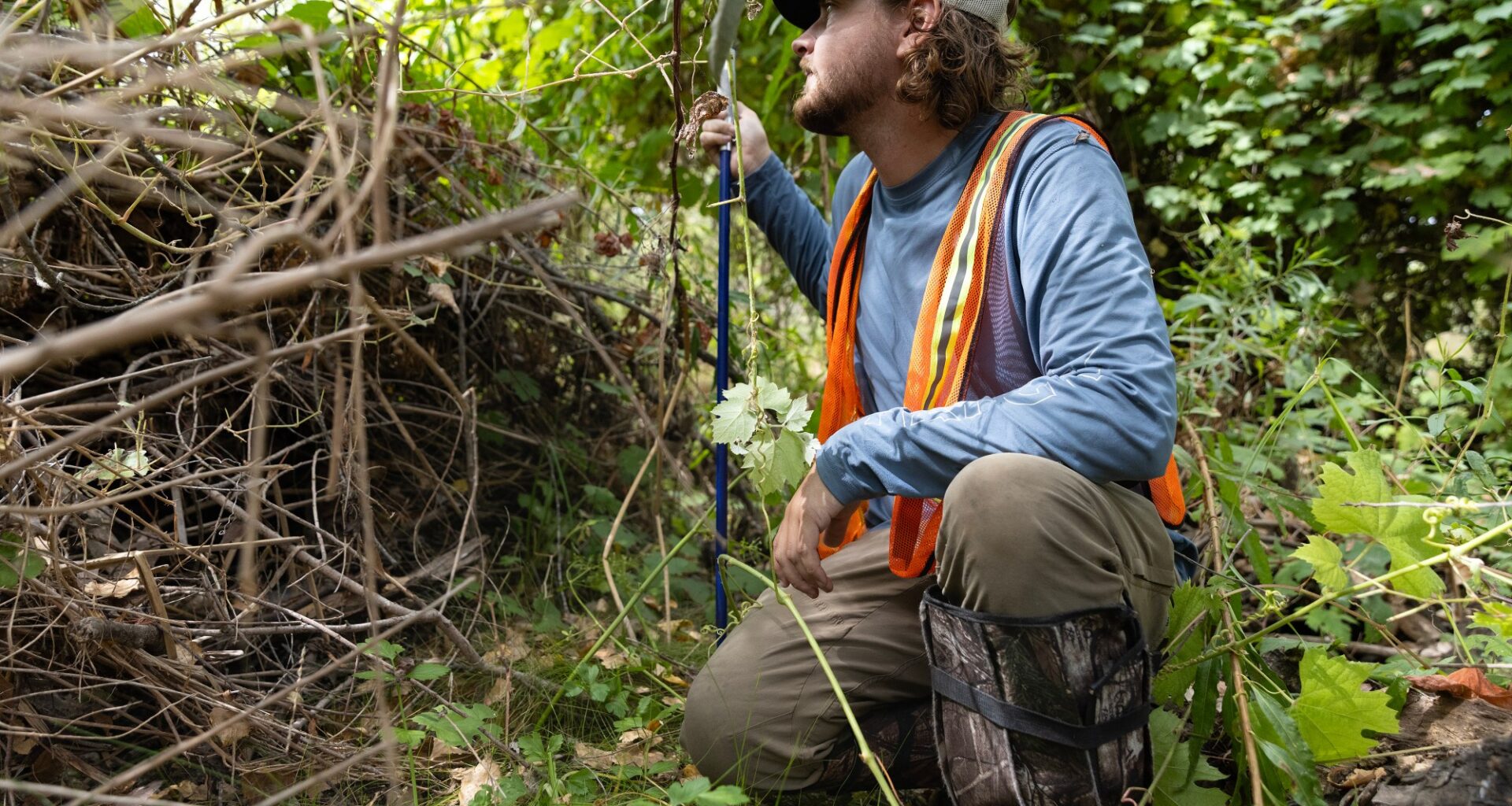
The air is cool as a group of San Diego State University students crouch beneath branches and push through brush along the San Diego River, in pursuit of a red diamond rattlesnake named Ruby.
Like many red diamonds, Ruby isn’t easy to find. She blends easily into the dark, leaf-covered ground near the river in Mission Trails Regional Park. Unless she’s moving, there’s a chance the students could walk right past her.
But they want to get eyes on the snake to size up her physical condition, location and the air’s temperature — all part of their larger study to learn how red diamonds are affected by disturbances like hikers and construction.
The team is about ready to give up when a San Diego Union-Tribune photographer spots Ruby just a few feet away, coiled in a hunting position and barely noticeable with her camouflage.
“You see one snake, and it makes it worth it,” says master’s student Vincent Marcantonio, grinning.
Marcantonio is leading the red diamond rattlesnake study for SDSU’s Clark Lab, which researches animal behavior and conservation.
His work, done in partnership with the San Diego Zoo, aims to shed light on how the snakes respond to human factors, especially as their coastal sage scrub habitat is threatened by human interference.
Red diamond rattlesnakes are considered a species of special concern by California’s Department of Fish and Wildlife, and Marcantonio hopes his research can help set conservation strategies for them in increasingly urban environments.
It’s the second year of a two-year project. Earlier this spring, Marcantonio caught 10 red diamond rattlesnakes and brought them back to the lab at SDSU. There, each got a sensor called an accelerometer surgically implanted, along with a small radio, before they were sent back out to their habitat in Mission Trails.
Several times a week, Marcantonio and his team come out to check on them — which is what they were doing when they saw Ruby on Thursday. They monitor the snakes using an advanced telemetry system, which includes a type of radio antenna that picks up a snake’s frequency via signals from its embedded radio.
They don’t always see the snake. But they can at least determine its general location and whether it moved since their last visit.
Later this fall, they will capture the snakes once again to remove the accelerometers, which have all the while been collecting data on the snakes’ movement. This will help the researchers understand the snakes’ behaviors in a place heavily trafficked by people.
“I’ve had snakes that moved miles, and I’ve had snakes that have moved feet,” Marcantonio said. “It’s dependent on the individual.”
His team may repeat the process over the winter, if they find and capture more snakes, to track them in their dens.
Once completed, Marcantonio’s findings from Mission Trails — with its climbers, hikers, runners, cyclists, cars and an ongoing sewer pipeline project — will be compared to a study done a few years ago that tracked red diamond rattlesnakes near the San Diego Zoo Safari Park on land that is largely untouched by people.
For now, Marcantonio is still getting to know the snakes he’s tracking. There’s Pigpen — so named for relieving himself one too many times in his enclosure at the SDSU lab. Then there are Jasper, Beatrice, Matilda, Mary and Wil, named after former Padres’ player Wil Myers. He’s a little worried about two of the females, including Beatrice, who has looked a bit thin lately.
Marcantonio’s love of snakes started when he was a kid; he’d go the San Diego Zoo each week and couldn’t be pulled away from the reptiles exhibit.
He got his first pet snake at 11 — a corn snake he named Snickers. Today, at 25, he has 12 — including Snickers, a couple California king snakes, a gopher snake and a garter snake, a Colombia boa constrictor and a couple ball pythons.
“I just found them fascinating, and I didn’t really understand why people didn’t like them,” he says of his interest in researching them. “So I kind of wanted to understand them a little bit better.”
Harshita Vallabhaneni, another student in the Clark Lab, feels similarly.
“It’s really easy to demonize them,” she said. “I just like being in a position where I’m able to educate people and come up with better conservation management strategies.”
Vallabhaneni is helping Marcantonio with his research in Mission Trails — but she’s also working on her own master’s project near the Safari Park to assess how relocation affects red diamond rattlesnakes.
So far, she’s found that most relocated snakes try to find their way back to where they were captured.
Understanding how snakes respond to human interaction and interference is important because they are so abundant in public spaces, says Rulon Clark, the biology professor who runs the SDSU Clark Lab.
Hikers and cyclists have a good chance of encountering a rattlesnake on the trails, so it’s important to understand how the animals serve as a link in the ecosystem, Clark says. He hopes that education can turn fear of snakes into respect and interest.
And he’s enjoyed seeing how working in the lab can shift his students’ career goals or encourage them to incorporate this research into their future.
Marcantonio hopes to work at the San Diego Zoo after he graduates with his master’s next year. But if he could keep tracking rattlesnakes, that wouldn’t be too bad, either.
“I would do this for the rest of my life,” Marcantonio said. “This is so cool.”