
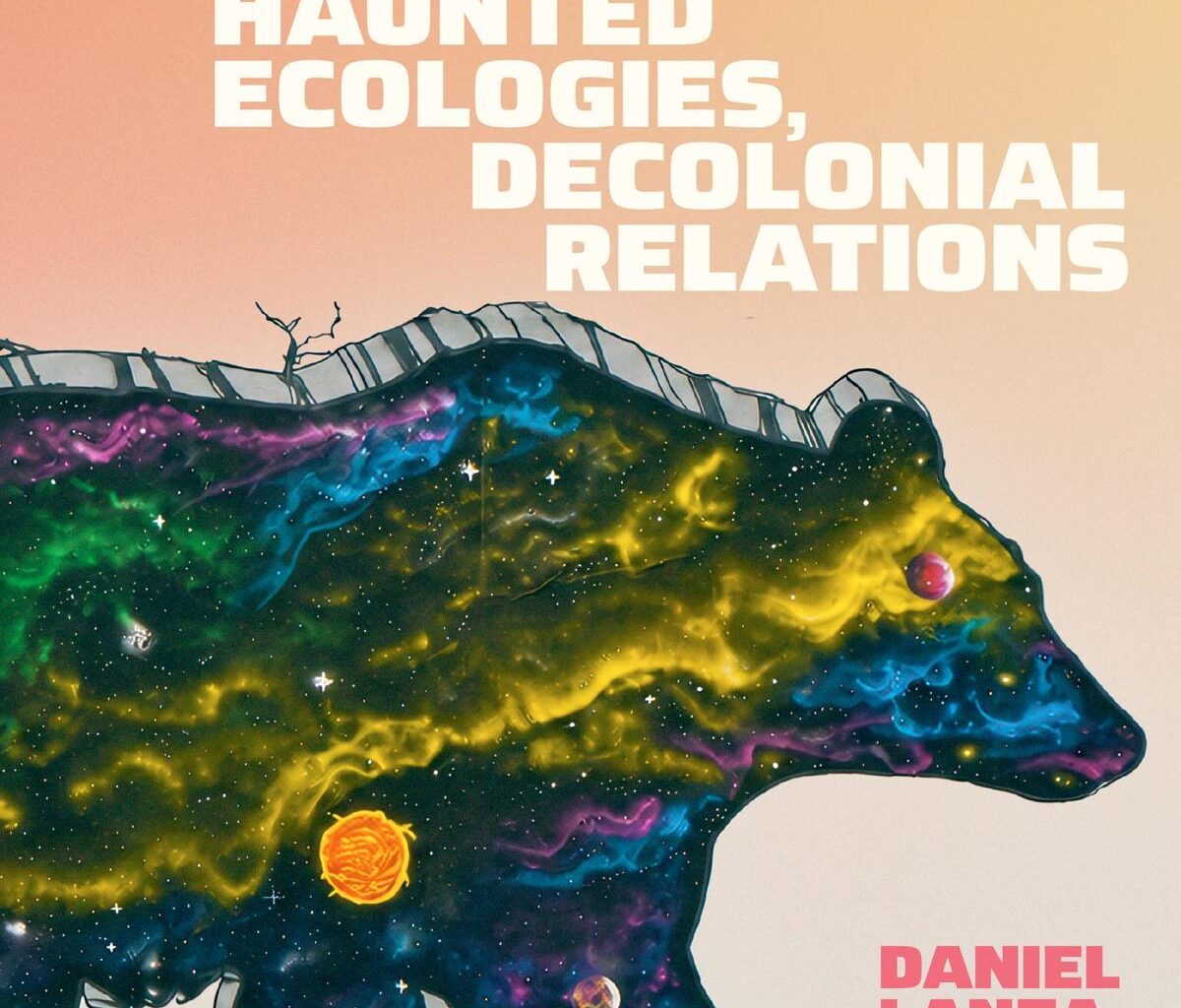
Climate disaster in the Colonial Anthropocene and returning ‘good fire’ to California.
California Futures: Haunted Ecologies, Decolonial Relations by Daniel Lanza Rivers. Duke University Press, 2026. 344 pages.Buy on Bookshop.org
Did you know LARB is a reader-supported nonprofit?
LARB publishes daily without a paywall as part of our mission to make rigorous, incisive, and engaging writing on every aspect of literature, culture, and the arts freely accessible to the public. Help us continue this work with your tax-deductible donation today!
MEGAFIRE IS A KIND of haunting. From the Eaton and Palisades fires that tore through Los Angeles County last year to the Canadian fires putting a hundred million people under air-quality alerts this summer, today’s megafires are not merely larger versions of wildfires that came before. Nor are they simply a symptom of our changing climate. They are the consequence of centuries of colonial mismanagement, yet to be reckoned with, that has sought to exclude fire from North America in order to transition the land into sites of enclosure, commerce, and industrial extraction. In California, we can trace the roots of our current megafire epidemic to state administrators’ persecution of Native communities, dismissal of Indigenous knowledge, and disruption of their practices of cultural burning. We are haunted by this history as megafire returns again, and again, and each time the militaristic strategies used to extinguish the fires prove that the state’s approach will never work.
California seems to have finally realized this: the Department of Forestry and Fire Protection (CAL FIRE) has begun returning fire to the land, using controlled burns that resemble the Indigenous fire cultures that colonial administrators have spent the last two centuries criminalizing. Anyone who’s driven past a “burn in progress” sign in California has smelled the difference between the airier, lighter smoke produced by a low-intensity fire and the harsher, chemicalized tang of wildfire ripping through the plastics and drywall of a residential community. Yet CAL FIRE’s turn toward seemingly progressive “prescribed burning” practices is a selective appropriation of Indigenous fire science and retains the same colonial logics that gave rise to our current crisis. As the activist group Red Nation has argued, “What creates the crisis cannot solve it.” In California, the best tools to address our megafire crisis come not from the institutions who have fostered the crisis but from the societies that have used science and intergenerational knowledge to shape these lands across thousands of years.
As California moves deeper into the epoch of megafire, many residents have become aware of CAL FIRE’s campaign to “fight fire with fire.” Far fewer of us know this tool was not the state’s to begin with. For the Karuk Tribe of the Klamath watershed, a leader in revolutionizing California’s fire policy, cultural burning, or “good fire,” is about more than just preventing, or “combating,” the next megafire. Good fire is a tool for practicing interdependence and reciprocity with the living world across yearly and multiyear cycles. Unlike today’s megafires, which spread across tens of thousands of acres by climbing into the forest canopy or moving outward through flying embers, cultural burns use low-intensity fires that travel at or below knee level across a demarcated patch of land. Where megafire scorches roots and fungal communities in the soil and turns forests into graveyards of dead wood, low-intensity fires sustain ecological and cultural benefits as well as fire-adapted plants and animals, such as the knobcone pine, horntail wood wasp, and the black-backed woodpecker.
Unlike megafire, the timing of cultural burning is not incidental. It emerges from a centuries-long mosaic of environmental and cultural practices shaped by observation, adaptive management, and spiritual relation across deep, coevolutionary time. Within Karuk fire history, burns follow environmental indicators—from the twice-yearly salmon migrations to elk calving and the nesting of certain birds, as well as the recession of mountain snow. Dennis Martinez, an O’odham restoration practitioner and founder of the Indigenous People’s Restoration Network, estimates that 85 percent of the plants California Native societies used before conquest were burned the year before harvest. Megafire’s hauntings direct our gaze toward this history and the Indigenous fire science—including the kind practiced by the Karuk—that have shaped California’s lands and ecosystems across coevolutionary time.
Karuk burning practices conclude when the constellation Pleiades disappears from the sky between April and June. In Karuk cosmology, Pleiades embodies Coyote and his seven wives, who descend to earth during this time of the year to support reproductive cycles before returning to the sky and marking the resumption of burning in the late summer, timed to the return of spawning salmon and the arrival of the August full moon and September new moon. Although California settlers, myself included, have associated wildfires with fear, loss, and an inability to move freely outdoors, the low-intensity smoke of cultural burns drifted through California’s forests for at least a thousand years, creating temporary blankets of low-lying smoke that cooled the river and safeguarded the passage of fry and adult salmon. The Karuk recognize salmon as kin. And the creatures play a central role in their culture, making up at least 50 percent of the Karuk people’s diet before colonial conquest.
Since conquest reached the Klamath in the 1820s, waves of genocidal, institutional, and environmental violence have disrupted Karuk and Klamath basin societies’ traditional land stewardship. Farming in the Upper Klamath and the proliferation of dams have degraded the region’s ecological vibrancy. Salmon—once so abundant during spawning season that it was said that you could walk across the river on their backs—dropped from yearly highs estimated at 400,000 in the late 19th century to 10,000 by the end of the 20th. It’s a painful irony that the late-summer period of burning that once attended the Karuk world renewal ceremony has become a time of intense wildfire and massive fish kill events, as warmer waters, agricultural pollution, and erosion along the riverbank have diminished the Klamath’s ability to renew itself. In particular, decades of logging managed by the United States Forest Service (USFS) have extracted fire-adapted redwoods and Jeffrey pine, and introduced quicker-growing lodgepole pine, which is more flammable and can become a ladder fuel that carries wildfire into the forest canopy.
Colonists understood that fires supported ecological abundance and Indigenous life, which is why they targeted fire first. In 1793, after less than two decades of colonial conquest, the Spanish government outlawed agricultural burning in California’s coastal territories. Following the region’s capture by the US government in the mid-19th century, California’s founding administrators extended this prohibition, criminalizing Native burning practices in the agenda of the 1850 Act for the Government Protection of Indians. Across settler California, these anti-burning policies were part of a legislative campaign aimed at murdering and dispossessing California Native people in order to open their homelands to colonial settlement, commercial and residential enclosure, and agro-industrial development. The state’s attempts to eliminate traditional burning practices gained federal support in the form of the 1911 Weeks Act and the “10 a.m. rule” adopted in 1935, which held that all forest fires were to be extinguished by 10 a.m. the following day.
Because 98 percent of the Karuk Tribe’s ancestral homelands are held by the USFS, the tribe’s traditional burning practices have, until recently, faced hostility from state and federal governments, as well as vigilante violence from settlers in the Klamath, who have been known to shoot at Karuk and other Native people for managing culturally significant harvest sites with low-intensity fire. On Karuk homelands, and often elsewhere, federal agencies have used fire exclusion to facilitate the sale of mineral and lumber extraction rights to private corporations. In addition to criminalizing cultural burning, the USFS and CAL FIRE have favored militaristic strategies that undercut human and ecological health, including fire retardants containing phosphorus.
This emergency-management mode routinely disregards the practices of California Native people. In a case from 2017 included in the Karuk Tribe’s Climate Adaptation Plan, USFS Heritage Natural Resource Advisor Frank Lake described identifying a heritage site that had been managed by fire and used for food processing, only for that site to be bulldozed by the USFS when administrators created a fire line without deploying the necessary personnel to safeguard its historic, cultural, and religious value. “[T]he legacies of Karuk food and fire stewardship are erased from the land, and replaced by the ‘safety’ needs of the dominant society,” Lake explains. “You lose not only the biological legacy of the forest structure, or the damage to the stone artifacts, but you have lost the ability to learn and teach in that site. You can no longer take the next generation to that site.” In this way, CAL FIRE’s approach perpetuates the erasure of the knowledge whose absence now haunts us as megafire.
In recent decades, the Karuk Tribe has advocated for the return of adaptive management and good fire, drawing on Indigenous science and applying it to a changing climate, all while pressing for recognition of fire sovereignty. In March 2025, two months after the Palisades and Altadena/Eaton Canyon fires ripped through Los Angeles County, the Karuk Tribe partnered with the California Natural Resources Agency and the state’s environmental protection agency (CalEPA) on a Senate bill that advances state support for cultural burning. Along with acknowledging federally recognized tribes’ sovereignty to conduct cultural burns on tribal lands, the bill creates a unique pathway for tribes to gain burn permits by working directly with local air districts and the Natural Resources Agency. Though the agreement does not extend to the state’s unrecognized tribes, it is a step toward addressing the “historical wrongs” of colonization—a model other California Native nations can use to advocate for further fire sovereignty.
This success builds on the Karuk Tribe’s decades-long advocacy for reviving cultural burning, including the yearly training series they have hosted over the past decade, which draws local and international attendees. With sessions that include five women-led (and trans-inclusive) trainings between 2016 and 2022, these trainings aim to create practical alternatives to state institutions overwhelmingly staffed by white men trained in militarized fire response. These multiday workshops prioritize enrollment from Indigenous people but include settler attendees, cultivating intercultural spaces of learning across Indigenous identities, nations, and fire traditions.
But Karuk fire sovereignty remains vulnerable to the political winds of their occupying nation. In 2021, Bill Tripp, one of the tribe’s most visible and vocal advocates, was appointed to the Wildfire Mitigation and Management Commission as part of the Bipartisan Infrastructure Law championed by then-president Joe Biden. Today, the same federal government, this time under the Trump administration, is eliminating habitat protections from the Endangered Species Act and ushering in the return of industrial logging to federal forest lands—the very forces that have produced megafire in the first place.
This is what the Colonial Anthropocene looks like. While the more common “Anthropocene” refers to the “human” causes of our changing climate, it obscures the root causes of the crisis by attributing equal responsibility to all humans. In contrast, the “Colonial Anthropocene,” a concept named by Macarena Gómez-Barris, acknowledges the colonial, racial, and commercial histories of land theft, genocide, slavery, and industrial resource extraction that have shaped the Anthropocene. For settlers, like me, this moment presents us with an opportunity to reckon with that history. In 2019, California governor Gavin Newsom issued a formal apology for genocide to California Native Tribes, and created the California Truth & Healing Council to pursue the process of restorative justice. On the Klamath, the sacred lands legislation passed in 2022 saw management of 1,200 acres of Karuk homelands transferred from the USFS to the Karuk Tribe—although an estimated 1,378,800 acres remain under federal control. Another 2,800 acres moved into management by the Shasta Indian Nation in 2024, and 47,000 acres of land along the southern banks of the Klamath River moved into management by the Yurok Tribe in 2025, following a successful movement to remove the lower four Klamath dams. Along with expanding tribes’ ability to practice cultural burning on their homelands, these historic land returns illustrate the possibilities of approaching climate change through the lens of decolonization. If we want to replace yellow skies and devastated landscapes with good fire, California settlers need to reimagine our relationships with Native societies. This means recognizing our shared vulnerabilities, and attending to the unique and serious threats facing Native people in this phase of the Colonial Anthropocene. It also means deepening state institutions’ recognition of tribal sovereignty, including the unique expertise of Native scientists and consultants. Returning 1,200 acres out of 1,378,800 acres of Karuk homelands is not enough.
While the state measures progress through the number of acres returned, Native communities are doing the harder work—to the benefit of all in California. When the 2025 Palisades and Altadena/Eaton Canyon fires burned an estimated 37,649 acres in Los Angeles—displacing entire communities, taking the lives of 31 people, and causing over $100 billion in property damage—help arrived from an often overlooked source: volunteers representing 15 California Native tribes traveled to provide mutual aid. Coming from the state’s northern reaches, members of the Yurok Tribe made the 750-mile trip from their homelands on the Lower Klamath River watershed. Later that year, a constellation of five megafires burned a collective 56,817 acres across the homelands of the Yurok, Karuk, Hupa, Shasta, Konomihu, and New River Shasta people. Whereas the Palisades Fire made international news and drew broad public support, the Orleans, Blue, Green, and Dillon fires went relatively unreported outside of Northern California. To address this era of megafire, we must move beyond the goal of merely preventing harm—as with prescribed burning—and instead embrace this moment as an opportunity to expand California Native communities’ ability to practice self-determination and good relations in and beyond the boundaries of reservation and trust lands. This includes supporting their ability to bring good fire back to their homelands.
As Karuk fire and forestry expert Bill Tripp has argued, the knowledge to prevent megafires exists, and it rests in the hands and histories of Native tribes. To apply that knowledge on land the state chooses not to return is appropriation, not repair. California’s state and municipal governments need to acknowledge the cultural and environmental violences of the past and move toward new forms of alliances and reparation that respect the self-determination and expertise of Native tribes and nations. We cannot adequately respond to climate change without facing its colonial, racial, and extractive roots. Regenerative and adaptive responses to the Colonial Anthropocene are possible, but we won’t achieve them unless we address the histories that continue to haunt our lands, our institutions, and our acts of collaboration. As today’s megafires illustrate, the time has come to return good fire to California, not merely as a tool for protecting settlers’ property, but as a sovereign practice, one that underscores the importance of Native tribes’ self-determination and scientific expertise in a time of climate chaos.
¤
This essay is an adapted excerpt from Daniel Lanza Rivers’s California Futures: Haunted Ecologies, Decolonial Relations, which will be published on August 18 by Duke University Press. Copyright Duke University Press, 2026.
LARB Contributor
Daniel Lanza Rivers is an associate professor of American studies and literature at San José State University, where they coordinate the program in environmental humanities. Their work appears in American Quarterly, Terrain.org, Tahoma Literary Review, and Writing the Golden State: The New Literary Terrain of California (2024).
Share
Copy link to articleLARB Staff Recommendations
The ongoing fight to restore the Colorado River Delta.
One poet’s journal entries during the 2025 L.A. fires.