
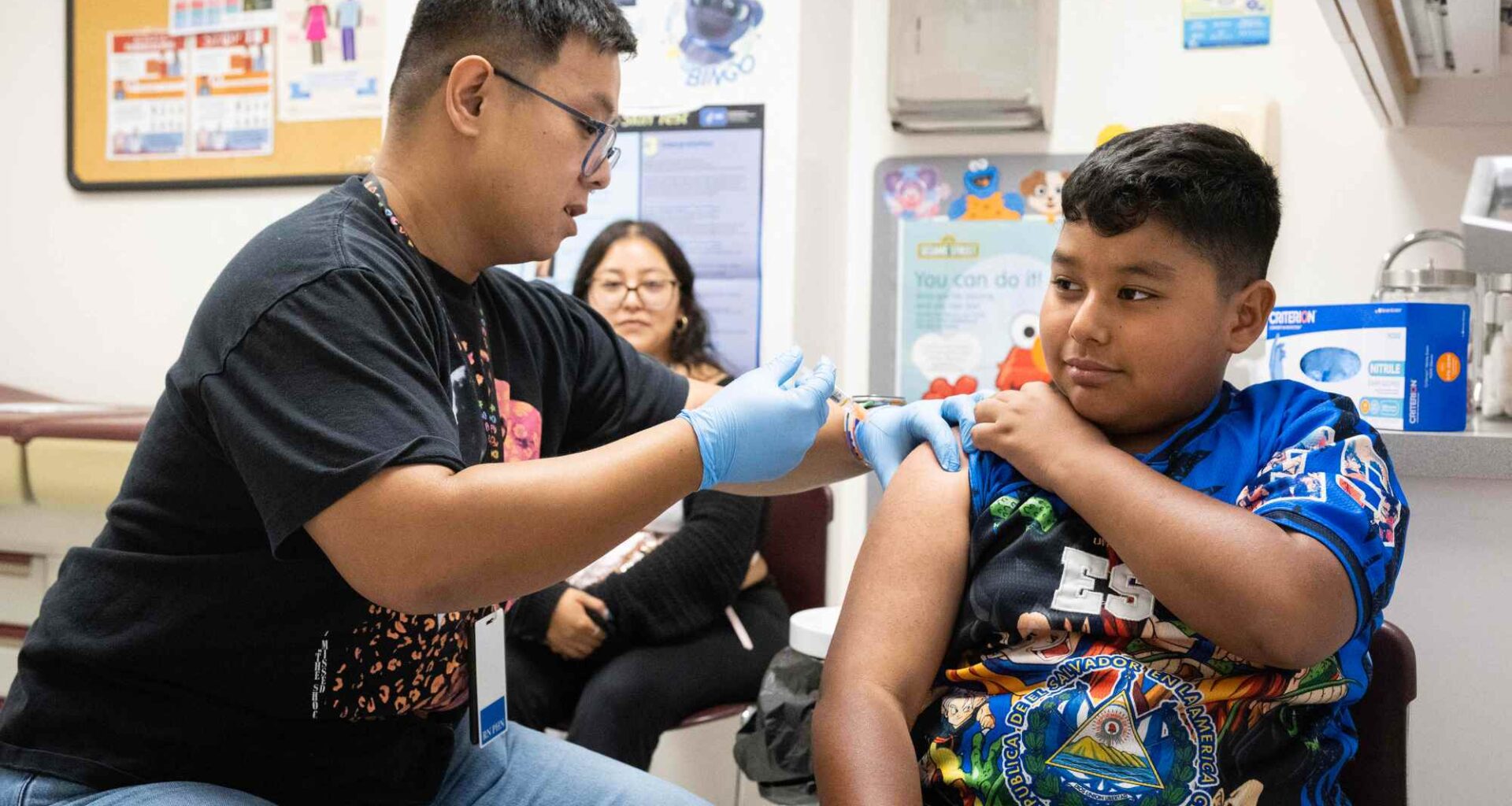
California will not follow the controversial changes that the Trump administration made to the nation’s childhood vaccination schedule last week, but that does not mean they will have zero local effect.
Given that California, Washington, Oregon and Hawaii created the West Coast Health Alliance last September, endorsed the latest vaccination schedule from the American Academy of Pediatrics in January and confirmed that stance on Thursday, some might think that changes at the federal level would land with little weight in the Golden State.
The courts have long upheld states’ authority over public health administration under the 10th Amendment, reserving for local legislatures all powers not assigned to the federal government.
And thus, local pediatricians are free to ignore the new schedule’s recommendation — it is not a mandate — that they hold “shared decision-making” sessions with parents who want to vaccinate their children against hepatitis A and B, rotavirus, meningococcal disease, flu and COVID-19. Instead, they can recommend folllowing the AAP schedule, which calls for vaccination at specific ages with no need for consultation.
Likewise, they’re free to keep using the combined measles, mumps and rubella vaccine, which President Donald Trump’s “Gold Standard Childhood Vaccine Recommendations” say “should be administered in three separate single-dose shots once products are domestically available.” For decades, one shot, often called MMR, has delivered all three vaccines simultaneously.
But parents usually are not legal scholars, and the administration’s attempts to change nationwide vaccine policy have made regular headlines for more than a year.
Recommendations against COVID-19 vaccination for pregnant women in May 2025 were followed by changes to policies for respiratory syncytial virus (RSV) and influenza vaccines in June 2025. A lawsuit by the American Academy of Pediatrics and other allies blocked those vaccination schedule changes in March, also declaring Health Secretary Robert F. Kennedy Jr.’s gutting of the nation’s top vaccine policy advisory panel illegal.
Still, the matter came up again Monday with the release of yet another executive order focused on childhood vaccinations.
Every action generates a fresh round of news coverage, driving up public awareness regardless of whether the state they live in has already said it will not comply.
So much noise, said Dr. Jamie Friedman, a pediatrician with Children’s Primary Care Medical Group in San Diego, engenders confusion in the minds of parents, turning into an endless stream of questions during office visits and potentially giving other health issues short shrift.
“Every time they do this, it adds a little kink into our workflow, because it does create a lot of questions for our families,” Friedman said.
It is not that the new federal schedule necessarily caused a massive spike in such questions last week, but rather that it fuels an ongoing focus on a part of pediatric care that used to be routine.
“In California, because we do have school requirements, there have always been those few families who only want to do what is required for school,” Friedman said. “I feel like, in general, in the past two years of this administration, the number of patients that I have personally had who have questions or concerns about the vaccines has definitely gone up.”
Dr. Marsha Spitzer, a San Diego pediatrician serving underresourced communities and a former board member of San Diego’s AAP chapter, agreed.
“Every pediatrician I’ve spoken to in San Diego and across the country is spending more time talking about vaccines in their daily practice, for sure,” Spitzer said.
Both experts said that most parents are satisfied by the explanation that California is sticking with the AAP schedule. But pediatric check-up visits last only 15 to 20 minutes, and vaccine dialogue is now burning through that precious time between doctor and patient when parents are free to ask about whatever most concerns them.
“We’re there to answer questions, so if all of their questions are about vaccines, then that’s what we’re going to talk about that day,” Spitzer said. “But if there’s lots of other things that a family wants to talk about, it makes it hard, because then we have to decide, what do we have time to talk about today, and what are we going to have to talk about on a different day?”
In the wake of last week’s vaccine schedule announcement, many in pediatrics and public health have said that the idea of splitting combined vaccines, now delivered in a single shot, into doses with just one vaccine each would dramatically increase the burden on pediatric offices, as would the idea that parents would routinely ask their doctors about vaccines that are now widely administered based on age.
A statement subsequently published online Tuesday by Dr. Andrew Racine, AAP’s president, concluded that such an idea would “not be feasible or safe,” especially when vaccine coverage is already thin in some places, leading to the largest surge in measles cases observed in 35 years.
Research has shown, Friedman adds, that when vaccination requires parents to jump through more hoops, fewer kids actually get their shots.
“For the administration to suggest that every child getting a flu shot should be talking to their doctor versus, you know, going to the pharmacy or a flu clinic, would drastically reduce the number of kids who get their vaccine,” Friedman said. “And it’s the same with splitting up the (MMR) vaccines.
“What the evidence tells us is that’s going to significantly reduce the ability for parents and pediatricians to keep children up tto date on their vaccines, because that’s a lot of visits to the office, and a lot of parents may not be able to handle that.”
Such a burden, Spitzer adds, would not fall evenly on all families. While some may have room enough in their schedules for additional doctor visits, many, especially those in less-resourced communities, would struggle.
“A lot of families, if they take time off from work, they’re not getting paid, and if they’re not getting paid, that makes it harder for them to afford the transportation to pick up their child, to put food on the table, all of those other things,” Spitzer said. “And so, it becomes an equity issue when we create these additional barriers to vaccination for children.”