
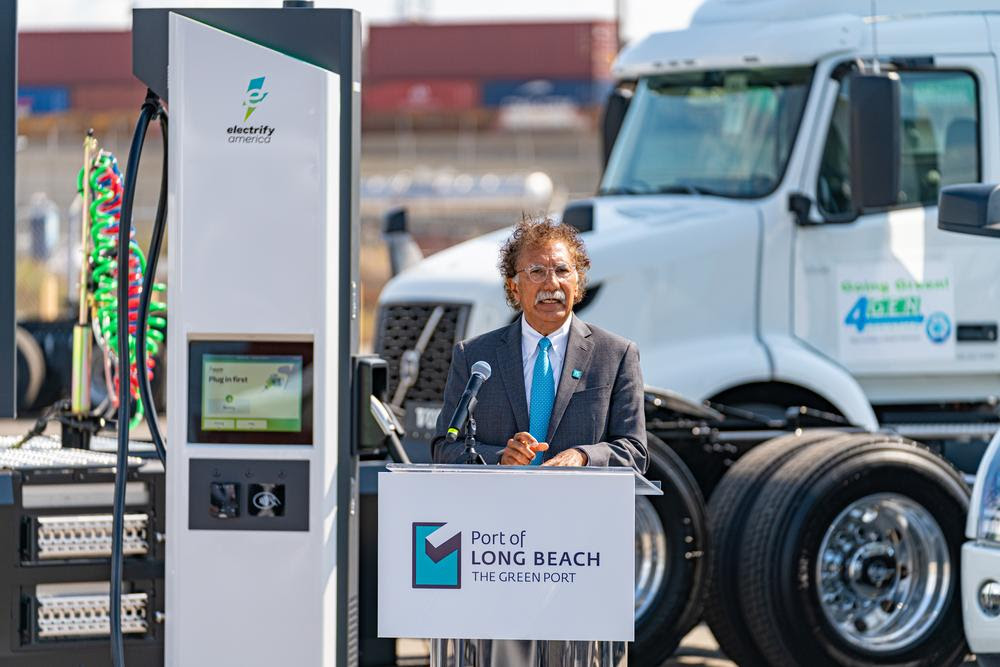
Port of Long Beach CEO Mario Cordero on Friday, Nov. 7, described 2025 as a year of uncertainty, but also one that brought stronger cargo numbers than originally predicted in the early months.
“For the months of November and December,” he said during a virtual news conference, “I think we’re going to see a reduced volume but we have a good chance of breaking even with the numbers from last year.”
The port had a record year for cargo volumes in 2024, Cordero said.
This year, though, has been characterized by uncertainty surrounding the Trump administration’s on-again, off-again tariffs, prompting importers to ship early in 2025 to avoid the added costs that could come later, Cordero said.
Speaking during the virtual news conference with Noel Hacegaba, the port’s chief operating officer, Cordero said what is needed going forward is a more settled and predictable trade policy.
Cordero will retire at the end of this year and a successor has not been announced, though Hacegaba is viewed as a likely contender.
The port released its October cargo numbers on Friday, with the data showing POLB has been moving containers ahead of the record-setting pace seen last year, largely because retailers ordered and shipped early. Cargo filled warehouses before tariffs and reciprocal tariffs were implemented in the spring.
Looking ahead to the holiday shopping season, Cordero said, a robust Black Friday is anticipated.
But, he added, consumers will likely be cautious with purchases because of rising prices.
“The consumer has not seen significant tariff impacts given that manufacturers, retailers and others have shared in incurring some of these costs and mitigating price escalation to the consumer, but that may change as we approach 2026,” Cordero said during the news conference. “Consumers will likely see price escalation in the coming months as shippers continue to pass along the cost of tariffs on goods and a higher percentage of these costs will be passed on to the consumer.”
Despite the early rush on cargo, the port did not see any logjams, officials said — crediting lessons learned during the pandemic.
“Even in the midst of the nation’s longest government shutdown, cargo continues to move smoothly through our port and across the nation’s supply chain,” Hacegaba said. “We continue to coordinate closely with all of our partners to anticipate and mitigate issues before they arise to keep cargo and our economy moving.”
Dockworkers and terminal operators moved 839,671 twenty-foot equivalent units in October, down 14.9% from the same month last year; October 2024, however, was the port’s strongest month in its 114-year history. Imports, meanwhile, declined 17.6% to 401,915 TEUs, while exports also decreased 11.5% to 99,817 TEUs. Empty containers moving through the port were down 12.6% to 337,940 TEUs.
But overall, the port has moved 8,229,916 TEUs through the first 10 months of 2025 — up 4.1% from the same period last year.
Beyond cargo, Cordero also stressed the importance of the port’s longstanding commitment to a green operation.
The port now has more than 100 truck-charging stations, he said, and ships are starting to arrive operating on methanol and natural gas, thanks to “Green Corridor” agreements signed with Asian ports.
When asked what he viewed as some of his accomplishments, Cordero said the move toward green operations was among his top achievements.
The Pier Wind plan to create a 400-acre terminal to assemble and deploy floating offshore wind turbines at the Port of Long Beach, for example, recently received $20 million from the California Energy Commission.
Despite the Trump administration’s announcement earlier this year that it would move to cancel federal funding for offshore wind turbine projects, Cordero has pledged to continue the effort. The $4.7 billion project would construct giant turbines that would be placed in areas 20 to 30 miles off the coast in Central and Northern California.