
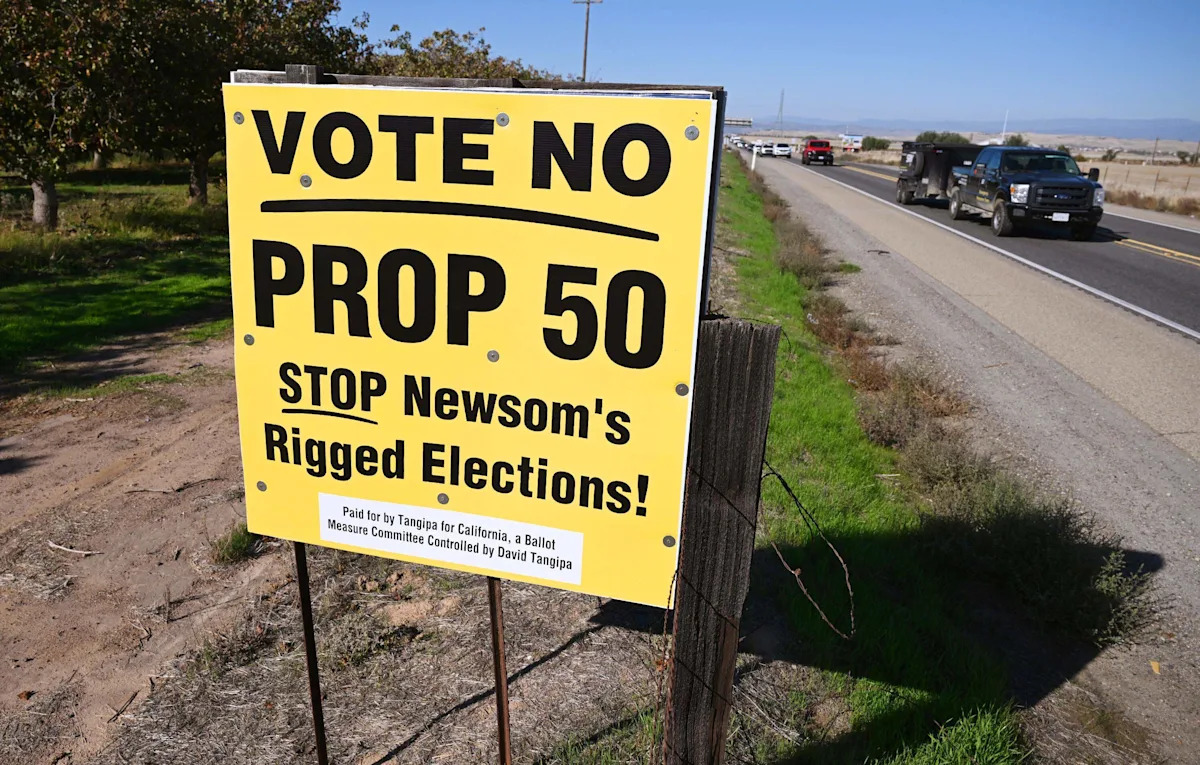
Sorry to put a damper on the Democrats’ celebration of a resounding victory for Proposition 50 that approves new congressional maps in California to be deployed for the June 2026 primary.
Gov. Gavin Newsom should take credit for successfully herding the proposition designed to thwart President Donald Trump’s directive to Republican states to redraw their congressional districts to carve out more GOP-friendly seats in an effort to keep control of the House.
“Yesterday California sent a message to Donald Trump: no crowns, no thrones, No Kings,” Newsom wrote in an email to supporters. “So today, I am proud. But I am very mindful about the state of things in this country.”
The president was not officially on the ballot, but Newsom and Democrats made sure his fingerprints were all over this election by blaming Trump for ordering the military to help carry out deportation missions in Los Angeles, gutting health care and sinking the economy.
Prop. 50 would never have been on the ballot for mid-decade redistricting had the president not pressured Texas into redrawing its districts to favor Republicans, said Fresno State Political Science Professor Tom Holyoke.
“While Gavin Newsom took the opportunity to use this to promote himself, he did not start it,” Holyoke said in an email. “So the overwhelming support for Prop. 50 is a rebuke to Trump, just as Democratic victories in Virginia and especially New Jersey and New York City were.”
That celebration by Democrats in the Central Valley should be tempered, however. While Californians overwhelmingly supported Prop. 50 by more than 27 percentage points — 63.9% to 36.1% — Valley residents went in the opposite direction. The combined percentage of votes from Tulare, Kings, Madera, Kern and Stanislaus counties against the proposition was more than 57%.
Fresno and Merced counties were the only ones to support Prop. 50, based on the vote count at 6:43 p.m. Thursday. Fresno voters favored the proposition by 1,303 votes out of more than 160,000 ballots. That means the results could flip once additional ballots are counted.
Merced voters gave it a 52.2%-47.8% margin.
What does Valley vote tell us?
A closer Fresno County count yesterday from the 2024 presidential race signals local voter discontent with Trump and his policies. Trump became the first Republican presidential candidate to win the county in two decades, but did lose the county to Joe Biden in 2020.
Buyer’s remorse?
“To what extent this is true, we don’t know at the moment, but there certainly seems to be a percentage of the population who voted for the president hoping he would improve their economic situation, but now they are not seeing it or feeling it,” said Holyoke.
The Prop. 50 results provide a snapshot of Valley voters, but do verify the area’s propensity to shed party labels when voting. Even Democrats have a conservative bent. I leaned heavily on Holyoke’s political expertise to gauge the impact of Tuesday’s vote.
“There are a lot of Democrats in the Valley, and while they are not San Francisco liberals, they will respond to an economic message from Democrats, or at least will support more Democrats in the House to block the Trump agenda,” Holyoke said.
It is too early to determine how the Prop. 50 voter votes will translate 29 weeks from now when the June primary will feature a throng of races ranging from city council to congressional seats.
The Valley will remain a battleground for both parties, despite what a top-ranking official told me two summers ago when he predicted the demographic shift in the region would bode negatively for Republicans. It turned out Valley Latinos, especially males, not only leaned toward Trump but also helped Rep. David Valadao, R-Hanford, hold onto his congressional seat in the heavily Latino 22nd District.
“The Valley does swing between red and blue, and many voters here are not fiercely loyal to one party or the other,” Holyoke said.
Valadao’s support will now be tested as his district will take on a portion of Fresno County and lean a bit more Democrat.
One thing is certain: Valley voters, especially Latinos, should be courted heavily by both political parties.
Juan Esparza Loera