
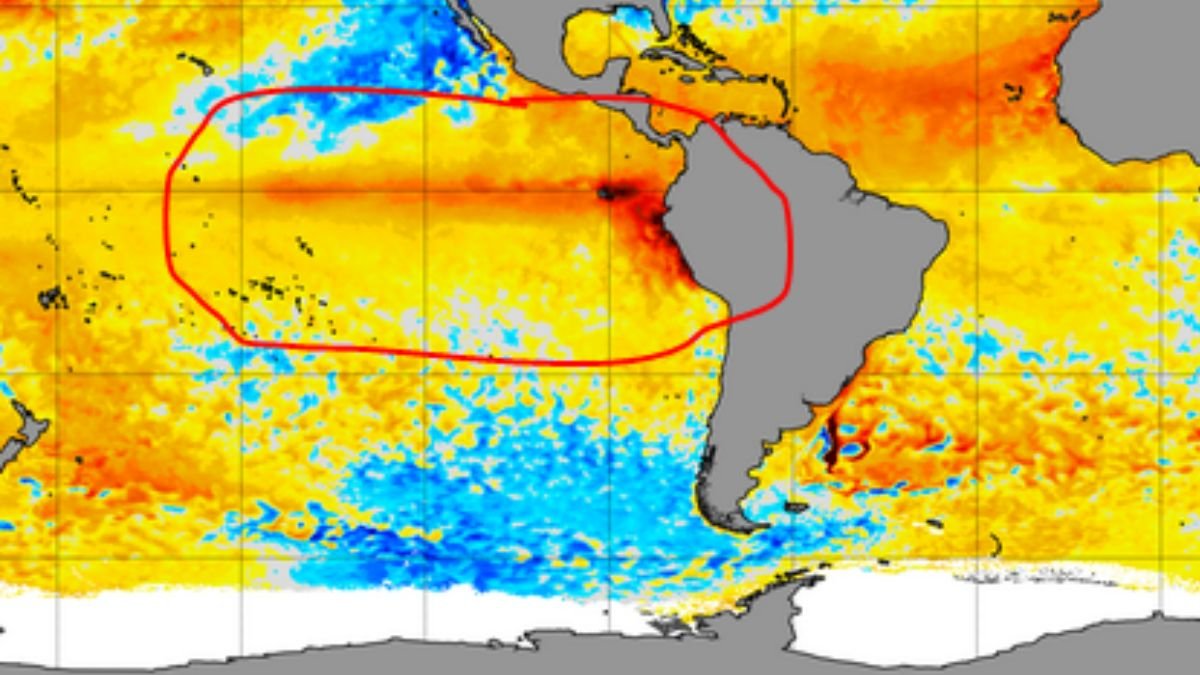
It’s becoming more likely that the U.S. could see a very strong El Niño this year, the National Oceanic and Atmospheric Administration said this week.
The confidence in the forecast has increased to 90%, compared to 81% a month ago, according to NOAA’s Climate Prediction Center, which puts out updates on the second Thursday of every month. The forecasted strength, however, has not changed.
“This El Niño could be one of the strongest in the historical records going back to 1950, but CPC indicates that is no guarantee that we will see ‘typical’ impacts everywhere,” NBC Los Angeles meteorologist David Biggar said.
What is El Niño?
El Niño — which means little boy in Spanish — is a warming of ocean waters off the Pacific coast of South America, typically peaking during the winter months, that causes changes in atmospheric patterns. It’s a seasonal variation, not an individual weather system.
As they take shape, there’s often an increase in Pacific hurricanes and a decrease in Atlantic ones. A warmer-than-average summer is also possible.
However, no two El Niños are alike. They are just one part of a complex puzzle that makes up the atmosphere and day-to-day weather.
Meteorological organizations, such as NOAA, use the following categories to describe El Niño intensities: weak, moderate, strong and very strong. The categorizations are based on how far the water temperature is from normal — not the impacts of El Niño. There is no official “super” category.
Will Southern California have another wet winter this year?
El Niños are not storms, nor do they generate storms or guarantee wetter winters. Some El Niño seasons have been dry, some wet and others are closer to average.
Biggar says it’s still difficult to say whether we’ll see a wet winter this year. Our rainfall depends more on the number of atmospheric rivers, and the strength of them, through the winter.
Was last winter an El Niño?
No, the last two winters experienced La Niña conditions, which are the opposite of El Niño conditions.
The most recent El Niño was in 2023-2024, and it was categorized as “moderate.”
Our latest very strong El Niño was in 2015-2016, and it was one of the strongest on record. It ended up being one of the driest years ever for Los Angeles.
One of California’s worst drought years also occurred during an El Niño in 1976-1977, but the following year’s El Niño had more than double our average rainfall with 31 inches of rain. Again, no two El Niños are alike.
Is El Niño caused by climate change?
El Niño is a naturally occurring phenomenon. While climate change may influence the frequency, intensity and impacts of El Niño events, it does not cause them.