
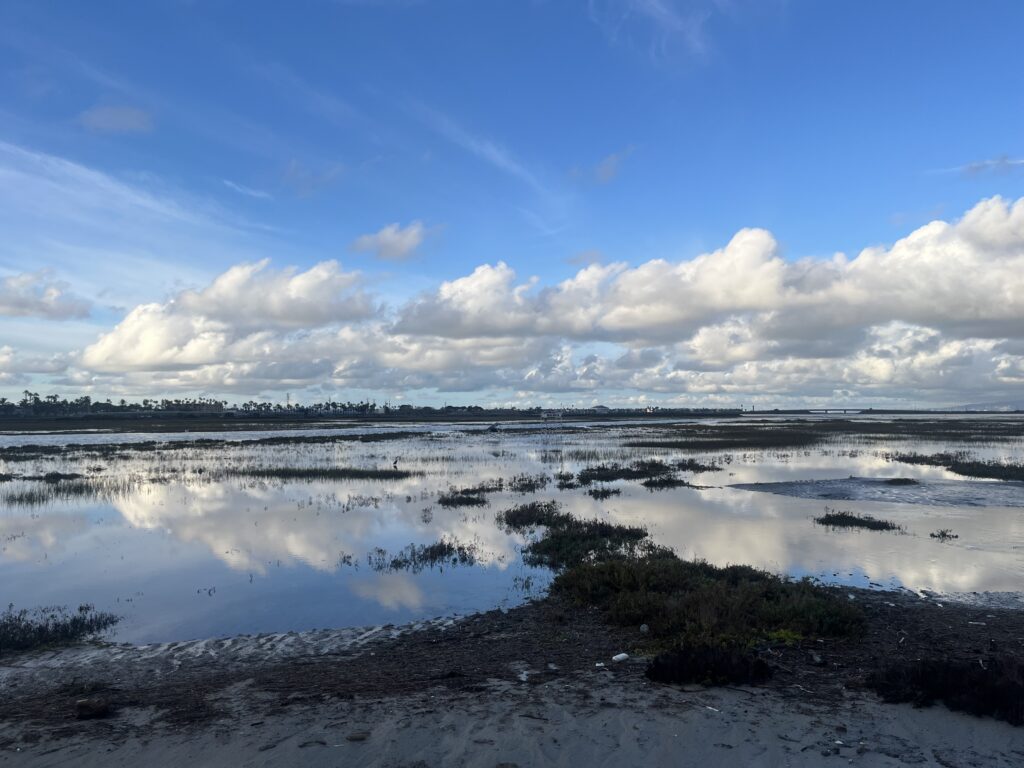
SANTA CRUZ — A research group out of UC Santa Cruz is taking their wetland monitoring work down to Southern California. The new data will strengthen our understanding of how restored wetlands keep carbon out of the atmosphere, and could even inform state policy.
“There’s more carbon sequestered per area in wetlands than in tropical Amazon forests,” said Adina Paytan, a professor of earth and planetary sciences at UCSC. Paytan is leading the monitoring project at the Seal Beach National Wildlife Refuge and the Los Cerritos Wetlands in Southern California.
Paytan’s lab studies biogeochemistry and chemical oceanography, including atmospheric microplastics and the impacts of climate change on coral reefs. The lab members also study wetland dynamics and how vegetation in these environments absorbs greenhouse gases such as carbon dioxide and methane from the atmosphere and keeps them buried for hundreds or thousands of years.
Since 2022, the lab has been monitoring both healthy and degraded wetlands in the Elkhorn Slough National Estuarine Research Reserve in Moss Landing. Part of their goal is to see how carbon sequestration improves when the saltwater marshes are restored. This kind of monitoring has been more common in Northern California, in places like the Bay Area’s San Joaquin Delta, Paytan said. There has been much less data collected in Southern California.
To fill that gap and get a better understanding of wetlands across the state, Paytan and some of her lab members have partnered with the California Air Resources Board and AmeriFlux to set up monitoring stations in two Orange County wetlands.
For at least the next three years, Paytan and her team will monitor two very different wetlands. The first, Seal Beach National Wildlife Refuge, is a pristine, well-preserved wetland. The second, nearby Los Cerritos Wetlands, is degraded and in the beginning stages of a restoration project. That restoration is extensive, and includes removing invasive vegetation, opening channels to bring seawater back into the tidal wetlands, and plant new vegetation, which will allow for carbon sequestration.
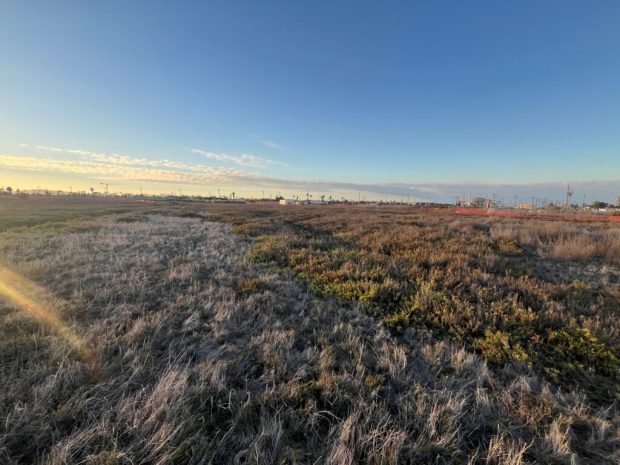 The second Southern California site the Paytan Lab will monitor is Los Cerritos Wetlands, which is in the beginning stages of restoration. (Courtesy of Adina Paytan, photo by Marco Montemayor)
In each wetland, Paytan and her team set up devices called eddy covariance towers, which sit in the marsh. On top are instruments that take measurements every 15 seconds, cataloguing the carbon dioxide and methane in the air. By combining these measurements with other data such as wind speeds to calculate how much carbon is being released and sequestered by the marsh’s vegetation. The goal, Paytan said, is to understand how restoration work at Los Cerritos Wetlands will impact its ability to sequester carbon. Seal Beach will serve as a reference point for a healthy wetland’s carbon sequestration.
Over the past few years, similar work at Elkhorn Slough has shown encouraging results. Over the course of the study, Paytan said, the part of the slough that is undergoing restoration has already gone from a carbon source to a carbon sink — meaning it now removes more greenhouse gases from the atmosphere than it emits.
“It is looking really good,” Paytan said. “It’s really exactly what we expected, but faster.”
The research is part of the state’s initiative to become carbon neutral by 2045. While restoration projects that take carbon out of the atmosphere will be an important component of that, Paytan said, they are a small piece of the puzzle. Natural solutions will have to be paired with new technology, and substantial reductions in carbon emissions, to meet these goals.
Still, restoring wetlands provides several benefits besides carbon sequestration. When these ecosystems are healthy, they provide homes for wildlife, including birds and otters, and help protect against sea level rise and storms. Much of the state used to be made up of wetlands. Now, around 90% of those areas have been developed. Identifying places where marshes could make a comeback will be a key part of preventing and adapting to climate change.
“We don’t have that much area left, but whatever we have that we can restore, we should restore,” researchers said. “Is this going to solve the climate problem? No. It’s going to contribute a few percent of our goals of (carbon) reduction. But every drop counts.”