
ROSAMOND — The problem with the vast majority of battery energy storage systems in California is that they discharge electricity for four hours tops.
That means if the sun goes down at 8 p.m., for instance, most of the state’s backup power may be available only until midnight. After that, operators of the state power grid generally must turn to conventional energy sources whose greenhouse emissions contravene the state’s climate goals.
Worry not: A solution has been built in Kern County that’s the first of its kind in California, if not the entire country.
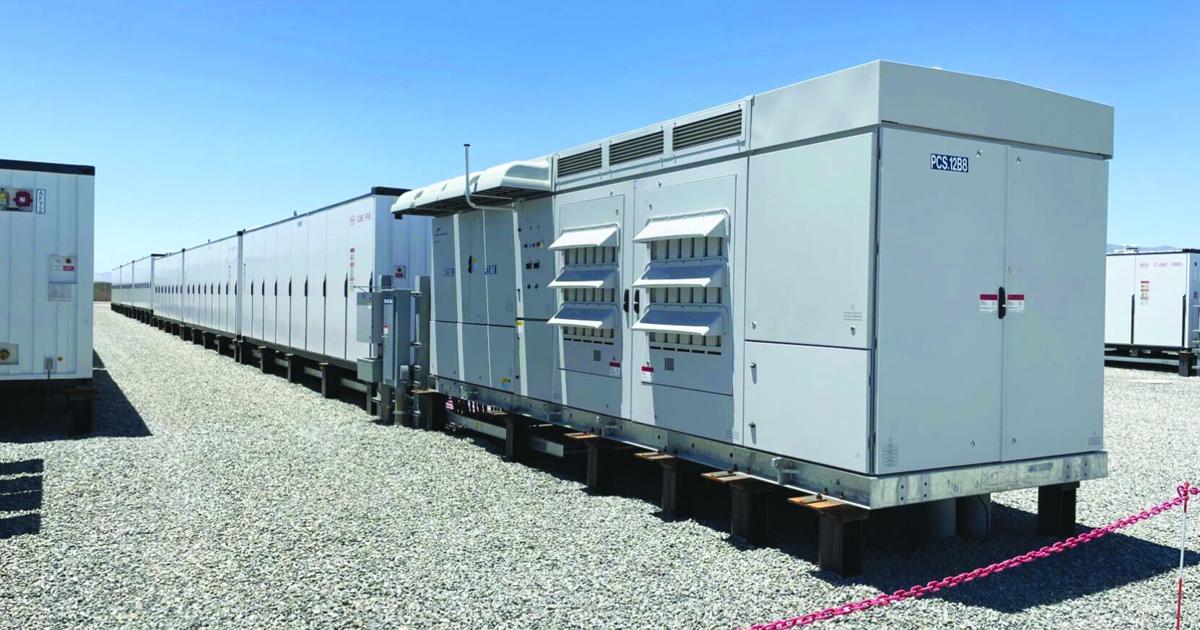
A Walnut Creek company has begun operation of a battery energy storage system that provides electrical power for eight hours at a time, helping reduce emissions while making the state’s power grid more resilient.
The Tumbleweed Energy Storage Project seven miles southwest of Rosamond switched on in June. It provides 125 megawatts of power to community-choice aggregation organizations serving 4.7 million customers in Northern California.
REV Renewables developed the two-phase project in response to a call by the California Public Utilities Commission in 2021 for longer-duration energy storage to support the state’s push for carbon neutrality by 2045.
REV manages a portfolio of 2.9 gigawatts of renewable energy and power storage projects across the country. The company is owned by New York City-based LS Power, which has developed or acquired 47,000 megawatts of power generation since its founding in 1990.
The Tumbleweed project is significant enough that CPUC Executive Director Leuwam Tesfai attended a ribbon-cutting ceremony at the site June 18. She took the opportunity to say developers, utilities, community-choice aggregators and regulators “all play an important role in turning California’s clean energy vision into reality.”
“This project shows that California’s renewable energy goals, while ambitious, are achievable,” she said.
The installation draws energy from nearby photovoltaic solar arrays then stores it before converting and sending it to the nearby Desert Flower Substation. The substation connects to Southern California Edison’s Whirlwind Substation.
Construction required the incidental take of up to 289 western Joshua trees and the loss of some of the plant’s habitat.
Technology contained within the site isn’t new, in that the facility essentially relies on twice the number of batteries as other battery energy storage systems providing the same number of megawatts.
The project was developed in partnership with Oakland’s Ava Community Energy and Sacramento’s California Community Power on behalf of participating CCA members CleanPowerSF, Peninsula Clean Energy, Redwood Coast Energy Authority, San Jose Clean Energy, Silicon Valley Clean Energy, SonomaCleanPower and Valley Clean Energy.
CC Power’s general manager, Alexander Morris, said in a news release the organization is pleased to have partnered with REV on the project.
“We are excited about this milestone moment for California, what it says about the role of CCAs in proactively advancing the state’s goals for clean, reliable energy, and how joint action through CC Power can be a valuable tool to achieve those goals.”