
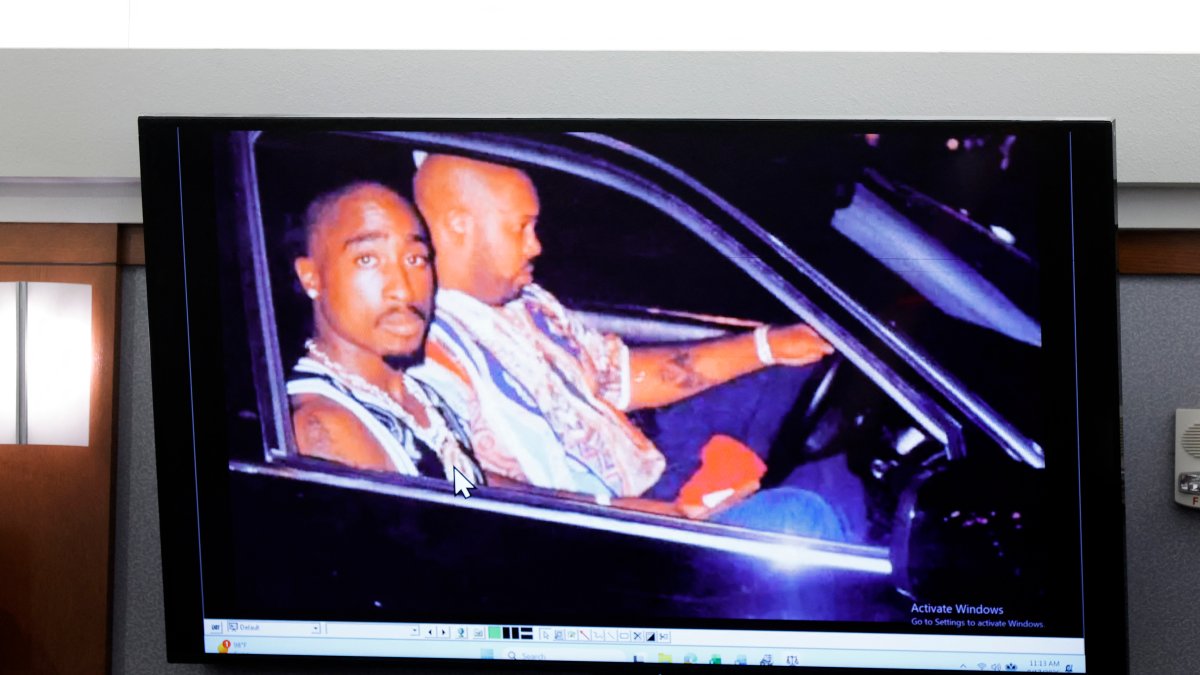
What to KnowDuane “Keffe” Davis is on trial for the murder of rap artist Tupac Shakur on the night of Sept. 7, 1996 in Las Vegas. In opening statements, prosecutors contended that Davis did not pull the trigger, but planned the shooting that killed the rap icon at 25 in retaliation of the beating of his nephew.The defense labelled the prosecution’s case “fiction” and said Davis wasn’t previously charged for the 1996 killing because law enforcement knew that he was “full of crap.”No one had been charged in the shooting that gripped the hip-hop community until Davis was indicted in 2023. Central to the case is Davis’ 2008 interview with a federal task force investigating the killing of Shakur’s rival, the Notorious B.I.G., March 9, 1997 outside the Petersen Automotive Museum.Davis instead spoke about the Shakur shooting and described handing a gun to the men in the back seat of a white Cadillac that fired on a black BMW with Shakur and Marion “Suge” Knight inside. If convicted, Davis faces life in prison.
Testimony in the long-awaited murder trial of Tupac Shakur will resume Tuesday a day after attorneys questioned former Las Vegas police officers about the investigation into the rap artist’s 1996 shooting death and focused on the defendant’s previous statements about the killing.
Prosecutors contend that Duane “Keffe” Davis, a former LA gang leader and the only person ever charged in the crime, planned the shooting that shook the hip-hop world on the night of Sept. 7, 1996 and portrayed him as the “one person who has a hard time being silent.” Davis is charged with murder with a deadly weapon with the intent to promote, further or assist a criminal gang in Shakur’s death.
He pleaded not guilty. If convicted, Davis faces life in prison.
“Let’s be clear, Duane Davis did not pull the trigger, but he did plan the shooting in retaliation of the beating of his nephew,” Chief Deputy District Attorney Binu Palal told jurors “Remarkably, you will learn that from Duane Davis himself.”
Palal showed jurors video of Shakur’s entourage attacking Davis’ nephew Orlando “Baby Lane” Anderson outside the boxing match at the MGM Grand hours before the shooting on Sept. 7, 1996.
Davis spent the next two hours planning how to get even, Palal said.
Attorneys on Monday referenced Davis’ own words related to the killing, including in documentaries, an autobiography and a 2008 interview with a federal task force investigating the killing of Shakur’s rival, the Notorious B.I.G. The Grammy-nominated hip-hop artist was shot March 9, 1997 outside the Petersen Automotive Museum at Wilshire Boulevard and Fairfax Avenue on LA’s Miracle Mile.
Instead of talking about that shooting, Davis spoke at length about the Shakur shooting and described handing a gun to the men in the back seat of a white Cadillac that fired on a black BMW with Shakur and Marion “Suge” Knight inside. Prosecutors played audio of David explaining the moment of the shooting.
Proceedings began Tuesday with the jury of 10 women and six men hearing more of a recording with Davis and LAPD investigators following the shooting death of the Notorious B.I.G., aka Christopher Wallace.
Opening statements
Palal told jurors Davis held onto a hatred for Shakur for decades that drove him to finally speak on the killing. He said as early as 1998, the defendant talked to the FBI and admitted he had been in Las Vegas the night of the shooting. He spoke again in 1999 to the FBI and said again he was in Las Vegas then but denied responsibility.
In 2009, he admitted to his role in the killing in an interview with Las Vegas police, Palal said.
Davis’ attorney called the prosecution’s narrative “fiction.” After opening statements and the first testimony Monday, attorney Michael Sanft said he felt good about the case and reiterated that his client’s confession does not mean it was factual.
Sanft said Davis wasn’t previously charged for the 1996 killing because law enforcement knew that he was “full of crap.”
Palal showed jurors the 2019 memoir that Davis co-authored, “Compton Street Legend,” that the prosecution will use and that the defense fought to keep out of the trial, along with several of the defendant’s interviews.
No one had been charged in the shooting that gripped the hip-hop community until Davis. In court Monday, a graphic was displayed that showed the three other men in the Cadillac died in the years since.
Davis was indicted in 2023.
“When he says he’s the only person who can tell what happened, he’s right,” Palal said.
Testimony from ex-police officers
Brent Becker, a former Las Vegas homicide detective, testified that Knight showed up to a police interview with attorneys, which Becker and other law enforcement officers thought was weird because Knight was a victim. Knight was timid, and his interview was practiced, Becker said.
“It was not the ‘Suge’ Knight I expected,” the detective said
Knight told investigators that he didn’t know anything.
“I thought he lied to us,” Becker said.
Becker described the difficulty of getting witnesses to talk. The four names of the people inside the Cadillac that investigators “were leaning on” were Davis, Anderson, Deandrae “Freaky” Smith and Terry “Bubble Up” Brown, the detective said. But he noted he had no living witnesses to tell him who was in the Cadillac.
The prosecution said it plans to call 35 to 45 witnesses, started with retired Las Vegas police officer Garry Dale, in a proceeding that is expected to take about one month. Dale testified Monday how he and another officer stopped a car carrying Knight and Shakur because the vehicle didn’t have a license plate.
They let the pair go with a warning.
About 10 minutes later the two officers responded to a call about a shooting and found Shakur being pulled from the car by EMTs, Dale said. Knight had been grazed by bullets, but told the officers to take care of Shakur, he testified.
Dale jumped in the ambulance and tried to get Shakur to tell him who shot him. The retired officer said that Shakur said something like, “No, we’ll take care of it.”
Another witness, Ingrid Stokes, testified that she and her friends were heading home from Las Vegas when they encountered Shakur and Knight, who was friends with a woman in Stokes’ group.
Knight invited them to a nightclub, she said, and they decided to meet them there.
The car Stokes was riding in was one lane over and a car length ahead of Knights’ vehicle, when they heard gunshots while stopped at an intersection, she said.
Stokes said they feared more gunfire and drove away, almost hitting a white four-door vehicle in the process.
When they returned to the scene, police treated them like suspects, she said, and made them sit on the sidewalks. She was scared to talk about the case, worried about poor treatment from law enforcement and the potential for retribution from the unknown shooter.
“Snitches get stitches,” she said.
Members of Shakur’s family, including his stepbrother Maurice “Mopreme” Shakur, listened intently in the courtroom.
Shakur remains a cultural icon and is considered one of the most influential and versatile rappers of all time. He was nominated for six Grammy Awards and was inducted into the Rock & Roll Hall of Fame in 2017.