
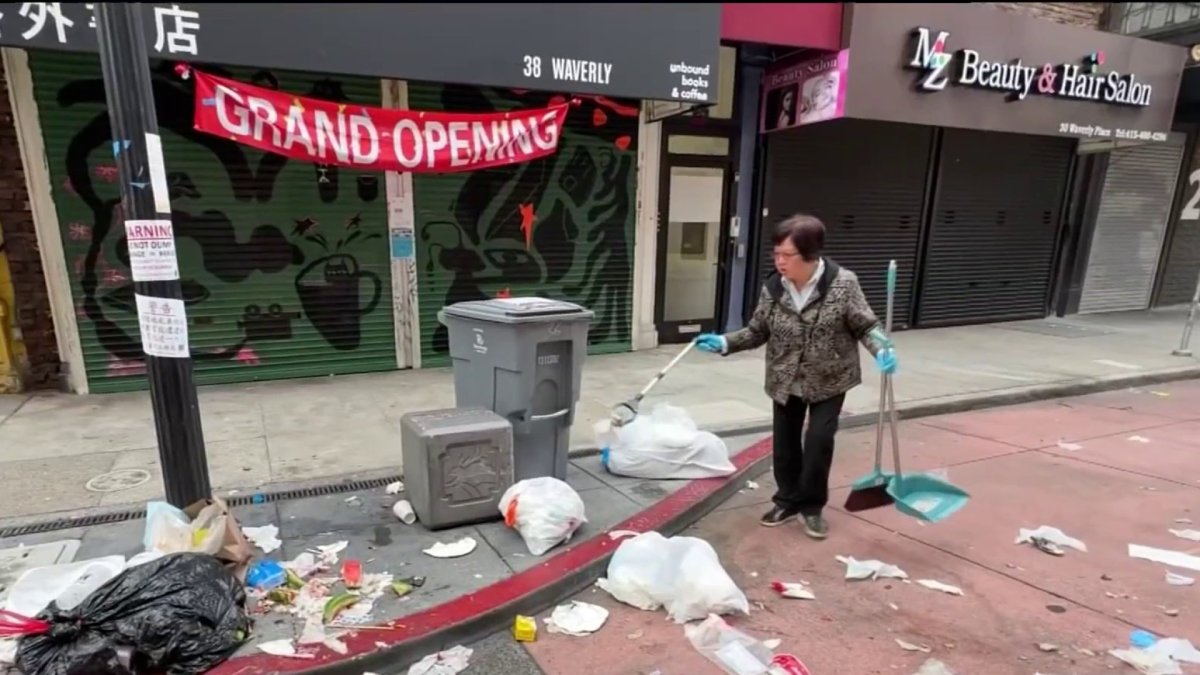
“Don’t trash Chinatown.”
That is the blunt message business owners are trying to share with their San Francisco neighbors as garbage and recycling pile up on neighborhood sidewalks.
The issue is being fueled by an increase in neighborhood activity and a lack of available garbage and recycling bins. On a recent Tuesday morning, individuals could be seen racing to load garbage into a collection truck before it drove off, while others left bags of trash and canisters of cooking oil on the sidewalk.
Lily Lo, a community leader with the organization BeChinatown, said the growing piles of street trash aren’t just unsightly, but unsafe.
“Children who walk around and the seniors. The safety, because I saw people fell,” Lo said. “And the street is so narrow already and you have food and oily and you got paper all over so, it’s not good.”
Lo has recently taken to cleaning the streets herself, largely out of concern over rats. Adding to the problem, unhoused individuals sometimes root through garbage bags and bins looking for food or other items.
Meanwhile, some neighborhood merchants say they are frustrated by fines they are incurring when other people fill their commercial bins. Jimmy Quan, a restaurant operator, said he pays an extra $20,000 a year in waste-related penalties.
“Because I cannot control the people who live around here who dump the garbage in my thing,” Quan said.
Quan believes elderly residents in the low-income apartments next to his restaurant are partly responsible, noting that their landlord does not provide enough bins or pay for frequent pickup service.
A grassroots effort is already underway to combat the blight.
“If you walk around Chinatown, you’ll see there’s already kind of a public effort — people posting signs — trying to tell people not to trash the neighborhood,” said NBC Bay Area reporter Sergio Quintana.
Representatives for the mayor’s office, Supervisor Danny Sauter, and the Department of Public Works (DPW) were contacted regarding the neighborhood’s concerns.
A spokesperson with DPW noted that garbage and recycling removal is a service that residents and businesses must pay for. When the pandemic hit and area activity slowed, many property owners and businesses dialed back their refuse removal services. Now that crowds have returned, some have not paid to ramp those services back up.
The DPW spokesperson added that the city does provide several other supplemental services, including block sweepers and outreach enforcement teams. Meanwhile, a spokesperson for the mayor’s office acknowledged the neighborhood’s concerns, stating that clean and safe streets remain a top priority.
Lo and other Chinatown community leaders say everyone needs to pitch in more to solve the problem.
“Business owner and property owner have to be more responsible,” Lo said. “And, I don’t know what the solution is. But we just have to try.”