
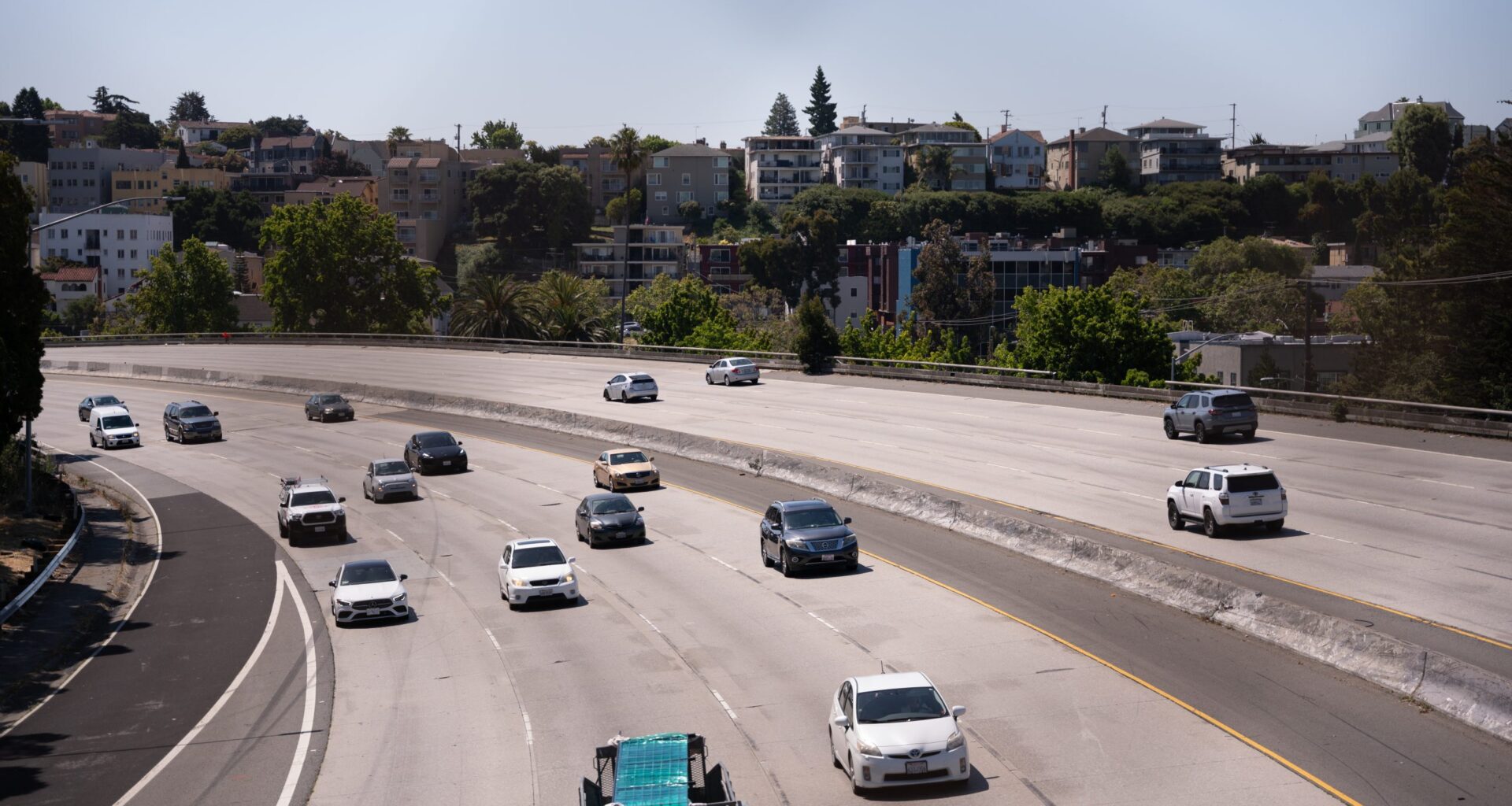
If the state removes a ban on heavy trucking on the I-580 freeway, which crosses Oakland below the hills from the Oakland Zoo to Lake Merritt, the highway will see a large increase in heavy trucks, according to new findings from a highly anticipated study paid for by Caltrans, the state transportation agency.
The study is part of a process initiated by Caltrans, the state transportation agency, to consider removing the truck ban, which has been in place since the highway was built in the 1960s.
Removing the ban, the study found, would lead to 3,800 heavy trucks and 75,300 heavy-truck miles a day on a highway that currently sees none and lies within 1,000 feet of dozens of schools, health care centers, and senior centers.
The change would reduce the number of heavy trucks on another Oakland highway, I-880, which runs along the city’s waterfront, by an estimated 35%, as “some heavy truck trips could reroute onto I-580 instead,” the study found.
Released last month through a somewhat byzantine “engagement portal” and presented at community sessions across Alameda County, the I-580 Truck Access Study memos, developed by the contracting firm Fehr & Peers and managed by Caltrans, analyzed the potential impacts on traffic, air quality, and noise of removing a ban that has been in place for decades.
The study’s area, as shown on Caltrans maps, includes all of Oakland and parts of adjoining cities, such as San Leandro, Albany, and Berkeley, as well as unincorporated areas of Alameda County that I-580 passes through. Major transit hubs, such as the Oakland Airport and the Port of Oakland, were also included.
The ban removal is being considered due to equity concerns, as trucking on other Oakland freeways has negatively affected the health of low-income, mostly Black, brown, and Asian populations for decades. Oakland communities already burdened by decades of truck particulate emissions along I-880 have seen elevated cancer rates. In recent years, some school kids in East Oakland have called for lifting the ban to ease the particulate burden on their communities.
The new findings say that removing the I-580 truck ban would “likely see slightly lower risk” in locations near I-880 “than if the ban is maintained,” and that more than half of people who live near I-880 are environmentally burdened by the effects of trucking, compared with 9% of people who live near I-580.
Still, the study found that environmentally burdened communities “would likely face a higher cancer risk than the study area as a whole in the future regardless of whether the ban is removed or maintained.”
Health and environmental impacts in the study were determined in part by estimating the amount of diesel particulate matter heavy trucking produces, despite the trucking industry’s growing adoption of electric engines. The study found that the use of “cleaner” diesel would reduce cancer risk across the entire study area.
An American Lung Association report found a few years ago that, nationally, medium and heavy truck vehicle pollution generated about 59% of all “ozone- and particle-forming NOx emissions” and 55% of particle pollution.
Caltrans said the study itself won’t determine whether the state will choose to repeal the ban. Doing so would require the state legislature to amend the California Vehicle Code, which was last amended under Gov. Gray Davis in 2001.
Further heavy trucking impacts, including on roadway degradation
Several other key data points, released as part of the study and illustrated in the portal presentation, are useful for understanding past, current, and potential future environmental effects on the city’s populations.
For example, in Chapter 2 of the presentation, the Sensitive Locations section allows the public to see exactly where schools, childcare centers, and senior centers are located near I-580, which turns out to be a larger number than near any other Oakland highway. In all, the study found 70 of these sensitive institutions located near I-580, 40 near I-880, and seven near I-238, which connects the other two highways near the San Leandro-Hayward border.
The Equity Priority Community section, in that same chapter, shows how many people in the study area live near highways, including I-580, I-880, and I-238. The maps reveal that 56% of all residents in the study area now live in equity priority communities, meaning they are impacted by the continued presence of heavy trucking nearby.
In May, The Oaklandside reported on a public meeting where many residents were incensed at the idea of having to maneuver around heavy trucks on their way to pick up their children from school. Worse, as one mother cautioned, was the idea of teens new to driving coming to and from school in the same lanes as dangerous heavy trucks.
The Fehr & Peers team said some studies of driver behavior “show that the presence of trucks may increase driver caution, potentially decreasing the risk of crashes.” Yet the study found that “truck-involved freeway collisions” in the study area “increased 30 percent between 2020 and 2024, outpacing the 7 percent growth in truck volumes.”
Over half of those collisions occurred on I-880, the study found, while 6% occurred on I-580. (Even under the current ban, only trucks over 9,000 pounds are banned, and even heavy trucks are allowed on some segments of I-580.)
The study also examined the potential effects of increased trucking on I-580 on nearby city roadways and whether that traffic could worsen road conditions.
The study found that if the ban were lifted, heavy truck traffic could increase on several arterial roads in Oakland, including on West Grand Avenue. Volume increases “could be as high as 270 daily heavy trucks,” the study found. At the same time, the study found that traffic on Telegraph Avenue could decrease.
Roadway degradation because of additional heavy trucks on these arterial roads — some of which have only recently been paved by the city after decades of inaction — could increase by 4%, according to the study. That would potentially “increase maintenance costs for local jurisdictions,” in this case, the city of Oakland, the study notes.
Caltrans said it will continue to receive feedback from residents on these memos over the next few weeks and that the study survey is open until the end of September. The agency expects to produce a draft report in the Fall, with a 6- to 8-week review period when people can review and comment on it. Then, the final report will be produced sometime in the Winter.
Continued pushback from residents and county
Over the last month, residents who live near I-580 have attended meetings run by Caltrans and have overwhelmingly pushed back against the idea of removing the ban.
One group — No Big Rigs on 580 — has created a website to present their side of the issue. The group said that based on their reading of the new data, the ban should continue because “the damage imposed on the people who live close to I-580 and SR-13 will be huge compared to any benefit that may accrue to the residents along I-880 and I-238.”
Donald Duggan, a civil engineer with No Big Rigs on 580, told The Oaklandside that while the trucking industry would benefit by having more driving lanes to operate in, lifting the ban would leave most everyone else with a worse environmental outcome.
No Big Rigs on 580 criticized the Caltrans study for failing to provide a comprehensive analysis of the seismic risk of removing the ban, especially since I-580 runs on several elevated highways. Similarly, they said the study lacked a thorough analysis of the effect of the proposal on evacuation routes during fires or on emergency response response times.
Residents who commented at a recent presentation of the findings before the Alameda County Transportation Commission mentioned their fears about fires. Melissa Rae Canio and Kasheica McKinney said in separate letters that during the last major fire along I-580, they struggled to evacuate.
“Traffic was so gridlocked that we sat for more than two hours and were ultimately unable to get out of the fire area. We had no choice but to turn around and head back toward the area threatened,” Rae Canio said. “What happens during the next major wildfire or emergency if our evacuation routes are also filled with semi-trucks and tractor-trailers?”
Correction: An earlier version of this article misstated the third highway examined in the study, in addition to I-580 and I-880. It is I-238.
“*” indicates required fields