

The voice on the phone is friendly and efficient. She tells you she’s from Medicare, calling to inform you that you’ll be getting a new plastic ID card to replace the old paper version. All she needs is your Medicare number to verify you are the legal beneficiary.
You dig up your paper card and recite your number. And now you are the victim of a Medicare phone scam.
“Usually, these scam callers impersonate government officials or sometimes even health care providers,” says Lucy Ngo, a Medicare fraud investigator. “That’s a way to earn your trust. Their primary goal is to get that Medicare number. Once they have it, they can start to bill Medicare for services that were never provided, for expensive durable medical supplies you don’t need, and other fraudulent schemes.”
Ngo works for the Senior Medicare Patrol (SMP), an arm of the non-profit California Health Advocates, the state’s premiere Medicare watchdog organization.
“Medicare will never call you out of the blue. Medicare won’t phone to ask for your card number, to threaten to cancel you, or to sell you products.”
Lucy Ngo
Senior Medicare Patrol fraud investigator
She says everyone needs to do their part in identifying and reporting these scams. Nationwide, Medicare loses approximately $60 billion annually due to fraud, errors, and abuse. That’s money that could be going to provide medical services, supplies and prescriptions.
Fortunately, there’s a simple test for detecting Medicare phone fraud.
“The key way to recognize it’s a scam is if someone says they’re calling from Medicare,” Ngo says. “Medicare will never call you out of the blue. Medicare won’t phone to ask for your card number, threaten to cancel you, or sell you products.”
And, she adds, Medicare typically only sends communication via physical mail.
“The only time you’ll get a call is if you phoned Medicare first and asked for a return call,” Ngo says.
Ngo’s work as a fraud investigator evolved from her previous position as a clinic director.
“I provided treatment for Medicare beneficiaries and also helped them understand their coverage and their benefits,” she recalls. “Eventually, I began looking for a way to put those skills to use in the non-profit sector.”
Joining California Health Advocates was a natural fit, she says.
“I’m able to make a broader impact and help more people through the Senior Medicare Patrol,” she says.
Rosana Bruhnke works closely with Lucy Ngo on fraud cases. Based in Humboldt and Del Norte counties, Bruhnke is a program manager with California’s Health Insurance Counseling and Advocacy Program (HICAP). The program offers free counseling and education to people on Medicare and long-term care insurance.
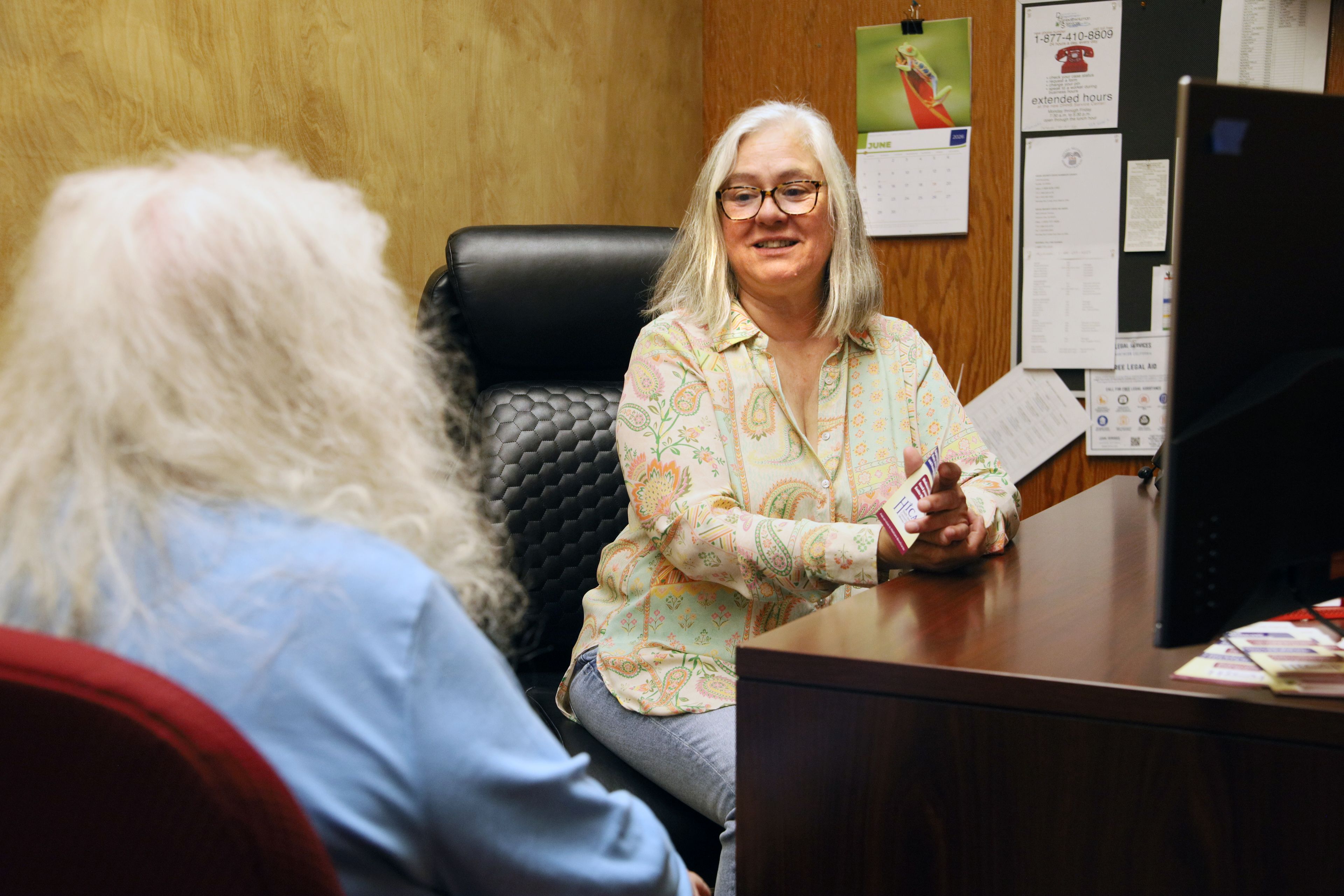 Rosana Bruhnke, a program manager with California’s Health Insurance Counseling and Advocacy Program (HICAP), advises seniors to create their own secure account on Medicare.gov as a way of tracking and monitoring their Medicare expenses.(Photo by Shawn Walker)
Bruhnke and Ngo both advise seniors to monitor their Medicare Summary Notices (MSNs) or the explanation of benefits that come with Medicare Advantage plans.
“You can see what was billed in the Medicare Summary Notices you get twice a year,” Bruhnke says. “Someone may call us and say, ‘I received a back brace you can get at Walgreens for 20 bucks but they billed Medicare hundreds of dollars for it.’ We tell them to check their summaries to look for suspicious charges or services they didn’t need.” She also advises people to create their own secure account on Medicare.gov. There they can sign up for monthly electronic mailings of their MSNs, or view them in real time rather than waiting for them to arrive in the mail once every six months.
Bruhnke says some people quickly realize the voice on the phone is a scammer, but not everyone has that capacity.
“We’ll hear from a worried wife who tells us, ‘My husband has dementia. He gave the caller his Medicare number. What do we do?’” she says.
The answer, according to investigator Ngo, is straightforward: Report it to the California Senior Medicare Patrol. Medicare’s website also has detailed advice on reporting fraud and abuse.
“If you do get a suspicious call, we highly recommend you report it to us at the Senior Medicare Patrol,” Ngo says. “You can reach us at (855) 613-7080. We’ll help you call Medicare to report your number is compromised. They’ll issue you another card with a new number.”
Prevention, however, is the best medicine. The first line of defense against phone scammers is to teach people to protect their personal information.
“Treat that Medicare number like a credit card,” urges Ngo. “Never share it with someone who calls out of the blue.”