
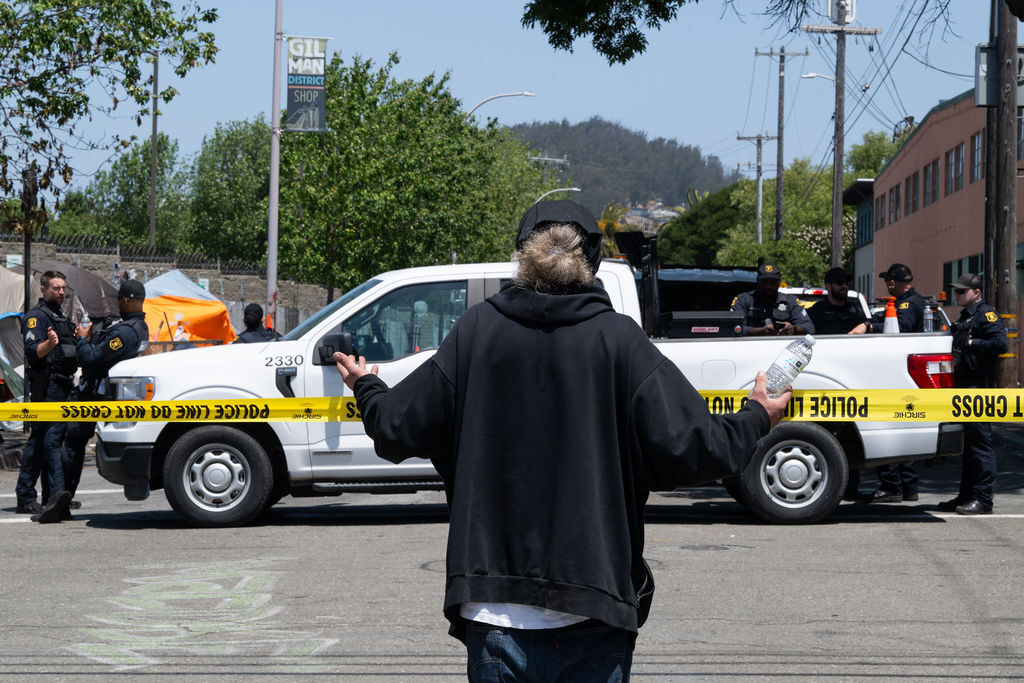
 Berkeley began sweeping the camp at Eighth and Harrison streets in June 2025 before a federal judge ordered the city to pause. Since then homeless advocates have secured several concessions from the city through lawsuits. Credit: Adahlia Cole for Berkeleyside
A federal judge has ordered Berkeley officials to consider specific locations where unhoused people can move when the city closes the long-standing encampment at Eighth and Harrison streets. But Judge Edward Chen rejected homeless advocates’ request for a long-term postponement of the camp closure, and said Berkeley can clear the area “in short order.”
Chen’s order Thursday states that homeless advocates must generate, and city officials must approve or reject, a list of proposed new campsites for 23 camp residents by Aug. 27. It is the latest concession homeless advocates have won in their legal challenges that seek to block the city from sweeping the encampment, though the order does not require the city to approve any of the proposed new camping locations.
Berkeley has been trying to close the camp for several years over what officials describe as issues of sanitation, fire hazards and public health risks, while some nearby business owners and residents have filed their own lawsuit accusing the city of letting public nuisances go unchecked.
“There are open flames in the encampment every day. There are rats running over people, screaming in the night,” Assistant City Attorney Katrina Eiland said in a hearing in federal court in San Francisco Thursday. Those rats have fueled an outbreak of the bacteria leptospirosis which has killed one person and hospitalized one more.
Attorneys for campers with disabilities say Berkeley has not yet done enough to address their needs, and accuse the city of “foot-dragging and obstruction” when Chen has ordered the city to make certain concessions.
Berkeley posted notices July 27 that ordered everyone camping in the area bounded by Gilman Street, San Pablo Avenue, the Union Pacific rail line and the city’s northern border at Codornices Creek to clear out by Aug. 3 so the city could clean the area. A fire marshal declared the encampment a fire hazard and a public nuisance, and the city’s public health officer said that unless Berkeley dealt with rat infestations there, the leptospirosis outbreak would continue to spread, according to the notices.
Chen ordered Berkeley to hold off on the sweep until Thursday’s hearing, when he considered arguments on a longer-term injunction. The Berkeley Homeless Union accused the city of ignoring Chen’s earlier orders to help some residents with their moves, sensationalizing the outbreak and improperly destroying or failing to store property during past closures.
Chen wrote in his order that he “expects the Harrison encampment will, in short order, be abated.” Berkeley must, however, continue to meet with some residents to assess accommodations for disabilities and move or help store property for some people who have to move, as he ordered in April.
Storage has been a sore spot for many unhoused Berkeleyans who say that the city has kicked them out of camps with promises to store personal property only for it to disappear.
“Over the course of nearly three years, Berkeley’s enforcement operations disposed of approximately 959,800 pounds of material across 52 encampment closures, 34 deep cleaning operations, and 11 RV closures,” Chen wrote in an order in a related case over the same encampment. “Despite that volume of enforcement activity and property disposal, the city issued only 34 property inventory notices.”
Attorneys for the city told Berkeleyside officials will post new notices to close the camp, but it is not yet clear when that will happen.
Lawyers for the city and the Berkeley Homeless Union each tried to blame the other for their apparent inability to work together.
Berkeley Homeless Union attorney Anthony Prince said the city should have already provided alternate camping locations to encampment residents who will have to move.
“The fact of the matter is that the city knows very well what it owns in the City of Berkeley, what is a vacant lot, and what is property that is under the management or ownership of the city,” Prince said.
Eiland said the city’s work would be more complicated than just throwing together a list of possible locations, and that outreach workers had to consider each resident’s request for accommodation individually — but that those residents have refused to cooperate. “The fact is that we haven’t denied a single accommodation,” she said.
Homeless plaintiffs and their advocates have long said that Berkeley’s overlapping restrictions on parking, sidewalk space and camping essentially make it illegal to be unhoused in the city. Chen has ordered Berkeley to make other exceptions to its rules, allowing for some RVs to park longer than the citywide 72-hour limit and, more recently, for some residents to use more than a 3-by-3-foot square of sidewalk for their possessions, which is all that city rules allow.
Even if Berkeley removes the camp entirely, it is unclear how it might keep unhoused residents from moving tents and RVs back in, as has happened after every previous sweep of the neighborhood. The City Council slashed a number of health department positions in the budget it passed in June. It also eliminated several vacant positions at BPD which, along with BFD and the health department, has the most frequent contact with unhoused residents.
Berkeley has largely kept Civic Center Park and Ohlone Park free of campers after sweeps last year. At another camp, on Carleton Street, the city gave the street underneath to Bayer, the city’s largest private-sector employer and owner of properties on both sides of the dead-end block, and the company evicted the campers shortly afterward.
Since those closures the camp at Eighth and Harrison has more than doubled in size. Attorneys for Berkeley said Thursday the camp had about 80 residents; homeless advocates estimated there were around 35 residents in June 2025 and 40 in February.
Correction: An earlier version of this article listed an incorrect title for Assistant City Attorney Katrina Eiland.
“*” indicates required fields