
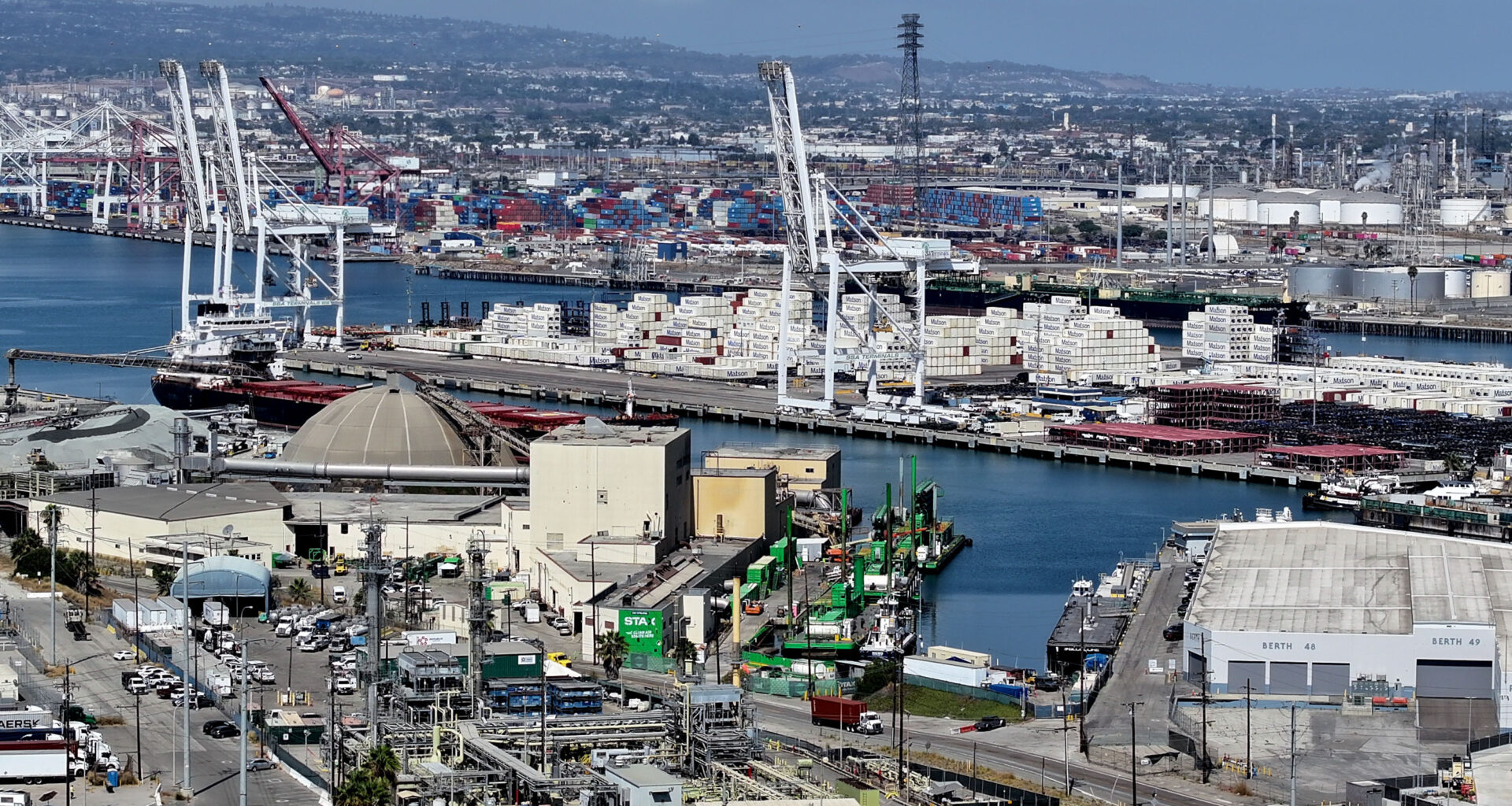
Cargo volumes at the Port of Long Beach remain strong so far in 2026, with the numbers currently 1.2% ahead of this time in 2025, a year that saw the port hit an all-time record, POLB CEO Noel Hacegaba said during his monthly virtual news briefing on Wednesday, Aug. 19.
Shippers and businesses, he said, are adapting to a new normal, having learned how to “take a punch” after years of upheaval caused by the COVID-19 pandemic and, more recently, changing tariffs and military unrest abroad.
“Businesses are not freezing anymore,” he said.
Instead, Hacegaba added, they are learning how to diversify and adapt to sometimes rapidly changing outside forces.
The July cargo data, released earlier this month, showed that the port moved 928,508 twenty-foot equivalent units, down 1.7% from the same month last year. Even so, it was the port’s second-busiest July on record — and the fourth-strongest month overall in its 115-year history.
Last year, the port had its busiest year in history, handling 9.9 million cargo containers, a milestone driven by importers front-loading shipments ahead of anticipated tariff changes.
Still, Hacegaba said, the overall economic climate remains challenging, noting rising fuel and grocery prices, and other increasing expenses that are spiking consumer uncertainty.
“Consumers feel like they’re riding an economic roller coaster,” he said.
Hacegaba also touched on the port exploring how to incorporate clean nuclear energy into its push toward zero-emission operations. Nuclear energy, he said, “belongs in that conversation.” This summer, the port signed an agreement with the U.S. Department of Transportation’s Maritime Administration to develop small modular reactor technology for commercial shipping and port terminal use.
Hacegaba called the agreement a “bold and unprecedented partnership.”
It will likely require years to test and develop the technology, Hacegaba said, but tech startup Bluecore Energy has already begun that process at the port’s Berth 48. No nuclear materials, Hacegaba said, are currently present in the port. And safety, he said, is the paramount concern as the research continues.
“It’s no secret that the port is growing,” he said, “and our goal is to move 20 million TEUs by 2050.”
That will bring more ships, the CEO said — so more power will be needed.
The briefing also included a rundown of toys set to dominate the holiday season. Joining Hacegaba was guest James Zahn, editor-in-chief of “The Toy Book” and senior editor of “The Toy Insider.”
There may not be a single hit toy this year, Zahn said, but rather, several that are sure to be hot: sensory toys and squishy toys will be big, he said, as will a new animated tech version of a 1996 favorite — Tickle Me Elmo.
SQZY Light-Up Gel Gems, mini vinyl record players, and cross-generational toys and games are also making the list, Zahn said.
Tariffs created a yo-yo effect for the holiday season last year, Zahn said, but this year appears to be more stable.
“We’ve seen the rates change so many times,” he said.
But now, he added, the general idea has settled in that tariffs will land somewhere between 10% and 30%.
Consumers, however, should still beware of counterfeit toys when shopping, Zahn said. The look-alike toys are becoming “more convincing,” he said.
“If the price is off,” Zahn added, “it’s probably too good to be true.”
Counterfeit items have been found being sold from carts in the centers of malls, he said, so “the safest bet is buying (toys) in a store where you can see it and feel it.”
The “knock-offs,” he said, “are getting closer to looking authentic.”
When ordering online on Amazon, Zahn said, customers should make sure it’s something that is sold and shipped from Amazon, not a third-party seller.