
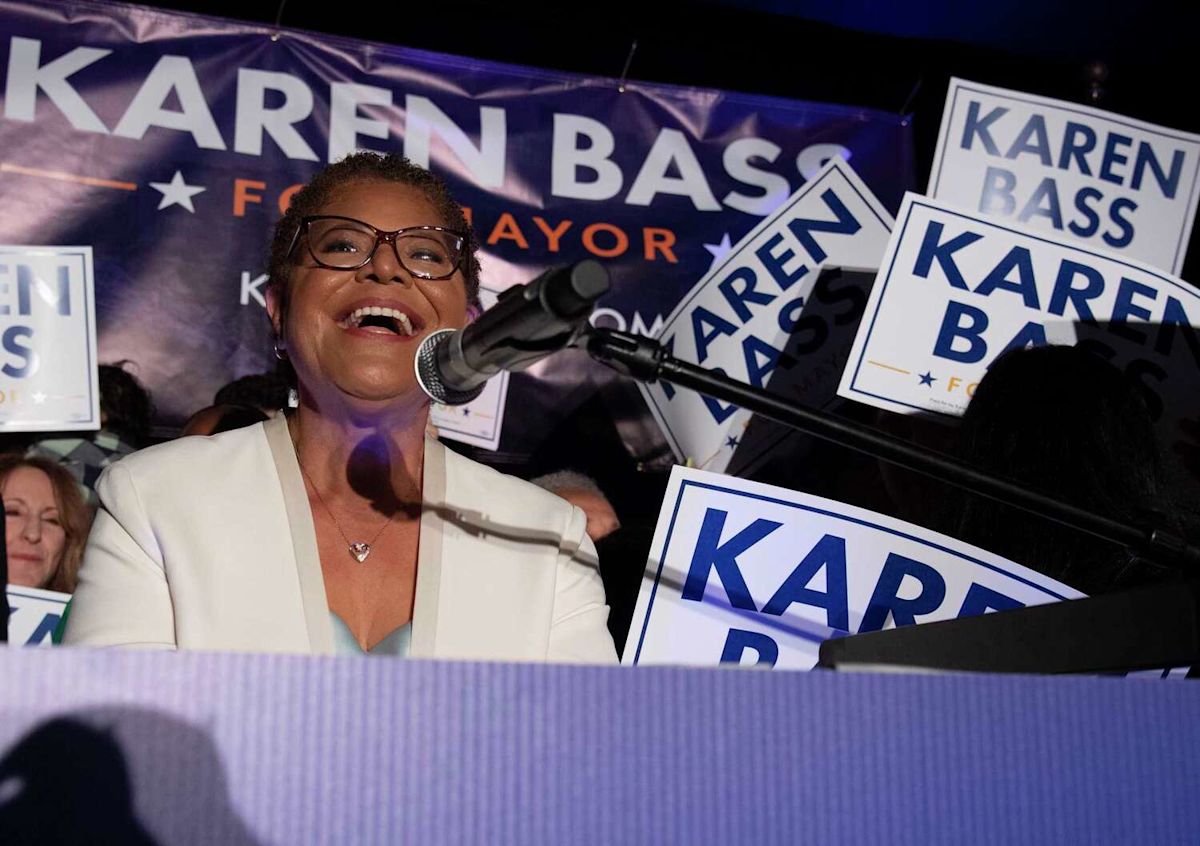
A viral poll that tricked both a national newspaper and Los Angeles Mayor Karen Bass but was later proved to be fake has also led to questions about whether it was created to influence election prediction markets.
At least three “polls” were published last Thursday by a group called Median Strategies and circulated around California, Nevada and Wisconsin. The California poll claimed that Los Angeles Mayor Karen Bass was 12 points ahead of opponent Nithya Raman.
But the entire survey was fabricated.
Representatives for Median Strategies told the LA Times on Monday that the entire project was a “social experiment.” The group took down its website and posted a statement late Monday warning that its data “should not be cited or treated as genuine polling data.”
Two political polling experts told SFGATE that the fake poll could have been an attempt to sway betting markets, which allow people to gamble on political races.
Christian Grose, a political scientist at USC who also conducts independent polling, told SFGATE in a phone call that he felt certain there was a motive to influence the betting markets, though he admitted he has no proof and that it’s only speculation.
Paul Mitchell, a political data expert, similarly raised theories about whether political betting was the motive behind the fake polling. In an X post, he called the findings “unbelievable” and wrote that it “seemed like it was an attempt to influence” Kalshi pricing.
Mitchell said in a call with SFGATE that he can’t prove why the fake poll was released but said he thinks “somebody is playing around with strategies to try to influence markets and betting markets in order to spike a market and have an impact.”
Jack Such, a spokesperson for Kalshi, the popular sports betting company, said even if the fake poll had been designed to influence betting markets, the move was ultimately unsuccessful because the market “did not move” upon its release.
Median Strategies, the group behind the fake polls, said in a statement posted to its website this week that the polls were not designed to influence betting markets and that no one associated with the group had placed bets related to them.
“Median Strategies was created as a short-term social experiment examining how purported polling information could enter and spread through the political information ecosystem without independent verification,” the statement said.
The fake California survey did have an immediate effect on the news cycle. The California Post wrote a story about the poll saying Bass “has opened up a double-digit lead over” Nathya Raman. The Post later updated the story, calling the poll “bogus” without any correction or reference to its earlier coverage. The Post did not return SFGATE’s request for comment.
Bass’s campaign also fell for the poll, posting on X that the poll showed her campaign was “gaining momentum.” The post has since been taken down, and Alex Stack, a representative for Bass’s campaign, called the fake poll a “bad faith” attempt to influence elections and that the fake pollsters should be prosecuted. Raman criticized Bass for promoting unverified polling data.
Right now, according to Kalshi, the market places Bass at a 64% chance of winning and Raman at a 36% chance. People can place their bets on each candidate and turn a profit if their chosen candidate wins.
Such, the Kalshi spokesperson, said that Kalshi has a strict policy against market manipulation and that creating a fake poll to manipulate the market price is a federal crime. He added that Kalshi works “aggressively” with its regulator, the Commodity Futures Trading Commission, and that it punishes bad activity on the platform.
Political betting markets have risen in popularity and have been thought to sway voter opinion in the same way that polls can. More than $40 million was bet on the Los Angeles mayor’s race market ahead of the June primary. But the accuracy of online markets has been brought into question. Former gubernatorial candidate Tom Steyer was briefly leading in the online markets before later falling behind. He ended up placing third place in the primary.
Mitchell, the data expert, said the fake poll serves as a lesson for the media.
“It did show what can happen when people blindly believe a poll that somebody’s posting without understanding who it is, the methodology, or understanding the source of the poll,” Mitchell said.
More Politics
– A resident-run PAC is causing an identity crisis for a Bay Area town
– He was the CEO of Truth Social. Now he runs a Pismo Beach wine bar.
– Becerra’s new ‘power hour’ idea would give Californians free electricity
– Mining claims appeared less than a day after Trump shrank 2 Utah national monuments
This article originally published at How prediction markets became the center of a fake California poll scandal.