
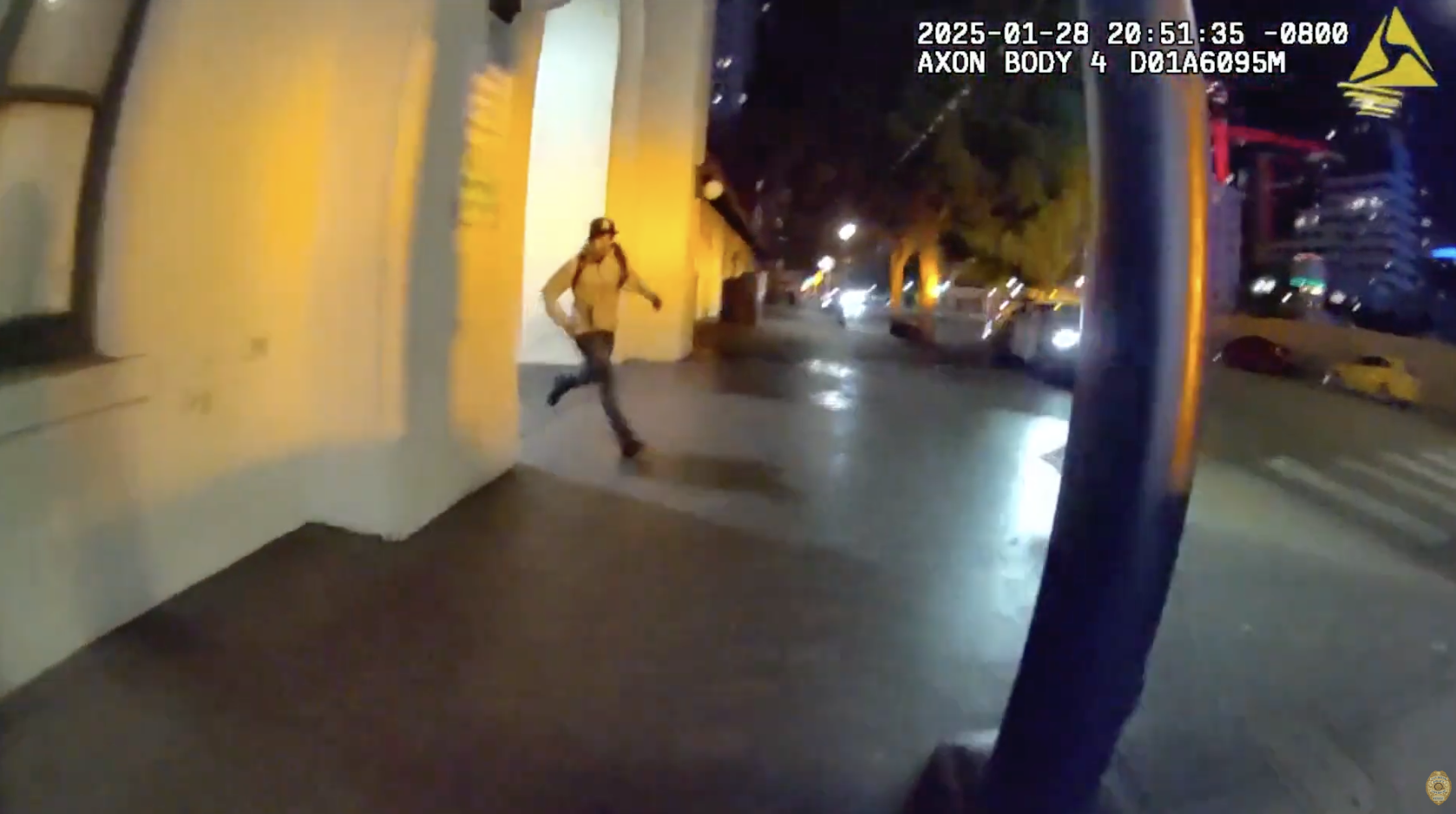
 Screenshot of edited bodycam footage seconds before the fatal shooting of Konoa Wilson.
A government accountability organization is threatening legal action against the city of San Diego, alleging officials have improperly withheld public records related to the 2025 police shooting of a 16-year-old boy that led to a $30 million legal settlement.
In an Aug. 19 letter to San Diego City Attorney Heather Ferbert, the legal director for the First Amendment Coalition David Loy said the city has failed to comply with California laws requiring police departments and cities to release any videos and recordings from critical police incidents such as shootings.
Failing to produce the records, said Loy, not only keeps information from the public but opens the city up to additional litigation.
“I write to ask that the city disclose the requested records immediately in the hope of avoiding imminent litigation,” stated Loy in his letter to Ferbert.
The letter comes more than a year and a half after San Diego Police Officer Daniel Gold shot and killed Konoa Wilson on Jan. 28, 2025. That night, just before 9 pm, Wilson was involved in a confrontation with another teenager near the train tracks at the Santa Fe Depot near Little Italy. The other teen fired a gunshot, and Wilson ran.
As Wilson exited the tunnel away from the gunfire, Gold, with his gun drawn, was running toward the sound of the gunshot. When Wilson emerged from the tunnel right in front of Gold, the officer fired his weapon, hitting the boy, who collapsed on the street.
The city released body-camera footage of Wilson’s shooting. The content may not be suitable for some readers.
Wilson’s mother and father sued the city in June 2025.
Months later, on Dec. 9, the San Diego City Council settled the lawsuit in a closed-session meeting, agreeing to pay the mother and father $30 million — one of the largest police wrongful death settlements in history.
In May, the First Amendment Coalition submitted a public records request to the city for the unedited police video and other recordings and records related to the shooting, as required by state laws.
Days after submitting the request, Loy says the city responded, saying all records were exempt from release because the investigation was ongoing, and also due to confidentiality exemptions.
The exemptions, states Loy’s letter, violate state transparency laws.
“Now that more than one year from the shooting has elapsed, the city cannot continue delaying disclosure unless it can prove by ‘clear and convincing evidence’ that there is ‘an active criminal or administrative investigation,’” reads the letter.
In a statement to Times of San Diego, Loy says that the public has a right to know and the city has a responsibility to follow state law in making those documents and videos public.
“It doesn’t matter if an investigation is ongoing. There is a timeline that jurisdictions must follow,” says Loy. “The public has a right to the full story, not an edited version of it.”
Loy says the public not only has a right to know the details of the fatal police shooting of a 16-year-old, but the public also has a right to know details about the $30 million settlement and why it was settled in such a speedy manner.
“The people have a right to full transparency anytime police officers use force or shoot and kill someone, and as a social matter, the shooting of a 16-year-old deserves full transparency,” added Loy.
In the First Amendment Coalition’s letter to Ferbert, Loy says San Diego needs to immediately turn over the records or litigation will commence.
“For the foregoing reasons, please ensure that the records requested by (First Amendment Coalition) are disclosed immediately to avoid potential litigation against the city.”
The San Diego City Attorney’s Office declined to comment on the letter.