
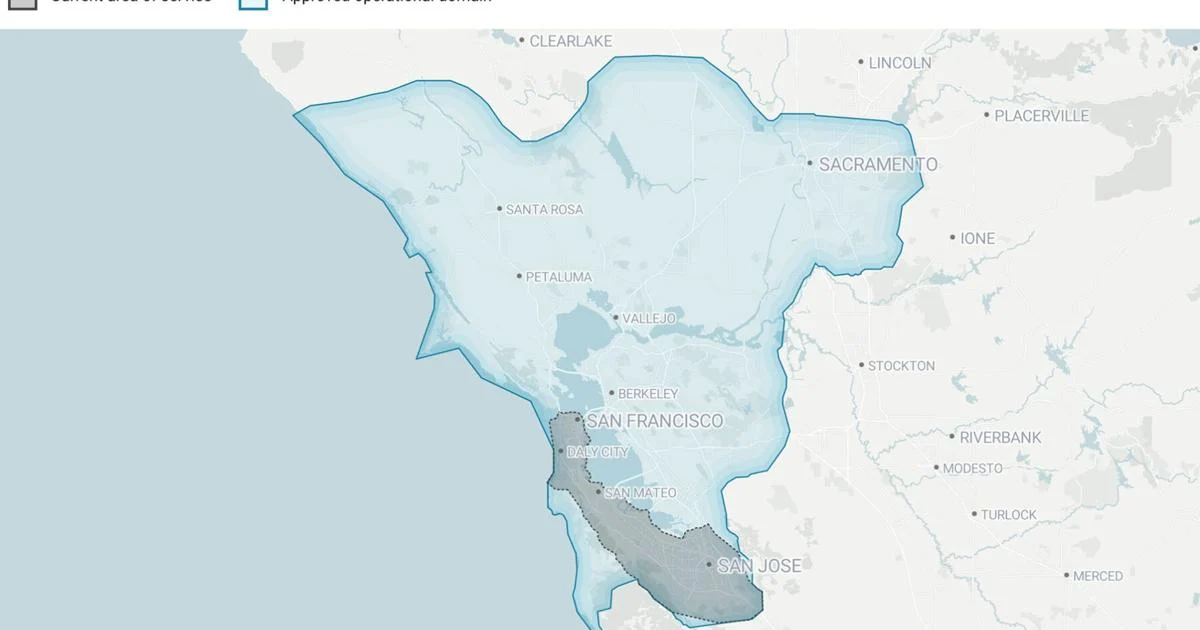
The self-driving taxi company Waymo, after five years of San Francisco rides, can finally cross the Bay Bridge.
On Friday, California approved a Waymo service expansion that includes Berkeley and Oakland, and stretches as far as Sacramento and Napa.
According to a Waymo spokesperson, the rollout will be “gradual” and guided by the company’s safety framework. They did not provide a timeline for the expansion other than clarifying it will not be immediate.
According to the spokesperson, Waymo is prioritizing launching rider-only service in San Diego and validating its technology in Sacramento.
The approval by the California Public Utilities Commission was the last governmental hurdle for the company after the DMV approved driverless testing in November 2025. This means Waymo can immediately begin charging for driverless rides across the larger service area, despite its apparent hesitation to do so.
The approval also allows Waymo to deploy their new model, Ojai, a self-described roomier and more accessible car that launched to the public in San Francisco on Wednesday.
According to Berkeley Director of Public Works Jamie Parks, the city currently has no relationship with Waymo and did not provide input on the decision.
Ren Zaro Fitzgerald, chair of the Berkeley Transportation and Infrastructure Commission and member of transportation activist group Safe Street Rebel, said they were not notified either. They shared some concerns about the autonomous vehicles, including their potential to increase traffic and hinder public transportation or emergency responders.
“If you’re driving a big muscle car and you want to go really fast and you want to break the law, are you going to get into a Waymo because it’s safer? Absolutely not,” Fitzgerald said. “The data backs this up … more than half the time (riders) were taking that (ride-hailing) trip instead of a bus or walking or biking, or another sustainable transportation mode.”
Autonomous vehicles such as Waymos, despite all Waymos being electric, also face questions regarding their impacts on congestion and energy usage, with debate growing around Waymo’s “deadheading,” or driving while no passenger is in the car.
Waymo argues that it accrues about as many empty miles as traditional ride-hailing companies. Waymo also argues that it has an incentive to reduce its empty miles because it has to pay the cost, unlike platforms such as Uber where drivers shoulder it.
A simulation run by UC Berkeley and UC Irvine researchers found that when autonomous vehicles park on the street, it reduces empty miles by nearly 60 percent. Waymo Research Manager Arielle Fleisher claims the company “like cities, wants to reduce empty miles as much as possible.”
UC Berkeley civil and environmental engineering professor Scott Moura claims his research found autonomous vehicles consume more deadheading miles and benefit from doing so.
“Human-driven vehicles acquire no value from floating around without a passenger. Automated vehicles still gain value by basically just collecting data,” Moura said.
Waymo touts its safety standards and accessibility, claiming recent data from more than 220 million autonomous miles demonstrates that the company is involved in an estimated 94% fewer serious injury collisions.
To get approval for expansion, Waymo had to submit a Passenger Safety Plan to the CPUC in order to collect fares, while the DMV approval allowed them to begin testing in the expanded region.
Some groups have raised concerns about the impact of autonomous vehicles on the labor market.
“Waymo’s recent announcement to expand services to new cities across the Bay Area comes at a time when workers across unions are united to ensure policies in Sacramento prioritize workers over robots,” said Teamsters California co-chair Peter Finn in an email. “We must continue demanding guardrails and accountability from AV companies while they roam free on our streets, threatening public safety and good jobs.”
While Waymo is the first autonomous taxi in the East Bay, it is far from the only growing service. Tesla is preparing to launch the Cybercab as soon as this month, and Amazon-backed Zoox is currently rolling out in San Francisco.