
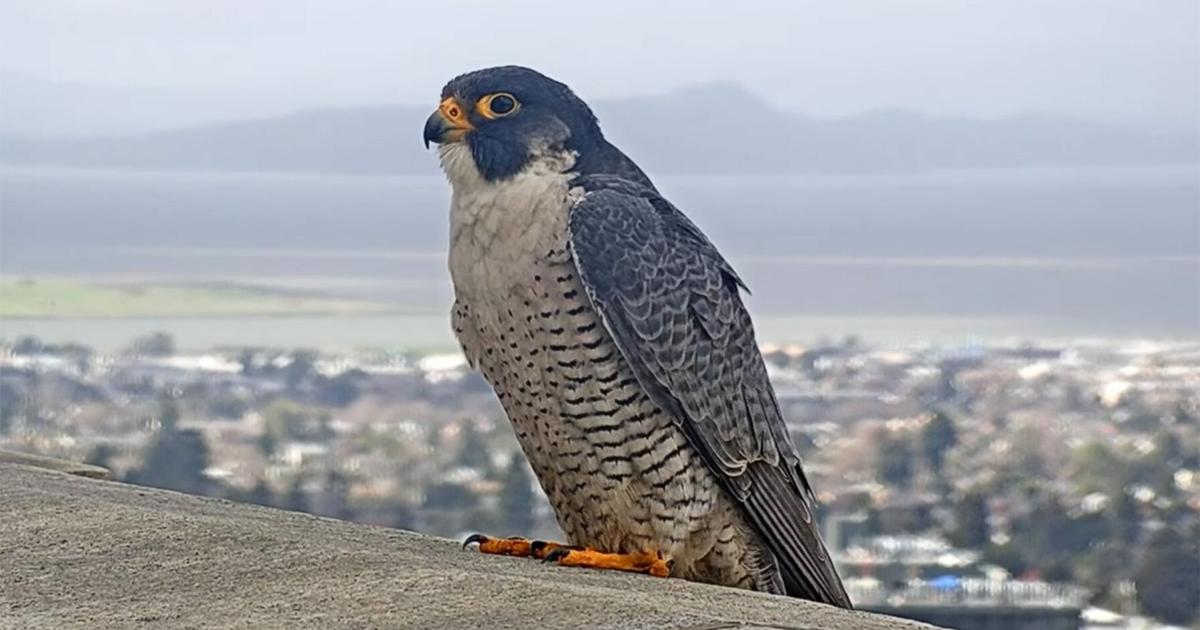
The cameras diligently watching over the peregrine falcons nested on top of UC Berkeley’s Campanile broke three months ago. Now, Cal Falcons, the scientists and volunteers responsible for the 24-hour livestream, hope to see them return despite ongoing complications with a bird flu.
A study published this month in the Journal of Raptor Research, whose authors include Cal Falcons scientists Doug Bell and Mary Malec, highlights the declining nesting of peregrine falcons in the Bay Area and might give context to this absence.
The study says a rapid decline in Bay Area peregrine falcon nesting was synchronous with an outbreak of highly pathogenic avian influenza, which started in July 2022. According to the study, while 47 peregrine falcon breeding territories showed nearly complete occupancy before the outbreak, only 36.2% of territories were occupied by 2025.
“With very rigorous monitoring over this period of time, a decline was pretty easy to show,” Malec said. “There’s some direct evidence that bird flu is affecting this population and a lot of indirect evidence by the decline in nesting.”
The last time birds successfully nested at the Campanile was in 2024 by beloved falcon couple Annie and Archie, who both likely died of bird flu. According to Malec, 2025 saw only 11 successful nesting sites out of 47 that were being closely monitored.
Bell called the peregrine falcon’s decline a “serious situation.” According to him, peregrine falcons once made a comeback as a species after facing endangerment due to the effects of pesticides in the mid 20th century.
Then, in the winter of 2022 and 2023, the H5N1 variant hit the Bay Area and began spreading and intensifying the following winters.
“The winter of 2024 to 2025 was the worst year as far as members of birds across the board dying from HPAI,” Bell said.
Despite the decline in nesting, Malec says that there is still some hope for peregrine falcons.
“The good thing is that where there is a pair, they are as successful as they have been in the past,” Malec said. “So if they exist, they’re bringing chicks to fledgling just about as well as they did.”
Additionally, Malec pointed towards an increase in floaters, which are non-breeding single birds, saying that she’s observed more floaters this year than the past two years combined.
The northeast corner camera went down during this time last year and the main nest cam went out three months ago. The northeast corner camera is broken, and while the main camera does work, its firmware is out of date and cannot connect to the livestream. Malec said that Cal Falcons are waiting for maintenance to replace and fix the cameras.
While Cal Falcons fans might not be able to view the nest on the livestream, Malec said there are not any falcons anyways, as it is not nesting season.
“People who live locally or work locally on campus do check regularly to see if there are any peregrines around, and so far there aren’t any,” Malec said.