
Chronic absenteeism, when a student misses more than 10% of school in an academic year, can diminish a student’s future academic prospects. And in Oakland, nearly one in three students was chronically absent during the last school year.
Research shows that students who are chronically absent in younger grades may develop weaker literacy skills, and missing a lot of school in upper grades can lead to lower graduation rates, prompting school leaders to make reducing chronic absenteeism a priority. Lower attendance rates also decrease the amount of funding a school district receives.
Oakland public schools’ chronic absenteeism numbers haven’t fully recovered from the pandemic, when attendance plummeted, and are notably higher than county and state averages. In the 2018-2019 school year, just before COVID-19 hit, the chronic absenteeism rate in Oakland public schools was around 29%, according to state data. That includes the 10% of students who were severely chronically absent, missing 20% or more of classes. Six years later, during the 2024-2025 school year, the rate was 32%, or nearly 1 in 3 students. Across Alameda County, the average rate was 18% and in California, 20%.
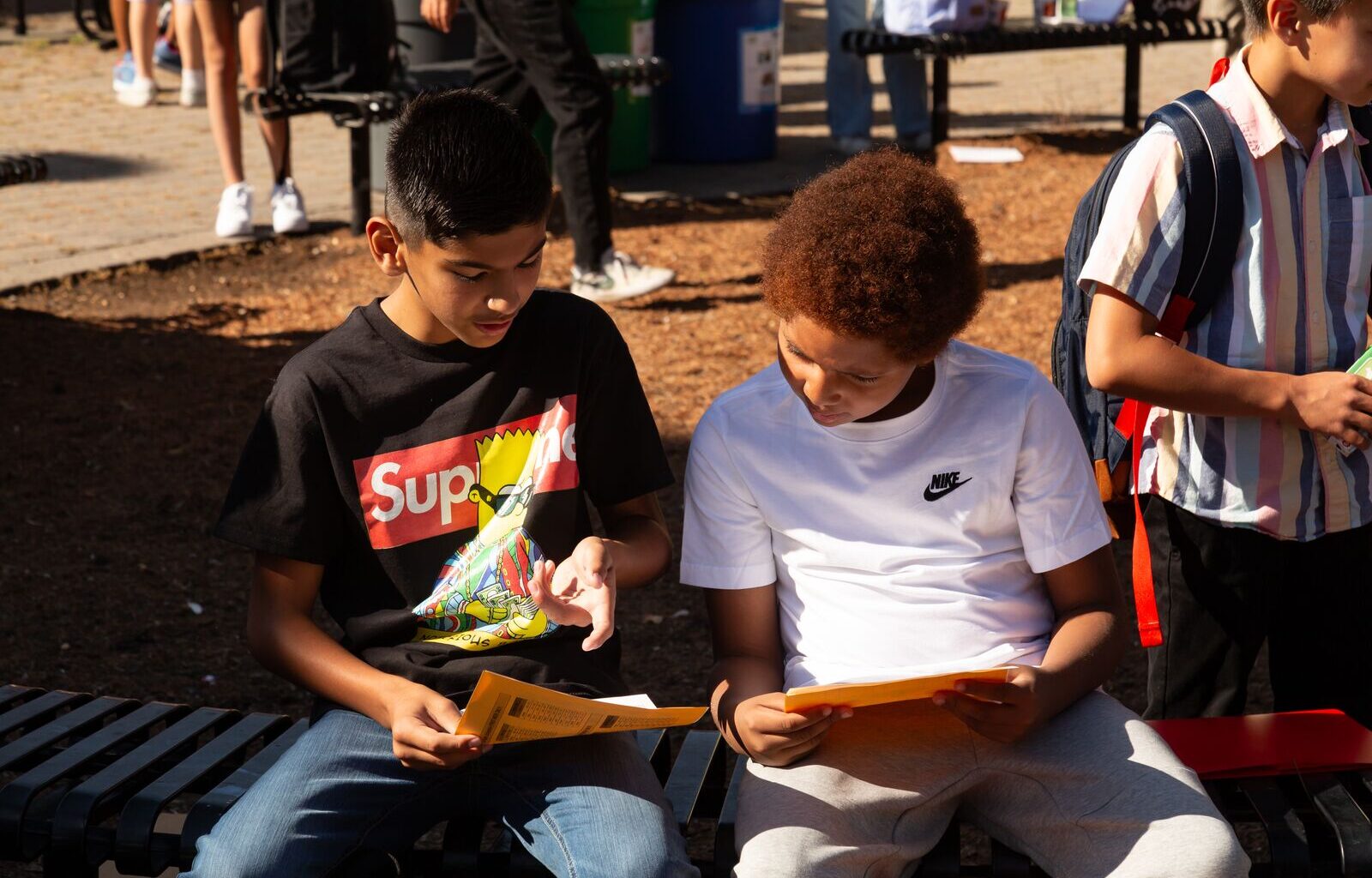
A novel partnership is trying to reverse those trends. Boosted by a $1 million investment from the Greenlight Fund, a philanthropic organization, the Center for Supportive Schools, is introducing a peer mentoring model in seven Oakland schools, training students to act as mentors to younger students and soften the transitions into elementary, middle, and high school.
“They’re creating these safe, supportive, small group spaces so students can feel a sense of engagement, belonging, and caring, and that is how it’s directly related to improving attendance,” said Sherry Barr, the chief program impact officer for the Center for Supportive Schools, a Princeton, N.J.-based nonprofit that focuses on improving school engagement and academic outcomes. “They want to be at school. They want to see their peer leader. They want to succeed.”
The Greenlight Fund works with local community leaders in U.S. cities to identify needs and then funds organizations to tackle those problems. Last year, for example, the Greenlight Fund supported Oakland’s Department of Violence Prevention to work with the Urban Peace Institute, a national organization, to create a violence prevention academy to train violence interrupters.
Kate Schwass, the director of Greenlight Bay Area, said the foundation spoke with community members and school and city leaders in Oakland before deciding to focus on chronic absenteeism.
“Oakland had made some strides around chronic absenteeism prior to COVID, but those numbers have taken a turn and haven’t recovered,” Schwass told The Oaklandside.
How peer mentoring works
Last school year, the Center for Supportive Schools introduced the peer mentorship program at Latitude High School, a small school in Fruitvale, and Learning Without Limits Elementary School nearby, which are both part of Education for Change Public Schools, a charter school network. This year, five more schools will be added as part of the expansion funded by Greenlight: Oakland School for the Arts, Achieve Academy, and Ascend TK-8, all charter schools, and OUSD’s United for Success Academy and Coliseum College Prep Academy. Through a federal grant, Center for Supportive Schools is also partnering with another charter school, the Downtown Oakland Science Academy, previously known as the Envision Academy for Arts and Technology.
At each school, fifth graders, eighth graders, and high school seniors can apply to become peer mentors. During the school day, the mentors take a class on leadership and facilitation to help them learn to be role models, Barr said. Once a week, the mentors meet in pairs with a small group of younger students. Fifth graders meet with first graders, eighth graders with sixth graders, and seniors with ninth graders. They talk about goal-setting and decision making with the goal of helping the younger students transition smoothly into their new school environment.
Over the next four years of the partnership, the Center for Community Schools plans to train more than 1,100 peer leaders who will support more than 6,100 students. A 2018 evaluation of the peer mentoring model at schools in New York City, Baltimore, and North Carolina showed that students who received mentorship attended school an average of six more days per school year than students who did not participate. Evaluations for the program in Oakland are still underway.
“It really pairs relationship building and social and emotional learning skills so that the younger students can be successful and they can navigate that transitional year,” Barr said.
Education for Change, with six schools in Oakland spanning elementary to high school, was the first network in Oakland to offer to pilot the peer mentoring model. The model aligns with the charter network’s priority of promoting student belonging, Superintendent Larissa Adam said. She said it’s a bonus that the program also develops student leaders.
“There are a lot of really great and important moves that all of our adults make every day to support students and make sure they feel safe and connected, but ultimately we need students to be doing the same for each other,” Adam told The Oaklandside. “It teaches students the skills to be peer mentors and build a more positive culture together.
At Learning Without Limits elementary, 15 fifth graders served as peer mentors last year to a class of first graders, Principal Nicki Fox said. She found that program was valuable for fostering relationships between grades, which she said can be more difficult to do in elementary school, where there are fewer programs like sports and extracurriculars that connect students of different grades. The program also empowered older students to feel a sense of care and responsibility toward the younger students, which is one of the school’s values.
This year, Learning Without Limits will expand the program to include all of the school’s first and fifth grade classes, and will have the mentorship groups meet more often.
During the 2024-2025 school year, 32% of the school’s students were chronically absent, a rate that dropped to around 20% last year, Fox said. She attributed the drop to the relationships that staff have built with families, and also the relationships that students have built with each other.
“It helps a lot to feel connected and to feel a sense of purpose to go to school, even if learning might not be at the forefront,” Fox told The Oaklandside. “They have other people or relationships that make them want to go to school.”
“*” indicates required fields