

Patrick O’Connor, EWMBA 28, spent his first 11 years in Ireland before he moved to Australia, where he lived until he was 23.
An interest in pure innovation and a desire to push the boundaries of what technology can do brought him to work on the AWS specialist prototyping team.
He chose Berkeley for an MBA because of its unmatched tech ecosystem and its proximity to everything happening in AI in San Francisco.
Patrick O’Connor, EWMBA 28, a senior WorldWide AI prototyping engineer at Amazon Web Services, has worked on some of the company’s most ambitious worldwide AI projects. In this first-person perspective, he traces his path from Australia to AWS—and how the connections he’s making at UC Berkeley Haas are pushing his career into new territory.

“I grew up between two worlds. My parents are Irish and Chilean, and I spent my first 11 years in Ireland before we moved to Australia, where I lived until I was 23. Technology found me early, through my father. He worked for years with radio-frequency identification (RFID), applying it to everything from using wireless tags to manage and check out library books to medical use cases like tracking bags of blood.
I started programming young, and Monash University became the scaling factor: I did a double degree in commerce, majoring in accounting, and computer science, majoring in advanced computer science, at one of the largest and most prestigious engineering schools in Australia.
In my final year, as COVID spread across the globe, I landed an industry-based learning placement at the National Australia Bank. As the world closed down and Australia entered some strict restrictions, demand for engineers exploded—and suddenly I had exceptional opportunities to learn and to lead.
It was at the bank that I first encountered AWS. My manager asked me to ‘ssh onto an EC2,’ and I was completely confused, not just by the lingo, but by what any of it had to do with Amazon, which I’d always thought of as an e-commerce site.
That moment kicked off a flywheel of discovery. I learned that AWS is the pipework of the internet, and I soaked up everything I could. I built and failed, built and failed, with each failure teaching me a little more about what can and can’t be done. My curiosity didn’t go unnoticed. It led to a job at Amazon with the AWS professional services team in Australia, where I worked across industries but concentrated on mining with some of the global leaders in mining operations.
Joining AWS’s Prototyping Team
It was my interest in pure innovation and a desire to push the boundaries of what technology can do that brought me to the specialist prototyping team.
When people hear ‘prototyping,’ they usually picture a quick demo or something to show short-term value and get a conversation rolling. What we do is different. Prototyping is about running experiments with customers to prove out the art of the possible: taking the latest developments in technology, combining them with emerging tech and research, and pointing all of it at a genuine business challenge.
It sits between a proof of concept and a pilot—real enough to prove the idea works, early enough that failure is still an acceptable answer. And it’s intense. In the span of four to six weeks, a prototyping engineer wears every hat there is: builder, coder, consultant, evaluator, all in the hope of pushing the boundaries of technology far enough to unblock an entire industry, not just a single customer.
That mandate has taken me to some unlikely places.
With HERE Technologies, the global leader in mapping, we took on one of the most tedious jobs in autonomous driving. Before a self-driving system can be trusted, it has to be tested against real-world road scenarios, and engineers were manually hunting through map data to find them. We built a tool that lets them describe what they need in plain English—a highway off-ramp at a particular incline, a complex intersection—and get back a simulation-ready scene. HERE launched it as a product called SceneXtract, and it draws on the same mapping data behind systems like Mercedes-Benz’s Drive Pilot. That’s the outcome you hope for: The prototype doesn’t stay a prototype.
With Metagenomi, a gene-editing company, the problem was pure scale. Somewhere among the billions of proteins encoded across the tree of life are enzymes that could become the next CRISPR. But finding them means searching a database of 3.5 billion candidates. We turned that into something closer to a search engine: Instead of scanning sequence by sequence, their scientists can now find the closest matches to a promising protein in seconds, for a fraction of a cent per query. It’s already helped them discover novel enzyme families they hadn’t been able to reach before.
Why an MBA, Why Now?
I decided to get an MBA for two reasons. The first is ambition. I have a long-term vision of becoming a technical leader in an organization, or one day as a founder. The MBA equips me for that: It complements my engineering skillset, challenges me on things I don’t typically encounter in my line of work, and surrounds me with exceptional people I learn from constantly, all while growing alongside a job I love. The second reason is simpler. I have the time. This is the season of my life where I can pour myself into something this intensive, and there will never be a better moment to invest in it.
I chose Berkeley because the depth of its ecosystem is unmatched, as is its proximity to San Francisco and everything happening there in AI.
Working in tech, you move at a relentless pace. There’s always a next build, a next release. What Haas has given me is professors who stretch your horizon beyond that rhythm: world-class experts in their fields who take the time to challenge you and set you up for success.
In Abhishek Nagaraj’s AI for Business Leaders, we examine how leaders should operate in a rapidly changing AI world—drawing on the paradigms of earlier general-purpose technologies, like how the chip revolutionized computing, and applying those lessons to navigate the moment we’re in now. And over the summer, I took Frontier Ventures: Space, Air, Marine, Arctic with Olaf Groth and Adair Morse—a class that pushes you to think about entirely new economic frontiers.
Learning to Build Bigger
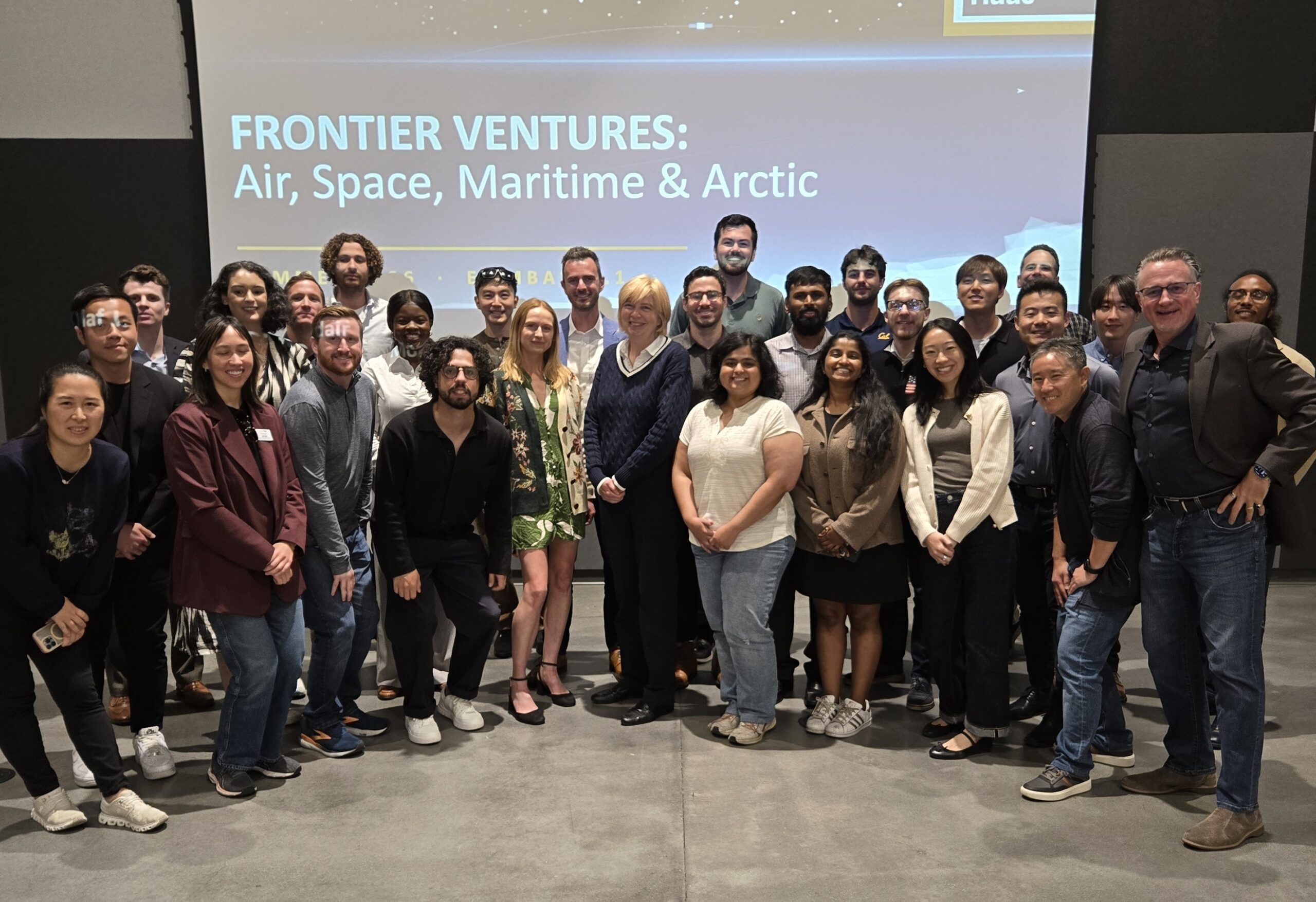 O’Connor (back row, middle) with classmates in the Frontier Ventures course.
It was through Frontier Ventures that Professors Groth and Morse connected me with Justin Wiley, who oversees a $25 million research portfolio at UC Berkeley’s Institute of Transportation Studies. Justin organized a visit to the Richmond Field Station.
We toured the facility, met early-stage startups working on physical AI, energy, and transportation, and heard from Berkeley researchers, including Professor Alexandre Bayen, who is working on coordinating safe landings for a future filled with eVTOL aircraft: vehicles that take off and land vertically like helicopters, but promise greener, quieter urban flight. These are precisely the kinds of problems I gravitate toward—novel, hard, and blocking an entire industry—and I’m now exploring how the work I do in prototyping could connect with initiatives like the Field Station.
The longer I’m at Haas, the more I realize the business of strategy, storytelling, the long arc of a decision is its own kind of engineering, and I had only a primitive grasp of it before. That’s what’s really changing me here. It’s pulling me out of pure engineering mode and saying: ‘Patrick, focus on the big picture.’ I came here to learn how to build bigger things. It’s teaching me to build them further into the future.”