
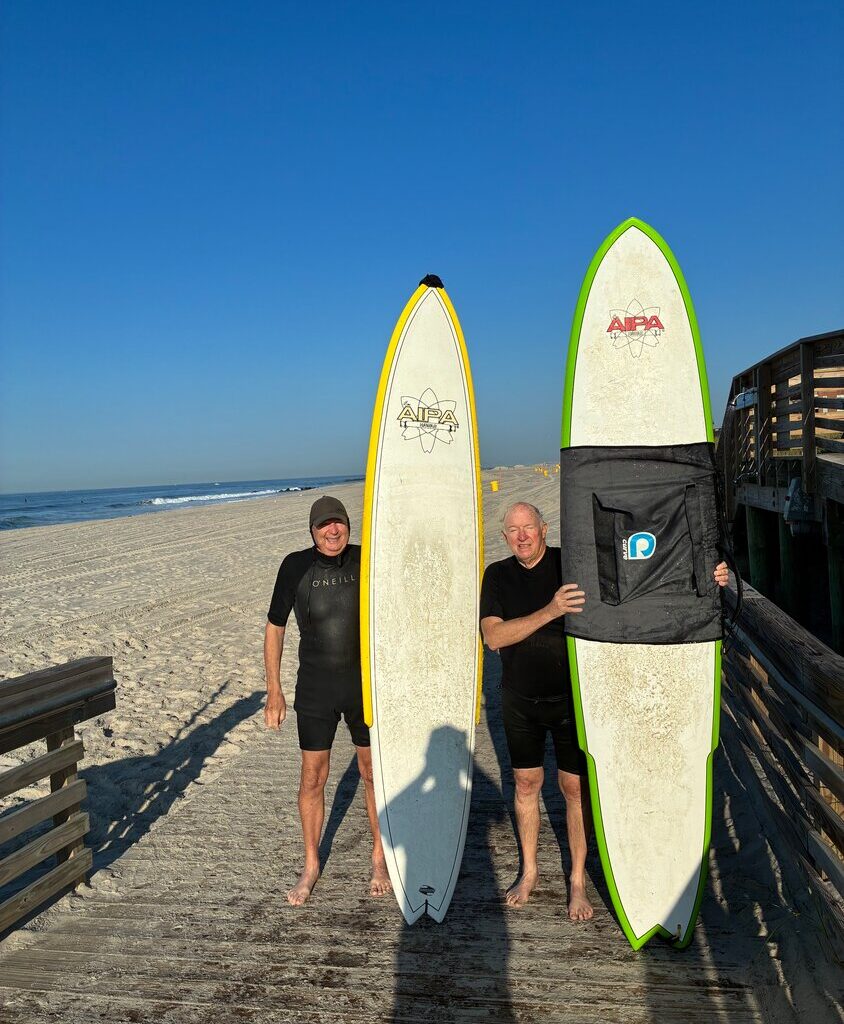
Few Long Beach residents have as unique a life story as Dennis Carey. His family began frequenting the city in 1921, and three of them still occupy the house on Wisconsin Street in which Dennis’s late mother, Geraldine McCarthy Carey, grew up.
Dennis, 78, and his siblings — Geraldine, 82, Bill, 77, Virginia, 72 and twins Tom and Irene, 68 — were self-described “water rats.” They learned how to swim in Reynolds Channel, and swam across it to Hicks Beach, in Lawrence. “There were no bulkheads on Minnesota and Tennessee at the bay,” Dennis recalled. “That was a rite of [passage] for kids, and my mother said the same things — she and her siblings all swam over to the other side.”
Carey joined the Long Beach Lifeguard Patrol in 1966, and said his seven years of lifeguarding were like a “summer fraternity” of watching the beach and having fun. During that time, he said, guards frequently saved swimmers who were pulled out past the jetties by rip currents, but no one ever drowned while they were on duty.
After hours, Carey and his friends Jack Murphy and Randy Dodd hung out at Leone’s, on Park Avenue, property now occupied by Starbucks. They also frequented the original Beachhouse, on Virginia Avenue.
In Carey’s rookie year, a cabin cruiser capsized near the rocks off the Maryland Avenue Beach. A half-dozen people were thrown into the water, he recounted, and one was trapped inside on the boat’s lower level.
“I got down there and I saw that all the lifeguards left Georgia Beach,” Carey said. “I wanted to make sure that all the people stayed out of the water and no other tragedy was going to happen. I think there was a child or two on the boat, so it was a real life-threatening situation.”
For seven years, Carey worked up and down the beach. In the East End, near Pacific Boulevard, he said, he pulled an unconscious man who had epilepsy from the water, and revived him with mouth-to-mouth resuscitation.
Mike DeLury, who is now the president of the Long Beach Lifeguard Alumni Association, worked with Tom Carey on the lifeguard patrol.
“Dennis’s wealth of Long Beach knowledge and the Long Beach patrol is vast,” DeLury said. “Long Beach was a different place back in the 1960s.”
In 1976, after Dennis completed a pediatric residency at Long Island Jewish Medical Center, in Queens, he applied for fellowships in pediatric endocrinology in California.
“I was willing to go anywhere,” he said. “San Francisco, L.A. I fell in love with San Diego. I just kept waiting until they were willing to pay me $10,000, and I was willing to take it.”
In July 1977, Carey began a fellowship at UC San Diego, after traveling across the country with his wife, Barbara. A year earlier, they had been in New York Harbor for Operation Sail, which celebrated the United States’ Bicentennial. They had attended the Montreal Olympics, visited national parks in the Pacific Northwest and Canada, and spent time in Hawaii. Encouraged by family members and friends, Carey ultimately turned the five-month-long, 20,000-mile journey into a book called “The Creamsicle Express: Off to See America,” which was published earlier this year.
“I kept a journal, and I always thought maybe I would write it up,” Carey said. “I have almost 1,000 photographs from that time. They brought back the memories and the beauty of the country.”
Carey worked as a pediatric endocrinologist at the University of Connecticut from 1980 to 1992 before spending almost three decades at Cohen Children’s Medical Center in Queens. He retired in 2021.
Recently, he rekindled his love of surfing. He had bought his first surfboard in 1964, when he was 17, for $80.
“I wish I started surfing when I was 10,” he said. “I could never imagine that I would have been surfing as an adult. My father used to always say to me, ‘When are you going to grow up?’”
Carey has also continued writing. He authored a historical novel, “The Silver Strand: The Long Beach Saga,” which depicts life in Long Beach from as far back as 1837, and was published by Yerac Press. It includes an account from resident Randy Dodd, who was one of many Long Beach surfers who learned from Hawaiians who were staying at what was then the Colonial Apartments, on Shore Road.
“They were performing at Jones Beach theater in 1961,” Dodd recounted. “They would come out and show us how to surf. We used to just take the board and ride in the whitewater. And they were the ones who showed us how to angle in the waves.”
These days, Carey, who has three adult children and also has a house in Huntington, enjoys spending time with his twin grandchildren, 2-year-olds Phoebe and Owen Carey. He and their father, his youngest son, Patrick, 36, recently took the toddlers into the ocean on boogie boards to get them ready to be surfers in the future.
And perhaps the next generation of Long Beach lifeguards?