
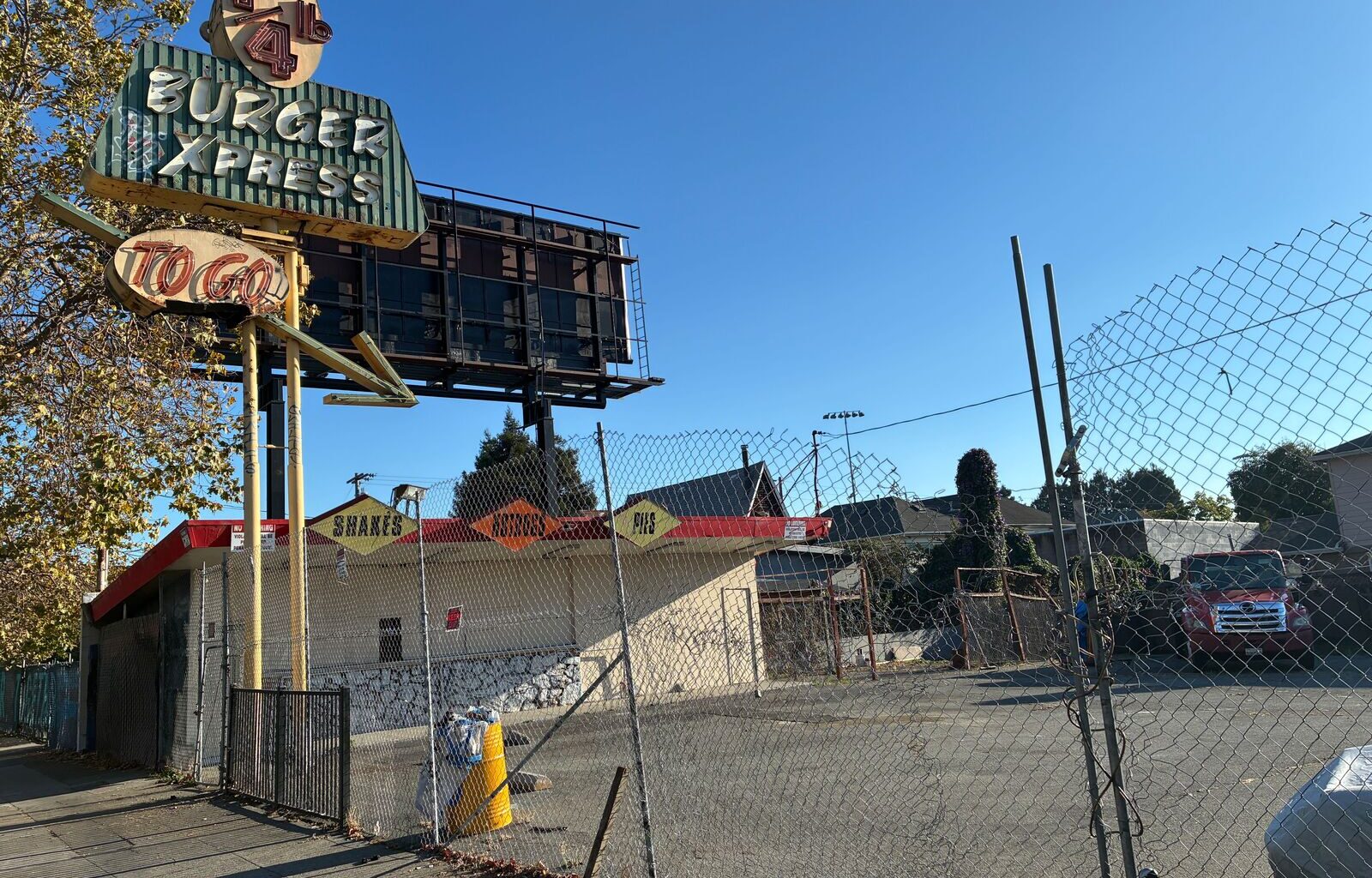
Forty randomly selected Oakland residents will convene for the first time this weekend to discuss how to transform the city’s many vacant retail spaces.
It’s Oakland’s first “civic assembly,” a group of people selected by lottery and compensated for their time to help solve some of the city’s thorniest issues. Members, known as delegates, will spend three weekends together between now and October to deliberate on how to revitalize empty storefronts and private lots and create a report with recommendations for local leaders.
Oakland has roughly 3,500 vacant commercial spaces and lots, and organizers are inviting the public to add any vacant lots, storefronts, or industrial spaces that concern them to a crowdsourced mapping tool on the project’s website.
Angela Glover Blackwell, founder of PolicyLink, a think tank focused on improving democracy, and a professor at UC Berkeley’s Goldman School of Public Policy, came up with the project after being inspired by other civic assemblies around the country. The process is being led by a community steering council made up of a dozen Oakland civic organizations including the Black Organizing Project, the Oakland Metropolitan Chamber of Commerce, and the Unity Council. While the city of Oakland is not involved in the process, Mayor Barbara Lee has expressed her support.
“This civic assembly is an exciting opportunity for Oaklanders to shape the future of our own neighborhoods and show the world that democracy is flourishing right here,” Lee said in a press release this week.
Glover Blackwell told The Oaklandside she hopes the project will not only enhance residents’ understanding of the civic process, but also result in visible improvements in Oakland neighborhoods.
“I’m hoping that a few years from now, a young person, an elderly person, or an artist will be able to enjoy a space that would otherwise be lying there vacant,” she said.
The luxury of time for debate
Greg Hodge, CEO of the Brotherhood of Elders Network, who chairs the steering council, said the assembly’s meetings are intentionally structured to provide time and space for more robust discussions. As a former Oakland Unified School District board member, Hodge said he’s seen how many public meetings don’t give community members enough time to share their perspectives on complex issues.
“Often you get three minutes in a public setting to address a body of your representatives, and it’s not uncommon that they’re the same members of the public who show up all the time,” he said. “A civic assembly offers a different approach.”
At the end of deliberations, any idea must win the support of a supermajority of at least 75% to become an official recommendation of the assembly.
Project organizers say the delegates were selected to reflect the city’s demographics. According to data obtained by The Oaklandside, of those expected on Day 1 of the assembly, the largest geographic representation is from deep East Oakland (12 delegates) and central East Oakland (12). Roughly half of the delegates own their home, and roughly half are renters; three delegates are either unhoused or live in some institutional setting. The delegates include Latino, Black, white, Asian, Indigenous, and mixed-race representation.
Participants will each be paid $1,350 for their time. Project leaders say they’re providing childcare, eldercare, transportation, and other support as needed to encourage participation.
Micah Weinberg, senior strategic adviser at the Goldman School, said project organizers are not releasing the delegates’ names at this time.
“Delegates to these sorts of processes often step into the public eye, but that’s generally later in the process when they feel good about what they’ve put together and are going before the city council and county board of supervisors,” he said.
Organizers are not publicly disclosing the location of the assembly’s deliberations due to safety concerns. Meetings will not be open for public observation.
Funding for the initiative comes from philanthropies including Kaiser Permanente, PolicyLink, and the Democracy Policy Initiative.
A ‘democratic lottery’
Delegates were picked through a process known as a “democratic lottery.” In July, more than 20,000 randomly selected households in Oakland received invitations in the mail to participate in the assembly. Residents who responded and expressed interest were entered into a lottery system. Organizers held a virtual public event where they selected the delegates who would serve on the assembly.
Over the past year, the community steering council has bounced around several ideas for the assembly’s focus.
“Illegal dumping, public safety, and improvements in education were in the mix,” Hodge said.
They ultimately landed on vacant spaces.
Researchers have found that social determinants of health — the conditions surrounding the places where people live and work — play a major role in a community’s physical and mental well-being. One of those determinants is a neighborhood’s built environment, according to the World Health Organization.
“When people see a flourishing physical environment, it makes them think differently, behave differently, and be healthier,” Hodge said. “If we can have more robust retail spaces, then that improves foot traffic, which improves safety, which improves economic opportunities.”
Civic assemblies in other cities have convened in recent years to produce policy recommendations. Petaluma hosted one of the country’s first official civic assemblies in 2022 to determine future plans for a local fairgrounds. A civic assembly in Boulder, Colorado, last year came up with ideas on how to implement 15-minute neighborhoods, an urban design concept in which a person’s daily necessities are all located within a 15-minute walk or bike ride from home.
“*” indicates required fields