
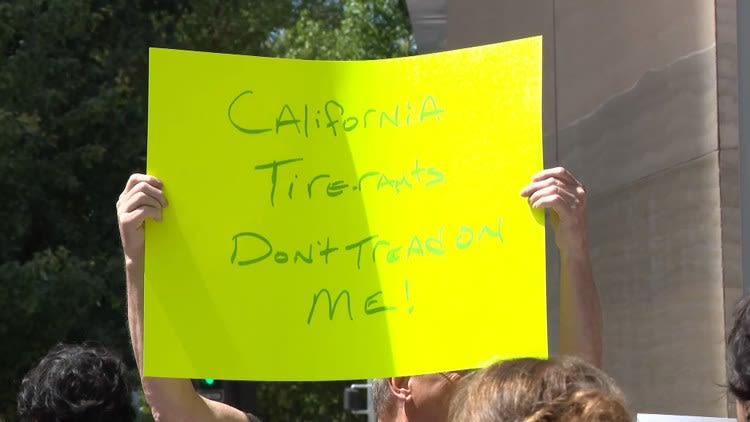
California’s first-in-the-nation replacement tire regulation is continuing to draw strong opposition, including calls for all five California Energy Commission commissioners to resign.
The mandate, approved unanimously by the CEC Monday, will require that starting in 2029, all replacement tires sold for passenger vehicles and light-duty trucks in California must have the same fuel efficiency as the original tires on those vehicles.
Simply put, the tires must be designed to offer the same mileage and range and help drivers save on gas. The CEC has estimated the regulation could help Californians save up to $1 billion in fuel annually, while simultaneously cutting down on carbon emissions (equivalent to taking approximately 400,000 gasoline cars off California roads, they say).
Republican state Sen. Tony Strickland, who is vice chair of the Senate Transportation Committee, is calling on all five commissioners to resign.
“If they had to face the voters in November, they would be thrown out. They’re tone deaf,” Strickland said.
In his letter to the commission, Strickland wrote, “As unelected and unaccountable political appointees, you should not be passing onerous policies that ultimately hit families in their wallets.”
All five commissioners are appointed by the governor. California voters have no input in their appointments.
“There’s no recourse, there’s no representation whatsoever,” Strickland said.
Local tire businesses also warn the regulation could lead to higher prices.
“The technology to build those tires is a lot higher, so it will hurt every consumer,” said Junior Tariq of A-1 Auto Tires and Wheels in Sacramento.
“We will absorb the minimum what we can, but everything will go down to the consumer,” said Eliseo Montero, lead mechanic at Blue Star Tires & Auto Repair in Sacramento.
Some tire manufacturers, including Goodyear, also warn that costs will rise.
“Quite simply, this regulation is not ready for adoption,” said Goodyear spokesperson Bret Gladfelty, speaking in opposition during Monday’s commission meeting.
“The sudden rush to pass this regulation as drafted will hurt consumers, drive up costs, and simply flood the state with used tires,” Gladfelty added.
But the California Energy Commission disputes those concerns. In fact, the media team for the commission on Thursday sent out a fact sheet to reporters, saying they want to “correct the record.”
One question is whether California is banning 70% of its tires.
Galdfelty confirmed to ABC10 that figure is an estimate from Goodyear based on data the California Energy Commission has published. But the commission disagrees with the estimate and notes that existing inventory can still be sold after the mandate takes effect.
We asked a CEC spokesperson if the agency has its own estimate on how many tires could be affected. She said no.
Another concern is whether the regulation limits consumer choice over tires. In a way, yes. But the commission disagrees that the new standard will reduce options, saying the goal is to give Californians a bigger selection of better-performing tires.
Another question is whether the regulation will cost Californians hundreds of dollars.
That is another estimate from Goodyear and other tire companies. The California Energy Commission disagrees, with the spokesperson noting they stand by their estimate that the regulation will cost $6 more for a set of tires in Phase 1 (2029-2033)and $26 more in Phase 2(2033 and beyond).
None of the five California Energy Commission commissioners were available for an interview for this story.
Meanwhile, Gov. Gavin Newsom has said he supports the new regulation, saying the return on investment seems good.
Watch more: California advances new replacement tire rules for 2029