
Oakland University and Automation Alley are joining forces to accelerate the development and adoption of advanced manufacturing technologies, launching a new center designed to put researchers, students and manufacturers under the same roof.
The Advanced Manufacturing Center of Excellence, a collaboration between OU’s engineering and computer science school and Automation Alley, will become the new home of Automation Alley’s Project DIAMOnD center.
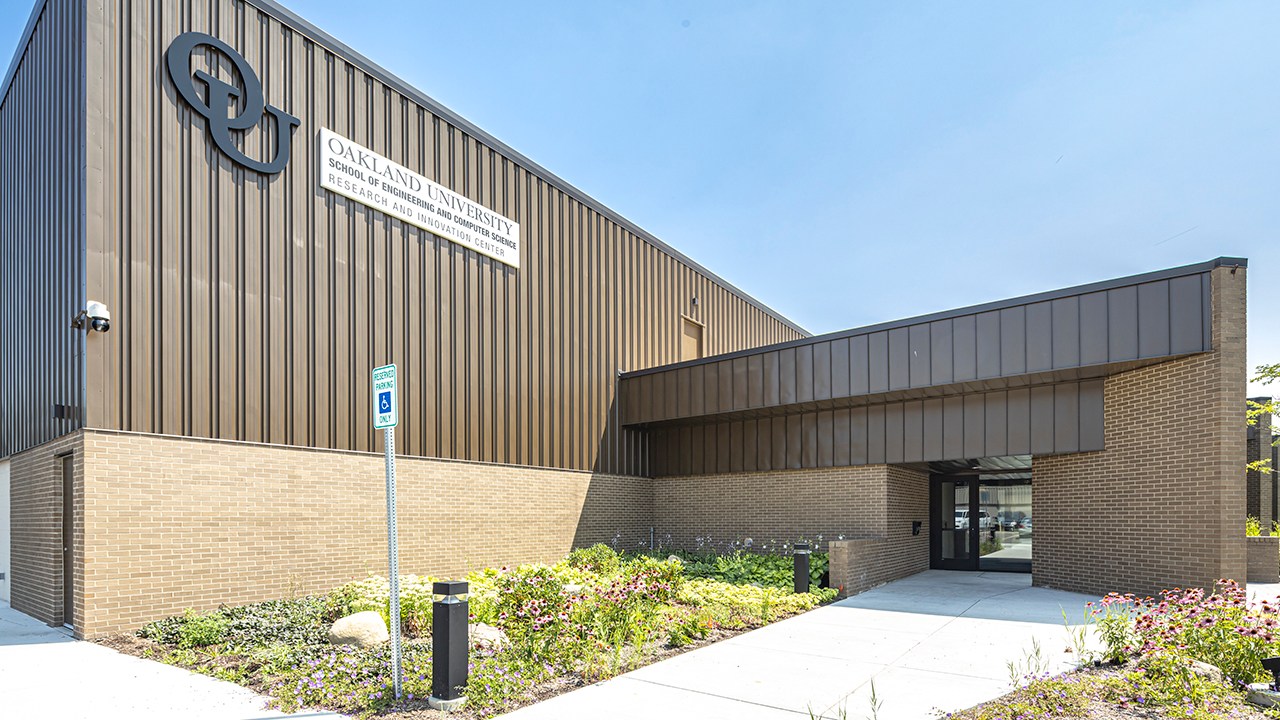
The facility is housed in OUs Research and Innovation Center, a 50,000-square-foot facility in Rochester Hills. The building, purchased by the university in 2022 and occupied since January 2024, sits in an industrial park on Adams Road south of M-59.
The location is intentional: Rather than placing the center on the main campus, the partners chose an industrial setting designed to resemble the kind of workplace where students eventually will apply their skills.
“It is basically an advanced production and research facility that looks like any privately owned, well-funded, well-resourced facility,” said Pavan Muzumdar, CEO of Project DIAMOnD. “This one was like the perfect fit.”
“Partnering our talent with our students and faculty for engineering research with Automation Alley’s network and their Project DIAMOnD network of 3-D printers will really help accelerate and innovate additive manufacturing, which is a technology that needs to be adopted faster than where it currently is, and we’re hoping to play a big part in that,” said Daniel Aloi, director of research for the engineering and computer science school. “I think joining forces is a great step in the right direction.”
The center will give manufacturers access to advanced technologies, technical expertise, training and research capabilities while providing students with hands-on experience tackling real-world manufacturing problems.
“This collaboration gives our faculty and students a place to work shoulder to shoulder with industry on problems that matter,” said Louay Chamra, dean of the enginering and computer science school. “The location, between the campus and the plant floor, is exactly where the next generation of manufacturing talent and research should be developed.”
At the heart of the collaboration is Project DIAMOnD, an acronym for Distributed Independent Agile Manufacturing On Demand, one of the nation’s largest distributed manufacturing networks.
The Automation Alley initiative connects more than 500 manufacturers with more than 475 operational industrial 3-D printers across Michigan. Since its launch, the network has produced more than 50,000 parts, helping manufacturers add manufacturing with printers, strengthen domestic supply chains and build greater production resilience.
The network began as a response to the COVID-19 pandemic, when supply-chain disruptions exposed vulnerabilities in traditional manufacturing. What began as an effort to establish a network of 3-D printers for use by companies without such machinery or resources has evolved into a statewide network capable of supporting on-demand manufacturing.
“This is really just the next step in our evolution,” Muzumdar said.
Automation Alley includes more than 4,000 members, most in Michigan, according to Muzumdar. Project DIAMOnD provides a specialized manufacturing network within that larger organization.
The Digital Transformation Center had operated in a private facility in Auburn Hills. Moving it to the Research and Innovation Center off campus represents a significant expansion for manufacturers, researchers and students to work together.
The center will support more than 3-D printing. The facility already includes laboratories and equipment supporting manufacturing, autonomous vehicles, battery testing and wireless radio-frequency technology.
OU has invested heavily in building those research capabilities. Aloi said the School of Engineering and Computer Science has secured about $8 million in federal funding over the past five years for new research equipment and facilities.
The model is intended to benefit both sides. Students gain experience working on actual industry problems, while manufacturers gain access to university expertise and emerging technologies.
“Most of the students get hired by them as well because they’re working on real-world problems and they’re interfacing with the community,” Aloi said.
The new center also is expected to speed development of ideas in research labsto commercial production.
“Academia is very good at conceiving new technologies, but then having a network like Project DIAMOnD, that helps us commercialize it and scale it,” Muzumdar said.
An example is 3-D printing metal parts and components. The center will work with Project DIAMOnD members to develop technologies that can move from prototypess to commercial-scale production.
Researchers, students and industry partners also will work on so-called Smart Product Recipes — standardized digital manufacturing instructions intended to help manufacturers produce consistent parts for Project DIAMOnD’s members.
“I know as much as people are afraid of technology and AI, what AI’s doing to jobs, but human judgment and human capabilities is going to be the difference,” said Muzumdar. “Automation Alley firmly believes that in the future, the X factor is going to be human, not technology, because technology is revolving down to a commodity.”
The approach could allow a manufacturing process developed in one location to be replicated elsewhere without requiring every facility to develop the process independently.
“This is where research becomes real-world manufacturing capability, allowing us to scale what we’ve proven works,” Muzumdar said.
“This Center is the next chapter of that work,” said David Coulter, Oakland County’s executive. “Bringing Oakland University’s research strength together with Automation Alley’s network under one roof creates new opportunities for our manufacturers, our workforce and the students who will build the next generation of this region’s economy.”
The partners envision the center expanding as new technologies emerge.
Tom Kelly, Automation Alley’s executive director and CEO, said bringing academic and industrial capabilities together can speed innovation across the manufacturing sector.
“Innovation in advanced manufacturing happens fastest when academia and industry stop working in parallel and start working together,” Kelly said. “This Center formalizes that partnership.”