
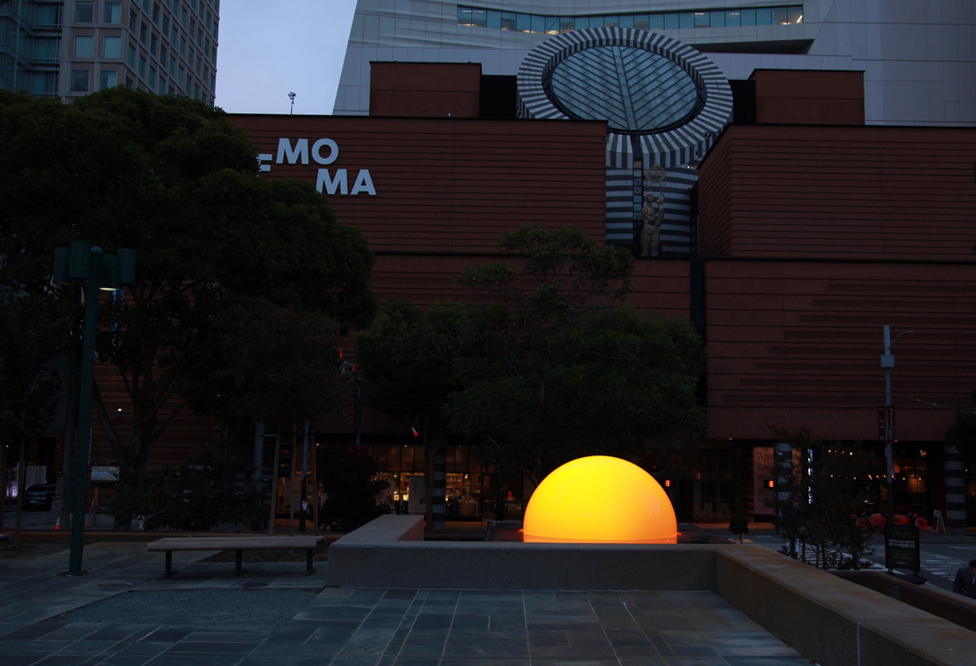
A corner of Yerba Buena Gardens will be illuminated this September by a second sun.
Named for the coordinates of the geographic center of the Philippines, the light installation “13°N, 122°E,” an amber dome floating above a fountain, will brighten and fade in sync with sunrise and sunset in the Philippines. The installation — the city’s first Filipino monument — will be formally unveiled on Sept. 4.
Located in the eastern plaza across from SFMOMA, the installation is a collaborative effort among artists and cultural and neighborhood groups, including SoMa Pilipinas, the art collective “mumu,” the Yerba Buena Gardens Community Benefit District, and the Yerba Buena Gardens Conservancy.
“When this opportunity came to work with SoMa Pilipinas on the sun dome, I mean, it just made sense,” said Seve Ghose, executive director of Yerba Buena Gardens Conservancy. “How do we make up for what happened here 35 years ago?”
The construction of Yerba Buena Gardens in the 1960s and ‘70s displaced thousands of people, many of them Filipino, with no official recognition of their community.
In 2020, SoMa Pilipinas conducted a study, offering ideas for ways to “illuminate” the gardens with a marker of Filipino culture. As mumu said, speaking for the collective, “We really just need to manifest our being and be seen, so that we can’t easily get pushed out again.”
Findings were presented to the Yerba Buena Gardens Conservancy and Yerba Buena Partnership in early 2024, and the idea was officially greenlit. From there, art collective “mumu” — the group behind the piece’s concept and design — began brainstorming different images. They toyed around with the star, another symbol of Filipino culture, before deciding on the sun.
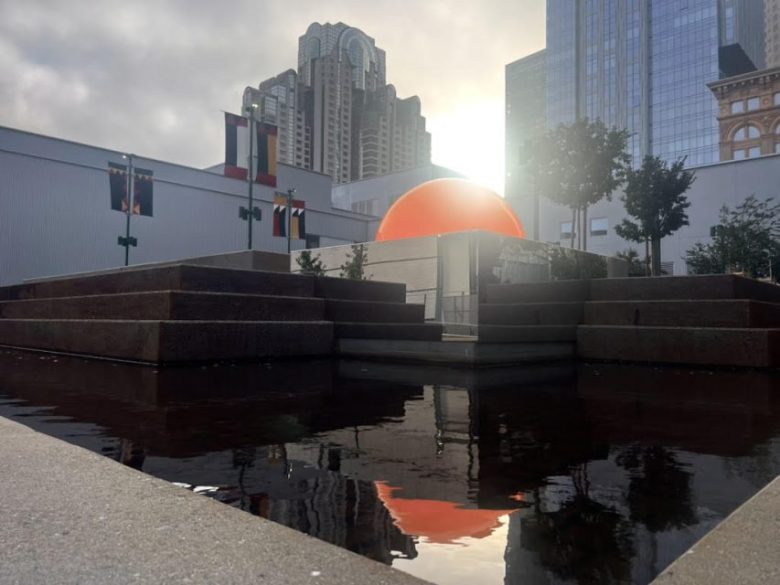 The light installation 13°N, 122°E during sunrise. Photo courtesy of mumu.
“The sun is a star,” said mumu. “We’ve traveled so far, so we wanted it to be a reminder of a sense of home. We are maritime people, an archipelago of over 7,000 islands. When you think about the unifying life force behind the motherland, it’s the sun.”
Deciding on the coordinates for the piece took some figuring out. “When you map out the latitude and longitude of the archipelago, there’s at least twelve hundred options,” mumu said. “So we wanted to make the coordinates at the center, not on any particular island — and for the dome to be floating in water. We wanted to leverage the idea of reflection on the water surface, and that sense of horizon, hope and longing.”
Turning that idea into a durable public sculpture took roughly two years. The glowing dome, designed to withstand San Francisco weather and potential graffiti, was fabricated in Thailand and shipped across the Pacific.
Officially, the installation will be temporary, slated to come down around 2030. “I’ll put the ‘temporary’ in quotes,” Ghose said. “The San Francisco Arts Commission has already set aside funding for a permanent installation,” said Raquel Redondiez, executive director of SoMa Pilipinas. “This light installation is really a reclamation,” she said. “Not only to acknowledge the history and presence of our community, but our resilience and our persistence.”
A mini “sun-veiling” took place at the gardens on Aug. 8, during the Filipino festival Pistahan, allowing community members to see the structure for the first time. A hundred people gathered around the glowing dome, watching it rise.
“To come together in community, serenaded by harana, for the soft launch of 13ºN 122ºE, feels like a return home,” said mumu. “It will always be this bright reminder in San Francisco of where we came from.”