
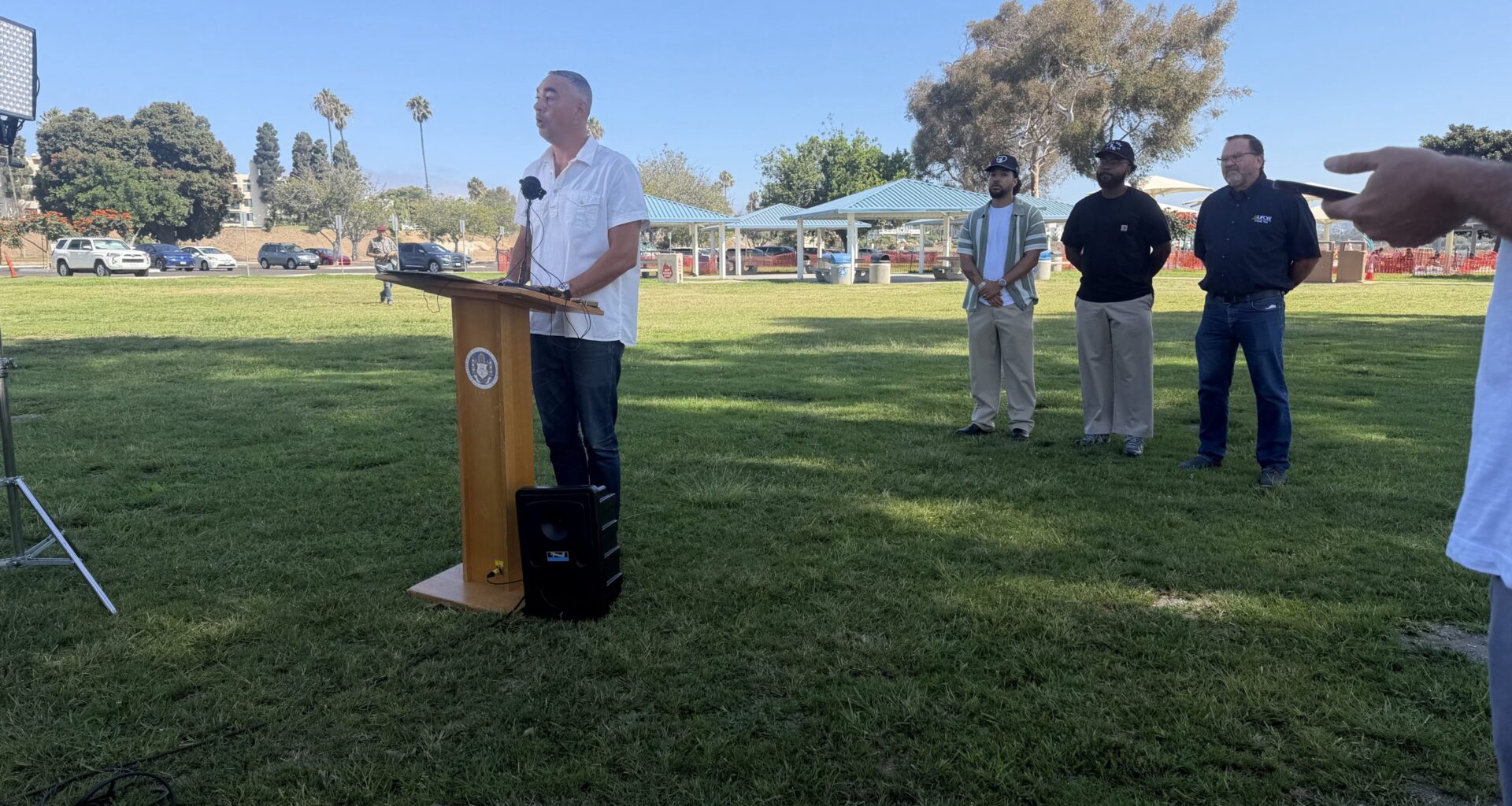
 Councilmember Sean Elo-Rivera speaks at a press conference Wednesday Aug. 19, 2026 to object to Amazon’s use of a public park to transfer packages. (Photo by Tessa Balc/Times of San Diego)
A video of Amazon workers using a parking lot at a public park as a package transfer site has been circulating on the internet, and is adding fuel to one councilmember’s rallying cry for residents.
Crown Point resident Tom Lemmon took the video of Amazon workers setting up their trucks to complete distribution. It began circulating on Saturday.
The footage caught the attention of former California Assemblymember Lorena Gonzales Fletcher, now president of the California Labor Federation, along with Councilmember Sean Elo-Rivera. He decided to take a stand against the online giant’s potential encroachment on public land, particularly when the city has been cracking down on local residents who try to host gatherings without proper permits.
The brouhaha is over Amazon’s new “walkers” program, in which delivery workers grab packages from nearby staging areas — Crown Point Park on the day Lemmon shot the video — and hoof it to take them to customers in high-density communities.
Multiple other locations like New York City have rolled out the on-foot delivery system, setting up staging areas on both public and private property.
Amazon spokesperson Austin Stowe, however, said Wednesday that the company “screwed up,” explaining that there was a misunderstanding over communications between the company and City Hall regarding stipulations for operating its new program within city limits.
He said the company already has corrected the error. There have not been any additional reported sightings of Amazon using public spaces for distribution.
But Elo-Rivera isn’t buying Amazon’s explanation.
“No one accidentally runs a distribution operation out of a park,” he said at a Wednesday press conference at Crown Point Park. “It wasn’t a mistake. Amazon made a calculation that nobody noticed and if someone did nobody would do anything about it.
“They got caught so they called it an accident.”
Despite the issue with the video, and Amazon’s quick claim of responsibility, the row among residents, online observers and local leaders resurfaced a consistent concern for the District 9 representative – that corporations, not residents, often come first.
He’s taken up this mantle against a range of corporate giants, including Waymo, which is launching driverless service in San Diego, and Airbnb, which fought his failed attempt to tax certain short-term vacation rentals.
He’s now, in light of the Amazon development, considering how the city helps San Diegans navigate issuing permits for the use of park space. From yoga teachers and remote-work hosts to DJs and influencers, the city has stepped in to pause free events as they have grown popular and attracted crowds that require organizers to obtain permits.
In one case in particular, DJ Daniel Joseph went back and forth with the city on obtaining permits after a few too many people showed up to a set. He’s been able to continue on account of his popularity — although this is also what gets him into trouble — and the connections he’s developed by cooperating with City Hall.
Winyl Club, a meet-up for those who love wine and vinyl records, wasn’t so lucky.
Recently, the group posted a video on its social media directly calling out the city for indefinitely stalling events. Winyl Club essentially waved a white flag, telling supporters to organize gatherings on their own.
Chris Walker, the co-founder of Winyl Club, joined Elo-Rivera at the press conference, along with representatives from labor groups.
Walker now sees benefit to entering the political arena, especially if he wants to rebrand the club and once again try organizing events. This time, he said, he would better educate attendees on the requirements for hosting a city-sanctioned event — both in terms of cash and conduct.
His main focus, for now, is creating a space for San Diegans to be outside together.
“As long as we have that be the main focus, I think having (to) kind of be political can definitely help and open more doors,” he said.
But for Walker, it’s frustrating to see an out-of-town company using a park to maximize profits, especially when it is difficult for San Diegans to obtain access to city parks in the first place.
“People like us, artists, DJs, community organizers have to go through permits, lack of communication and, of course, stuff that doesn’t always get shown right away. Because of that, we have to jump through these hurdles to put on free events for the community. It leads me to ask this question: if these spaces are for the public, then why isn’t there more accessible pathways for the public to use them?”
Permits or written permission could also be granted to a business like Amazon to lawfully continue operations from parks like in Crown Point.
But that’s not what Elo-Rivera wants.
“I have zero interest in seeing our parks turned into distribution centers for a trillion-dollar corporation,” he said.
Instead, Elo-Rivera put in a request with the City Attorney’s Office to see what action, if any, can be taken to bar the nearly $2.9 trillion company from operating in public parks.
The City Attorney’s office said they could not comment on the status of his request; Elo-Rivera’s team also said they have yet to receive word.