
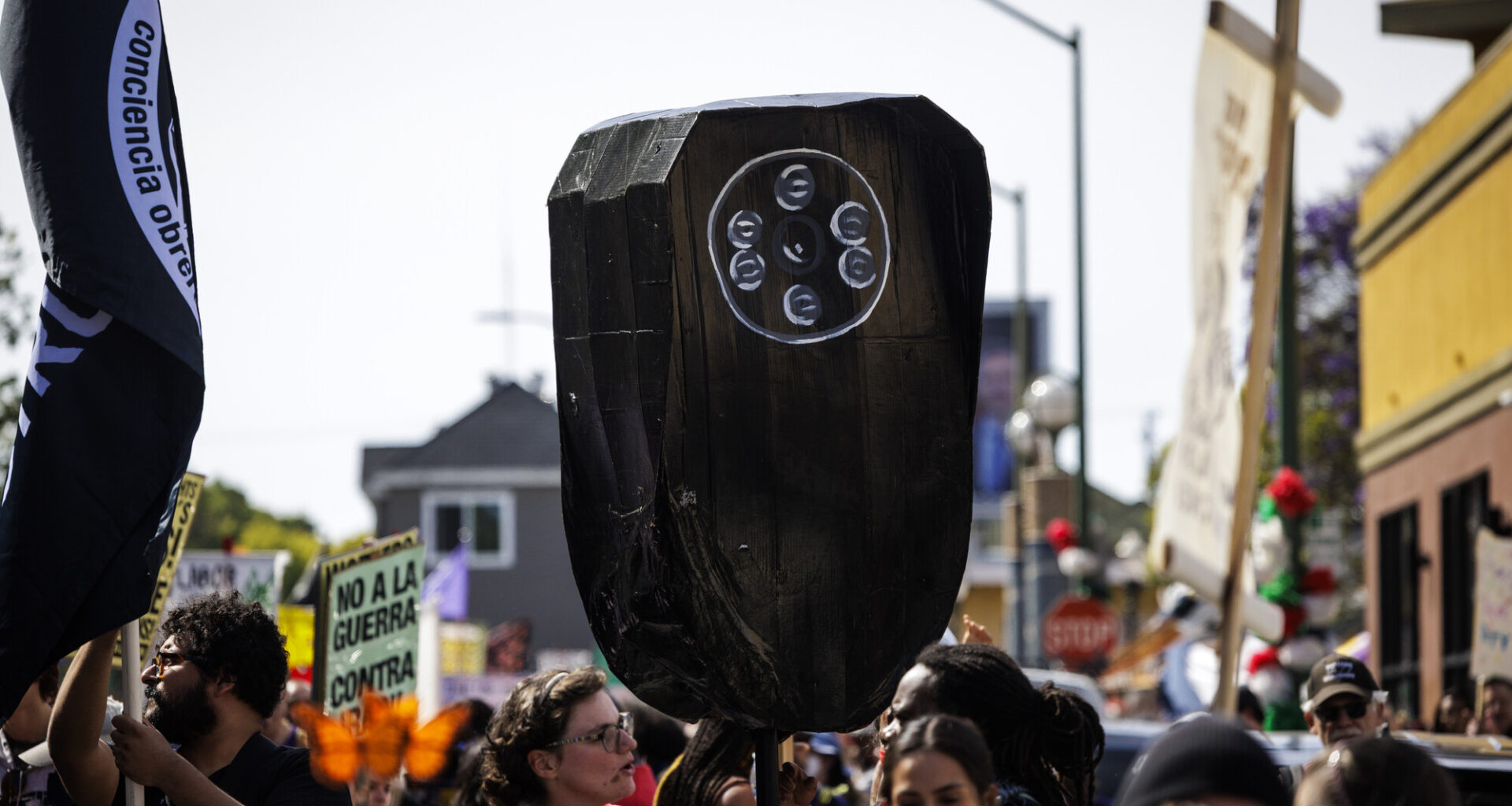
Activists are holding events across the region through next week, urging cities to shut off license plate readers.
Aug 21, 2026
Updated 11:47 am PT
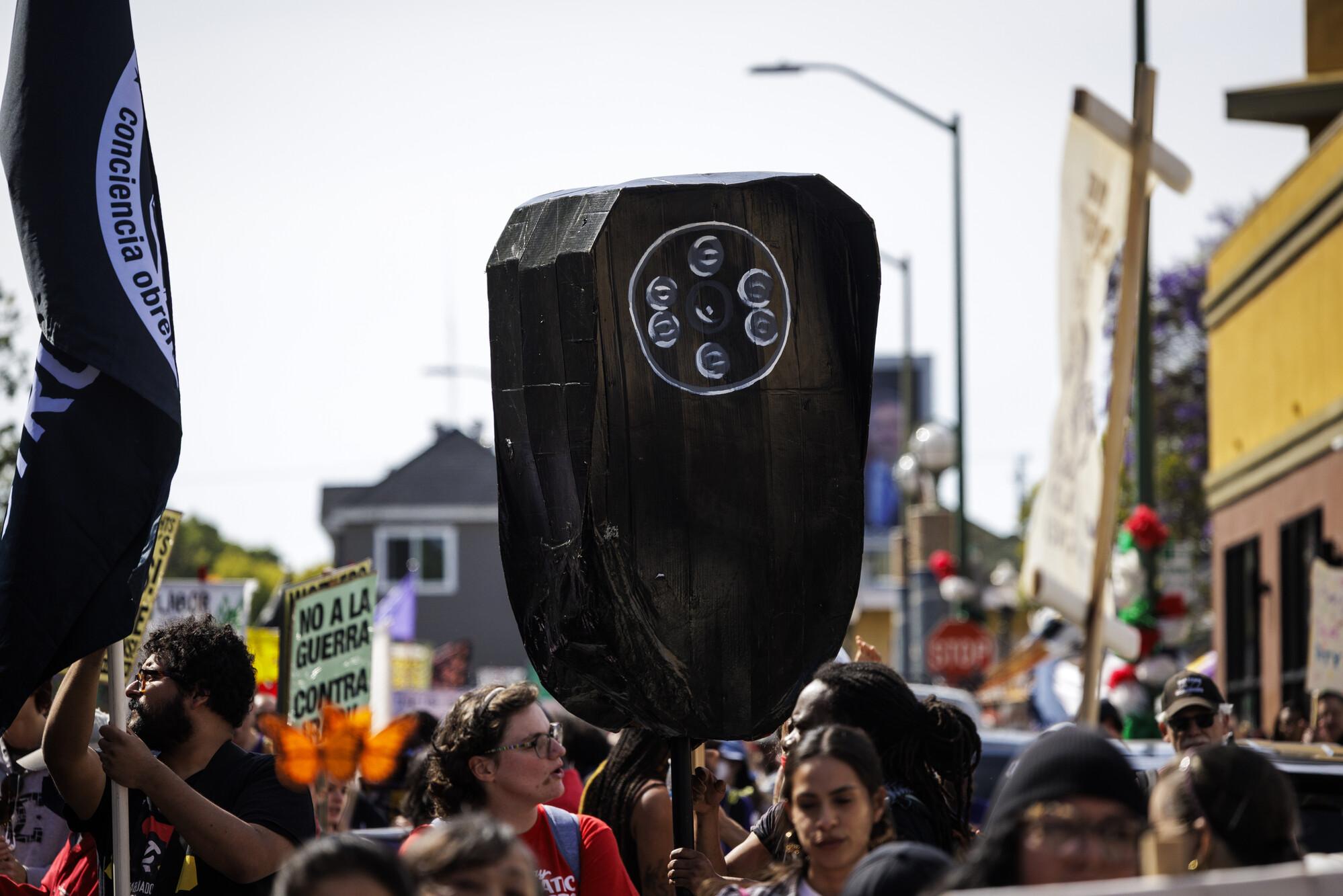
Protesters march carrying a papier-mache camera to protest the use of Flock security cameras at the Oakland Sin Fronteras May Day march in Oakland on May 1, 2026. (Martin do Nascimento/KQED)
Bay Area activists launched a multi-day wave of protests this week to demand that cities shut off automated license plate readers entirely instead of adopting new regulations.
The mobilization by 20 immigrant rights groups, climate organizers and other community groups is part of a national week of action and arrives as the technology and its primary provider, Flock Safety, face mounting pushback. Over the past eight months, several Bay Area cities, a county and a university have canceled contracts, switched cameras off or tightened their rules.
These moves followed audits and public records that showed federal and out-of-state agencies accessed local camera data in apparent violation of a 2015 California law that bars it. Flock announced privacy changes on Aug. 13, shortening the default period it holds data from 30 days to seven and requiring police customers to turn on misuse-detection tools by Jan. 1.
Organizers say the changes don’t go far enough.
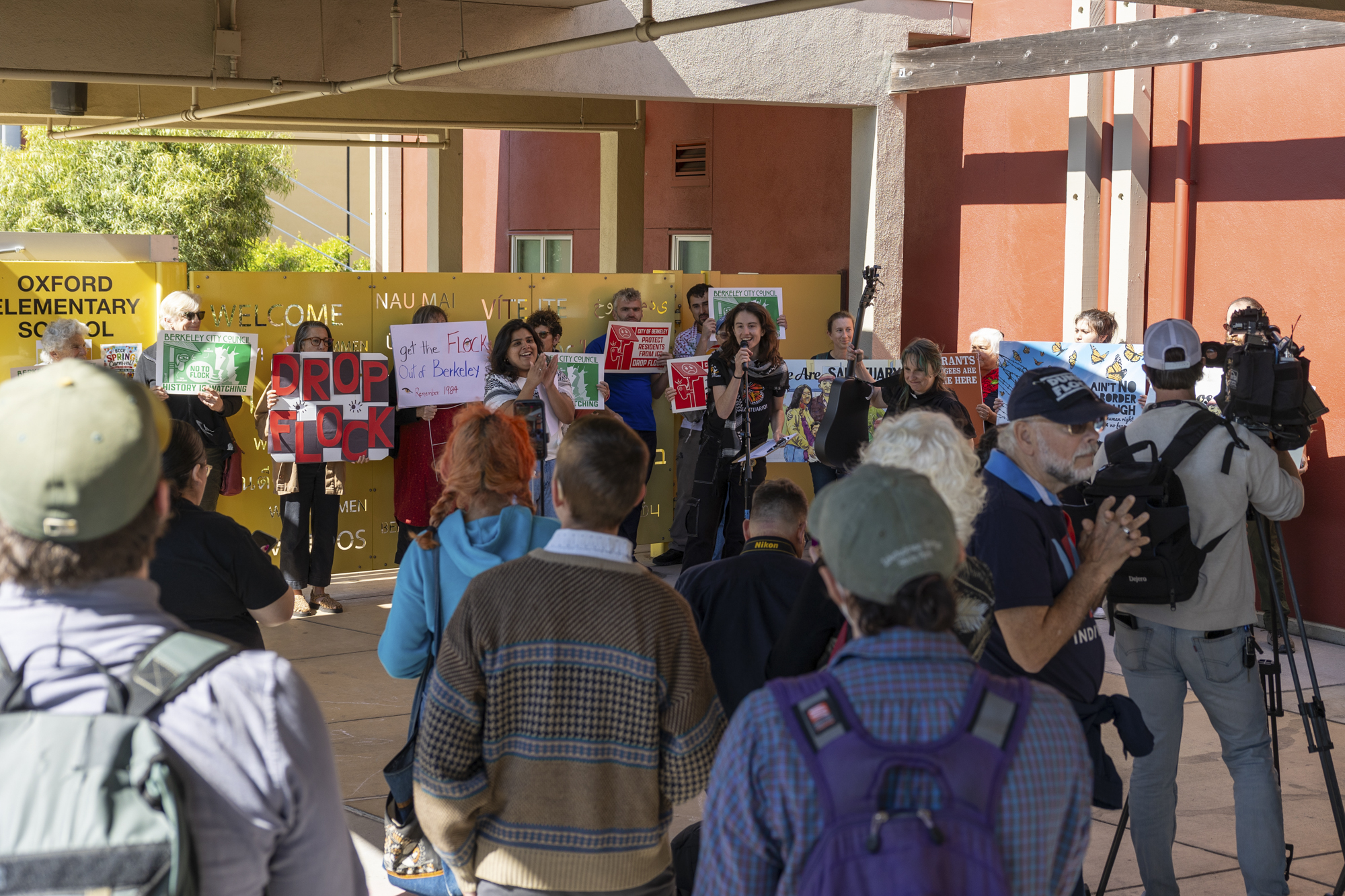 Organizers speak during a rally opposing Berkeley’s proposed contract expansion with surveillance company Flock Safety outside the Berkeley Unified School District boardroom in Berkeley on May 7, 2026.
“We cannot sacrifice every person’s rights for the false and dangerous illusion of safety,” said Kimberly Woo, a community organizer with the Services, Immigrant Rights and Education Network, or SIREN, in San José. “That’s why the best solution is to turn all these cameras off.”
Many of the events are taking place in Bay Area cities that are actively grappling with how to best balance public safety with privacy. In Palo Alto, where organizers gathered Thursday evening outside City Hall under a “Safety Over Surveillance” banner, 30 cameras are still in use under a contract that extends to 2029. The city council is scheduled to take up an independent audit of the program on Aug. 24. Reporting by The Palo Alto Weekly earlier this year found that police agencies around the country had searched Palo Alto’s Flock data, something city police said they had not authorized.
Other Bay Area cities have embraced the technology. The Oakland City Council voted in December to renew and expand its Flock network in a $2.25 million, two-year deal, adding pan-tilt-zoom cameras that can follow pedestrians as well as vehicles. Berkeley extended its contract by up to a year in May but rejected a $1.4 million expansion after a city attorney memo warned the company might not be able to honor promises about data sharing.
 San José Mayor Matt Mahan helps install a Flock Safety automated license plate reader on April 23, 2024. Civil liberties groups are now suing the city and Mahan over the technology’s uses.
Police departments have consistently defended the cameras as among their most effective investigative tools. San José Police Chief Paul Joseph told the city council in March that no technology in his career had been more useful for solving serious crimes. Oakland’s Lt. Gabriel Urquiza told the city council in December that the system had produced 232 arrests and the recovery of 68 firearms since mid-2024.
Anti-Flock advocates reject the link between the cameras and safety. Woo said crime has been trending down nationally for years for reasons that predate the cameras, and that clearance rates don’t move measurably when the systems are switched on or off.
In an email earlier this month, Flock spokesperson Courtney Terlecki told KQED that pulling out a technology that is actively helping solve violent crimes moves public safety backward, leaving cases unsolved longer and victims waiting.
She added it supported more than a million criminal investigations in 2025 and helped locate more than 10,000 missing people, and that new city partnerships this year have outpaced nonrenewals by roughly seven to one. In California, she said, it has disabled its national search feature, blocked out-of-state discoverability and cut off federal access to state agencies’ data.
In Gilroy on Sunday, organizers plan to draw a connection between Flock cameras, a planned Amazon data center and an ICE processing facility under construction to highlight the dangers of data collection by automated plate readers. More than 50 agencies and jurisdictions nationwide have canceled, suspended or rejected Flock contracts since January, according to DeFlock, the volunteer group that maps the cameras.
A lot of the group’s concerns center around the use of license plate readers for immigration enforcement. Woo described immigrants who fear that a trip to work, school or the grocery store could be the last time they see their families. Some of the organization’s most outspoken people now come to public events in masks, or skip them, worried that being recorded could be turned against them, Woo said.
In an email to KQED, the youth climate group Sunrise Movement’s Bay Area chapter said that it sees the two fights as connected. Getting to a “green economy,” one that runs on clean energy and the jobs that come with it, requires a democracy that puts working people’s needs first, not mass surveillance, the group said.
“We want cities and counties to completely reject ALPRs and mass surveillance and instead invest in initiatives that create healthy communities like education, affordable housing, green jobs, and social services,” it continued.