
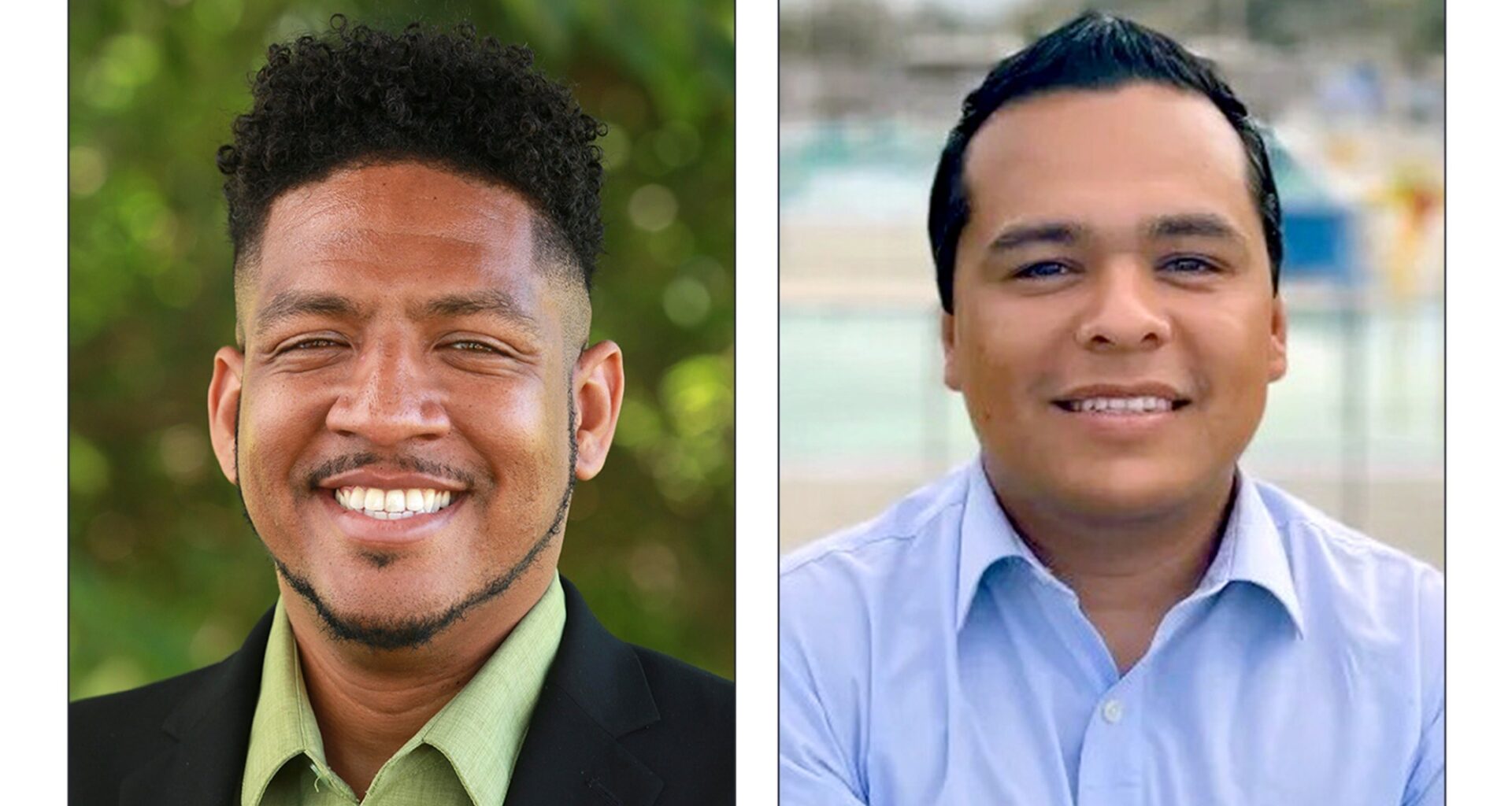
Marcus Bush and Jose Rodriguez, two sitting Democratic National City Council members with nearly identical voting records, are competing to become the city’s next mayor in November, a race unfolding alongside a deepening municipal budget crisis and the retirement of longtime Mayor Ron Morrison.
Two lesser-known candidates, longtime City Treasurer Mitchel Beauchamp and environmental activist Jacobb Castrejon, are also on the ballot.
The race comes as National City confronts what City Manager Doug Schulze has called a potential path to insolvency by 2030. The city’s deficit, which stood at roughly $13 million in the budget adopted this year, is projected to grow to $15 million by 2028 and $30 million by 2029 without intervention, according to Schulze.
The council voted 3-2 this month to pull a proposed business-license tax overhaul — estimated to generate roughly $7.1 million in annual revenue — from the November ballot after sustained opposition from the business community, deferring the measure to a possible 2027 special election. Rodriguez cast one of the two dissenting votes alongside Councilmember Ditas Yamane.
Morrison, 76, announced Aug. 8 that he would not seek reelection, ending a tenure in city government that spanned 34 years, including 16 years as mayor. He cited the city’s financial strain and said it was “time for things to come to an end.”
At a distance, the two councilmembers vying to replace Morrison look similar. Up close, their approaches to governance diverge sharply.
Rodriguez has centered his campaign on fairness for working families and the working class, pledging to protect programs like the nutrition center and libraries during the ongoing budgetary crisis while pushing big businesses to pay what he considers their fair share. Bush has centered his on his strong community roots, transparency and institutional accountability, arguing the city must show spending discipline and make tough decisions in order to get National City back on a fiscally sound path.
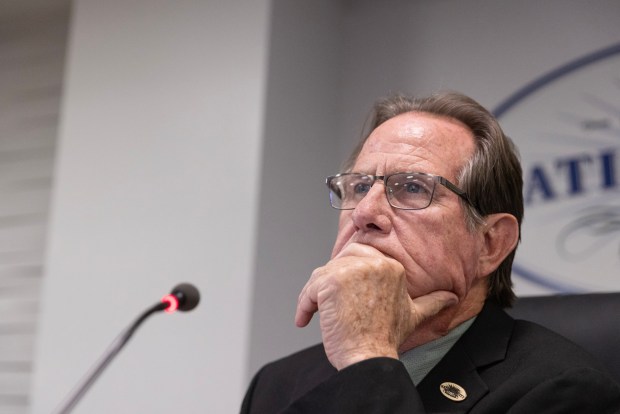 National City Mayor Ron Morrison listens to public comment during a city council meeting at National City City Hall on June 16, 2026. (Luke Johnson / The San Diego Union-Tribune)
Morrison steps down
Morrison endorsed Bush in the mayoral race, along with Councilmember Luz Molina for District 1 reelection and resident Edward Nieto for the District 3 council seat. He said a central reason he sought a final term in 2022 was to keep Rodriguez, with whom he has repeatedly clashed, out of the mayor’s office.
“A large part of why I ran four years ago was because I knew otherwise Jose Rodriguez was going to win, and in my personal opinion, he’s not fit for office,” Morrison said.
Rodriguez, the District 2 council member, unsuccessfully ran for council in 2016 and 2018 before winning his seat in 2020 — he again won a reelection bid in 2024. He is now making his second run for mayor after losing to Morrison in 2022 by roughly 68 votes, about 0.05% of the electorate.
“I feel like we’ve made up that ground over the last four years,” Rodriguez said, pointing to a 74% win in his district in 2024. He said his campaign will rely on door-knocking six days a week and phone banking four days a week.
Bush, the District 4 councilmember, filed his candidacy papers the day before the extended filing deadline. He said he had been weighing a run but held off until Morrison signaled his own plans, citing strain from balancing council duties with his personal life.
“Leading up to my decision to run, there was a lot going on in my life,” Bush said. “I really had to concentrate on my work and see how the race was shaping up.”
Bush first ran for city council in 2020, winning his seat in a city-wide election. He ran for reelection in 2024.
Should business pay more?
Rodriguez has secured institutional backing that Bush currently lacks, including renewed endorsements from the Democratic Party, the San Diego-Imperial Counties Labor Council and roughly a dozen elected officials in the South Bay.
“I think we’re coming into this mayoral election very strong,” Rodriguez said.
Framing the race as a contest over who city government serves, Rodriguez argued National City has too often prioritized outside interests over residents and pledged a more community-based approach to leadership.
He pointed to the recent business-license tax vote — in which Morrison, Bush and Molina voted to bring the measure back for a later election with Chamber of Commerce input — as evidence of that dynamic playing out.
“I am here standing for working families and (Bush) is going to be there standing with big businesses,” he said. “My values don’t change and I think his have.”
Rodriguez has argued National City’s current business license structure allows large companies to underpay relative to peer cities, saying big-box retailers like Walmart that operate in the city should be paying $100,000 to $150,000 annually rather than the $2,000 to $3,000 he said they currently pay.
“Unfortunately, Morrison then goes around and kills the initiative along with Councilmember Bush,” Rodriguez said. “And no surprise, a couple days later at a press conference, not only did he announce his retirement, but he endorsed Councilmember Bush.”
Bush defends vote
Bush pushed back on the characterization that his vote was about protecting big businesses, saying the tax measure affects small businesses in National City as well, and that both large and small business owners had told him they were willing to work on reform. He said the council rushed the process, noting the ordinance language — 53 pages — was posted less than 24 hours before the vote, leaving no time to educate the public.
“That’s dishonest to say my values have changed, because they haven’t,” Bush said. “This election is about trust, integrity, it’s about accountability and transparency — I’ve always been that way. That hasn’t been the same for Jose.”
Bush also said Rodriguez’s approach to supporting the measure was “divisive” and counterproductive, adding that he tried instead to build trust with business owners during the process.
“He was on social media attacking and criticizing (businesses) and saying they need to pay their fair share,” Bush said. “I just didn’t think that that was the best approach.”
Bush said his opposition to the business license tax stemmed from the rushed timeline and his belief that the city needed to make its own spending cuts before asking businesses to pay more.
“I didn’t think it was fair for us as a city to come out to the businesses with our hands out, when we haven’t made the tough choices,” he said.
Surprise endorsement
Morrison described his endorsement of Bush as less about political alignment and more about trust, saying Bush has matured since joining the council six years ago.
“He kind of came in as a fireball, but I’ve seen a lot of maturing on his part,” Morrison said. “I don’t feel he would make a mistake that would deliberately hurt the city.”
Bush said the endorsement, delivered in person at Morrison’s retirement announcement, came as a surprise given the two have disagreed over the years on issues — including term limits, development projects and budgeting priorities among others. Morrison is a registered independent with fiscally conservative leanings, while Bush is a Democrat with strong ties of his own to the San Diego County Democratic Party establishment.
“We’ve definitely gone through our ups and downs and we’ve had our disagreements,” Bush said of Morrison. “But I’ve never questioned that he works hard and is passionate about National City.”
Bush has cast himself as a coalition-builder who draws support across ideological lines, saying his backers include Republicans alongside more progressive residents.
“There’s nothing red or blue about filling potholes or being responsible for your budget,” he said, adding that he felt he is more willing than Rodriguez to hold allies accountable and more deeply rooted in the community.
“I’m more local, I grew up here,” he said. “I have a much longer lived experience in the community. I know more of the people and I’m more familiar with the issues that our people face.”
Rodriguez has pointed to his own political consistency as evidence he can be trusted to follow through, saying he’s held the same core positions since he first ran for office in 2016 and his positions aren’t shaped by who funds his campaigns.
“My position will not change based on who endorses me or who gives me money for my campaigns,” he said.
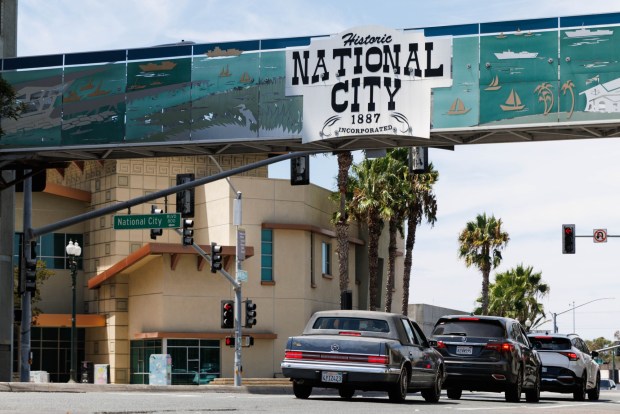 A pedestrian bridge on the intersection of 8th Street and National City Boulevard in National City. (Kristian Carreon / The San Diego Union-Tribune)
Port payments
Rodriguez has also pointed to National City’s arrangement with the Port of San Diego as an example of the city being shortchanged. He said the city’s roughly 150 acres of Bayfront land are used largely for industrial purposes, generating $12 million a year in revenue for the port while National City gets little in return.
Most Bayfront activity involves car imports that are shipped out rather than sold locally, meaning the city collects no sales tax from that activity. The revenue the city does receive comes in the form of property tax and “in lieu of” property tax — a payment the Port pays to National City in place of standard property tax on port-controlled land.
Morrison said he introduced what’s known as the Balance Plan in 2014 as an effort to generate more revenue from the Bayfront, and said the city is “just now getting it where we can start to move ahead with it and implement it” after securing approval from the California Coastal Commission and other regulators.
Public safety, air quality and homeownership opportunities round out Rodriguez‘ list of priorities.
“I think it’s important that we build more home ownership opportunities, enough of these luxury apartments all over the place,” he said. “These are kind of focal issues to what I believe the future of National City should look like.”
Bush has also outlined a broader set of municipal priorities, including redevelopment of the city’s port and Bayfront area and expanded partnerships between the city and Sweetwater High School to give local youth pathways into city careers, pointing to past collaborations with the fire and police academies.
He said arts and culture — including the city’s lowrider, veteran and music heritage, along with restoration of the long-neglected Granger Music Hall — should be leveraged to draw visitors and revenue to National City.
“We have each other, and that’s the spirit of National City, who we are as a people, as a community,” Bush said.
Campaign finance filings covering Jan. 1 through June 30 show Rodriguez has raised $12,661 and spent about $11,060, with donors including labor officials, educators and Democratic Party figures such as Chula Vista City Councilmembers Cesar Fernandez and Jose Preciado.
Bush has not yet filed a dedicated mayoral committee statement. His most recent filing, still under a 2024 council reelection committee, shows $1,170 raised and $2,509.22 spent, with too few donors to characterize a broader base. He said he is resolving the debt on his previous statement and will file his mayoral statement at the next filing deadline in September.
Beauchamp, also a former city councilmember, has cast himself as a fiscal watchdog in his candidate statement, saying his role gave him insight into financial decisions he could not otherwise control.
Castrejon, 25, a second-generation Mexican American and Southwestern College and UC San Diego graduate, is running on a platform focused on infrastructure, affordability and green space.
Morrison’s term ends in December, roughly a month after the Nov. 3 election.