
Grand Avenue is the cultural heart of Downtown LA. From modern art museums and world-class concert halls to public green spaces visited by millions each year, Grand Avenue is a destination for tourists and locals alike. This fall, its museum scene will come to life, with revolutionary exhibitions on display at the Museum of Contemporary Art, The Broad, the Arizona State University Fashion Institute of Design and Merchandising (ASU FIDM) Museum and Dataland — the latter the newest addition to the arts scene in LA.
Visual Arts
The Museum of Contemporary Art
250 S. Grand Avenue, Los Angeles. 213-626-6222 moca.org
Founded in 1979, the Museum of Contemporary Art (MOCA) has a collection of 8,000 objects with two distinct venues in Los Angeles — MOCA Grand Avenue and The Geffen Contemporary at MOCA in Little Tokyo. The museum’s exhibits often focus on American and European art, including paintings, sculptures, photography, video and new media installations. On Sept. 20, it will open two exhibits that showcase the breadth of its collection.
The Expanding Field: MOCA’s Collection from the 1940s to 1970s, now through Sept. 20
Open since April, this exhibit focuses on artwork from the 1940s to the 1970s. It demonstrates the museum’s historical depth, the museum explains on its website, as well as a commitment to artistic experimentation and global awareness. “The Expanding Field: MOCA’s Collection from the 1940s to 1970s” includes a gallery dedicated to the abstract expressionist works of Mark Rothko, as well as paintings, sculptures and other works by Luchita Hurtado, Piet Mondrian, On Kawara and Anne Truitt.
In These Times: Recent Acquisitions at MOCA, Sept. 20 through Jan. 3, 2027
This upcoming exhibition will survey artworks that were added to the museum’s extensive collection over the past five years. This includes works by the following, among others: Ed Bereal, Louise Bonnet, Andrea Bowers, Justin Caguiat, Philip-Lorca diCorcia, Christina Forrer, Charles Gaines, Sawako Goda, Jacqueline Humphries, Alex Israel, Suzanne Jackson, Tomashi Jackson, Larry Johnson, Liz Larner, Julie Mehretu and Nairy Baghramian, Rebecca Morris, Kathleen Ryan, Diane Simpson, John Sparagana, Magdalena Suarez Frimkess, Henry Taylor, Vincent Valdez and Ulla Wiggen. “In These Times: Recent Acquisitions at MOCA” is organized thematically by gallery.
Alexander Apóstol Regime: Dramatis Personae, Sept. 20 through Jan. 3, 2027
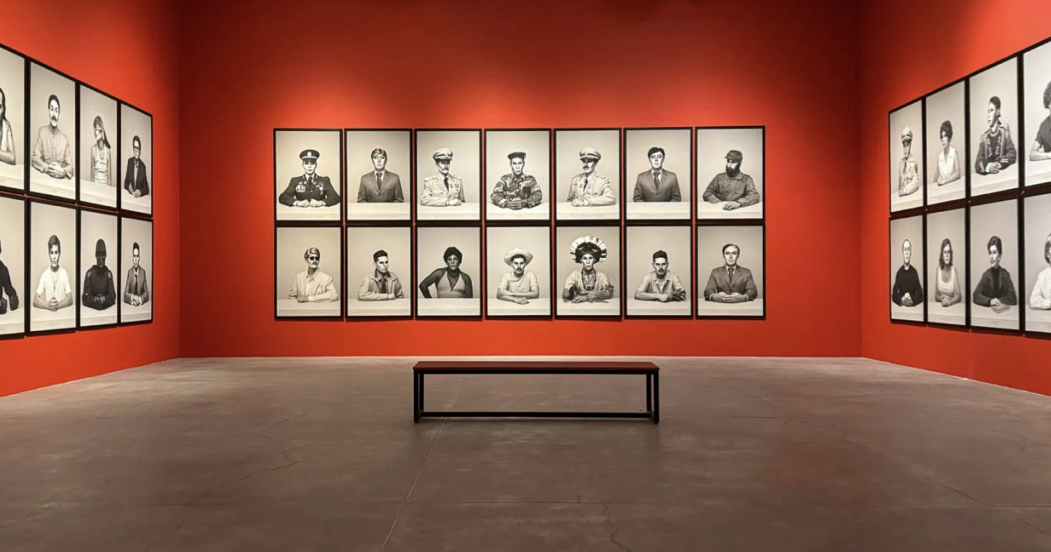
Alexander Apóstol is a Venezuelan artist based between Madrid and Caracas. The artist studied photography with Ricardo Armas, and art history at the Universidad Central de Venezuela, Caracas. His photographs, videos and installations focus on the iconography of the urban landscapes of his home and across South America. Apóstol explores the entanglement of art and systems of political power, MOCA said on its website. The work on view in MOCA’s upcoming exhibit is “Regime: Dramatis Personae” (2017), which is a series of black-and-white portraits that depict archetypal figures appearing on the stage of populist and authoritarian governments. The photos were taken in Caracas during the height of violent political repression that was underway in Venezuela in 2017. The exhibit will feature a total of 24 portraits, including “The Dictator,” “The Masked Police Officer Who Acts with Impunity” and “The Trusted Public Official.”
Cecilia Vicuña Quipu of Encounters: The Dream of Water, Nov. 15 through June 6, 2027
Cecilia Vicuña, a New York-based Chilean artist who was named an inaugural recipient of the Eric and Wendy Schmidt Environment and Art Prize, will debut a newly commissioned project at MOCA this November. “Quipu of Encounters: The Dream of Water” is the latest in Vicuña’s series of collective actions that she developed alongside the participation of communities and publics since the 1960s. It confronts the ongoing water crises unfolding in Los Angeles and in Chile. “Quipu” is derived from the Quechua word for “knot.” This exhibit will showcase an art piece created from a “quipu of encounters.” The exhibition is accompanied by a publication.
Julian Charrière, Nov. 15 through June 6, 2027
Like Vicuña, MOCA will display Julian Charrière’s inaugural Eric and Wendy Schmidt Environment and Art Prize exhibition starting Nov. 15. A Berlin-based artist from Switzerland, Charrière will debut a new commission alongside his recent work devoted to the fragility and resilience of planetary water systems. The exhibition will be Charrière’s first museum presentation in Los Angeles, and it will feature immersive environments that explore humanity’s relationship with the planet.
The Broad
221 S. Grand Avenue, Los Angeles, 213-232-6200, thebroad.org
The Broad presents exhibitions on contemporary art from the 1950s to the present. Known for its efforts to make art accessible to the widest possible audience, it operates a lending program to art museums and galleries worldwide. It has a collection of more than 2,000 works of art, displaying the works in its 120,000-square-foot building with two floors of gallery space. The building itself is a work of modern, contemporary art, with an innovative “veil-and-vault” concept that integrates the museum’s storage into its design. The Broad welcomes more than 900,000 visitors every year, and general admission is always free.
‘Yoko Ono: Music of the Mind,’ now through Oct. 11
Open since May, this exhibit traces Yoko Ono’s seven-decade career, from early text-based works in the 1950s and ‘60s to more modern large-scale installations. The exhibition is Ono’s first solo music exhibit in Southern California, and it explores her radical approach to art, language and participation.
The exhibition’s “instruction” pieces invite the community to become a part of the art, including tying a wish to an olive tree, hammering a nail into a painting or writing a note to a loved one.
‘Has the myth been shattered,’ Nov. 21 through Aug. 4, 2027
Drawn entirely from the museum’s collection, “Has the myth been shattered” spans six decades and features a range of media. Its theme focuses on how media shapes history, memory, and mankind’s collective experience, while highlighting artists who address persistent social and political injustices in American life. The exhibit is named after a 2024 work by Guadalupe Rosales and will juxtapose artworks from the 1980s and 1990s with contemporary pieces.
“This exhibition spans decades of collection artists asking questions about injustices that persist in American life and offers a glimpse of how the collection is evolving,” founding director Joanne Heyler said.
DATALAND
DATALAND is the newest addition to the arts scene in Downtown LA. The 25,000-square-foot institution opened on June 20, and it is the world’s first permanent museum dedicated to AI art. DATALAND was co-founded by media artist Refik Anadol and cultural researcher Efsun Erkılıç. It was conceptually built around the idea of a “museum of dreams” and it renders generative art that evolves continuously in real time.
Machine Dreams: Rainforest, now through Jan. 31, 2027
“Machine Dreams: Rainforest” is the opening exhibit at DATALAND. The 25,000-square-foot exhibition translates global ecological data into an evolving, interactive artificially intelligent environment. It is driven by the Large Nature Model (LNM), an open-source AI trained on over 500 million nature images and 50,000 audio recordings, with the dataset incorporating ethical, permission-based inputs, including recordings from 16 rainforests alongside archives from partners like the Smithsonian. The exhibit includes custom algorithmic ambient scents engineered with L’Oréal Luxe.
ASU FIDM Museum
919 S. Grand Avenue, Los Angeles, asufidmmuseum.asu.edu
Located at the Arizona State University California Center Grand in Downtown, the ASU FIDM Museum is committed to preserving and exhibiting the art, culture and history of global fashion. It has a collection of more than 15,000 fashion objects that span 400 years, as well as 200,000 Special Collections artifacts. Admission is free, with galleries open to the public during active exhibition cycles.
ADRIAN: Designing Hollywood, Dressing America, Aug. 28 to Dec. 12
This exhibit celebrates the legacy of Gilbert Adrian (1903–1959), a legendary costume designer from Hollywood’s Golden Age. Known for his work in the 1930s, Adrian created glamorous looks that offered escapism during the Great Depression. The phrase “Gowns by Adrian” became synonymous with cinematic style. “He helped transform Joan Crawford into a fashion icon, draped Jean Harlow in slinky bias-cut glamour and designed costumes for more than 200 productions, including ‘The Wizard of Oz,’” the ASU FIDM Museum website said. “In 1942, Adrian brought Hollywood glamour directly to American women when he opened his couture salon on Wilshire Boulevard, later expanding his influence through fashion sold by major retailers nationwide. His razor-sharp tailoring, dramatic silhouettes and unmistakable flair continue to inspire designers today.