
This story is part of Finding Your People, a series celebrating the Bay Area’s meetups and subcultures that bring people together IRL in an increasingly online world.
There’s a new gigantic work of art on 5th Avenue in Oakland, and it’s as colorful as the community that created it.
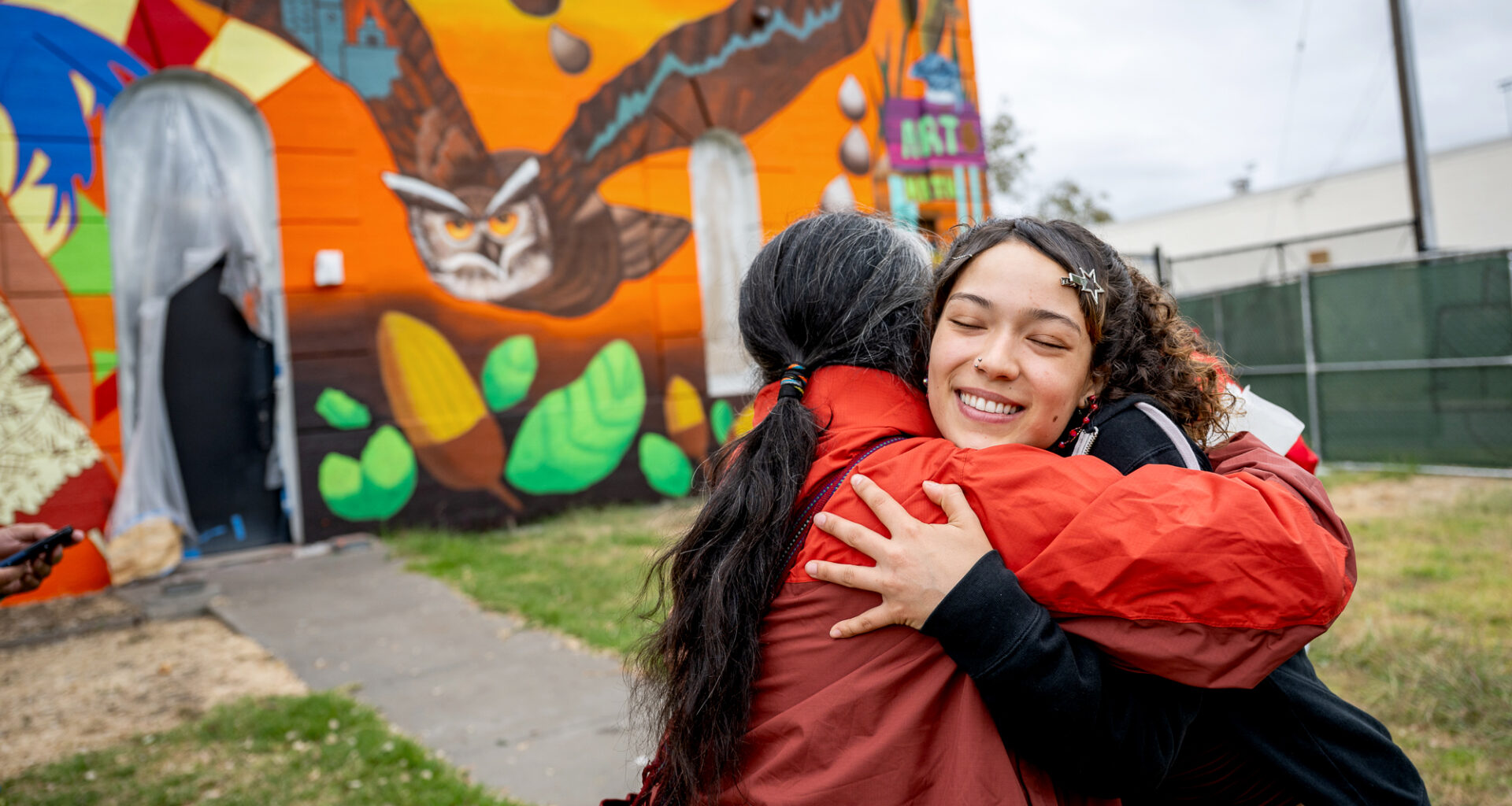
Sorbet-like shades of yellow and red provide a background for an array of flora. An Iranian dancer in orange strikes a fierce pose on one side. And on the other, a young Aztec dancer with piercing eyes holds a drum. Double meanings and secret messages are interlaced throughout the piece.
Painted on a Peralta Community College District warehouse, the mural centers the four school mascots from the network of East Bay junior colleges: a Merritt College black panther, a Berkeley City College owl, a College of Alameda cougar and a Laney College eagle.
 Ernesto Cortes (left) and instructor Fredericko Alvarado touch up a mural created during Laney College’s ART 129 summer mural course in Oakland.
Roughly 20 students and a handful of volunteers painted the murals as part of Laney’s Art 129 summer course. It covers the broadside of a nondescript building, visible to a steady flow of thousands of daily commuters on 5th Avenue and Interstate 880.
This undertaking shows the power of individuals coming together in pursuit of a simple lesson in art. When they signed up for the class, they knew they’d create a gigantic mural. What they didn’t realize was that they’d also walk away with cross-cultural connections and lasting bonds with dope artists that go beyond paint on a wall.
“Mural making is a cross-section between labor, psychotherapy, art making and community work,” says instructor Fredericko Alvarado, who has taught the class for the past four years. All of this happens at once, he stresses while painting in the sun.
“It’s labor-intensive and heavy on the body,” adds Alvarado, a longtime muralist himself, “especially at the scale that we were working.”
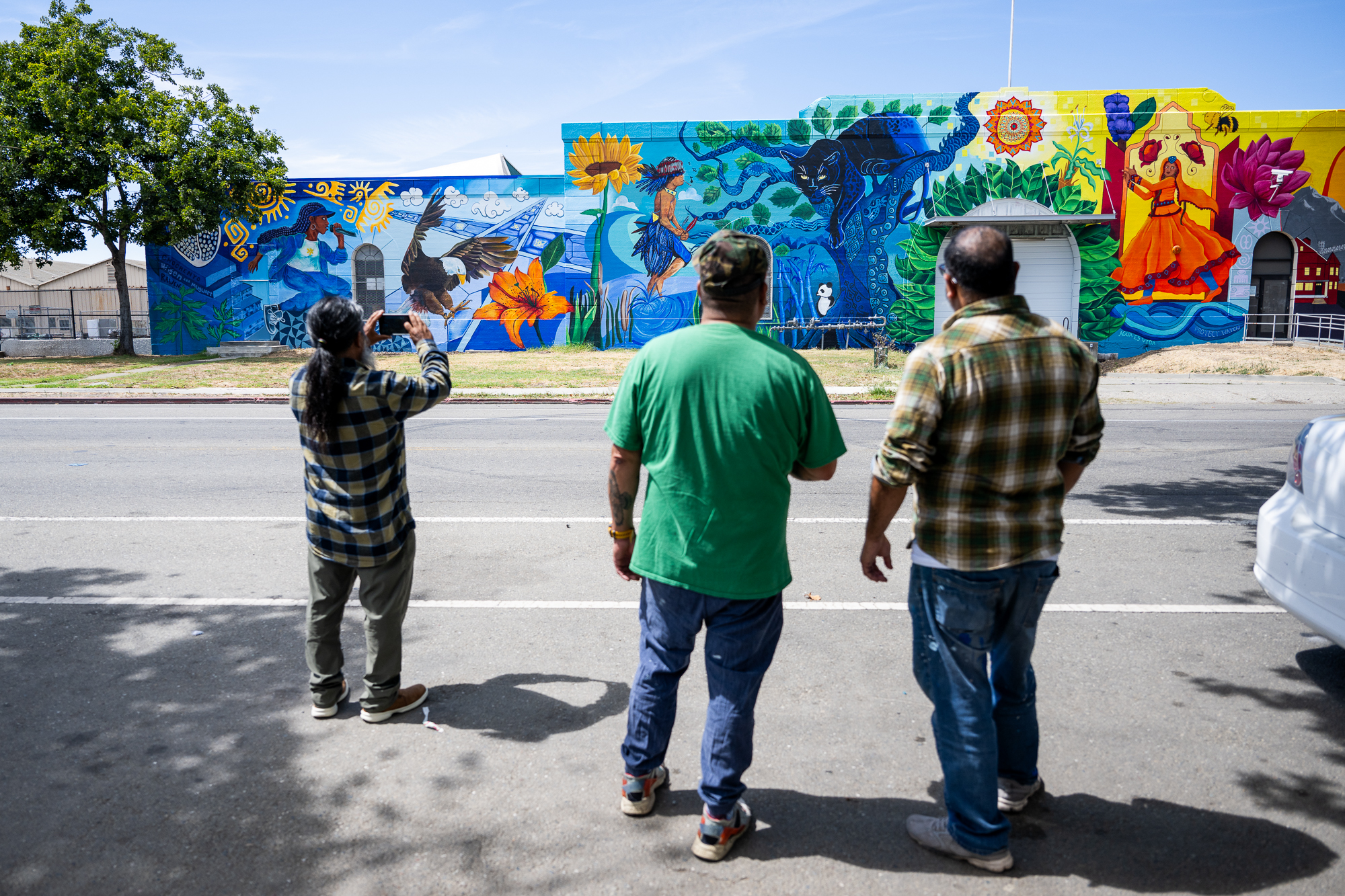 (From left) Ernesto Cortes, Fredericko Alvarado and Emilio Hernandez look at the mural created during Laney College’s ART 129 summer mural course after a fence blocking it from view was removed in Oakland on Aug. 18, 2026.
Yet according to his students, the hard work pays off.
“I’m finally giving myself permission to go to art school,” says Malena Mayorga, standing on a patch of grass near the sprawling mural.
Mayorga, a longtime Oakland resident originally from El Salvador, contributed a tree that represents the original people of this land, the Ohlone people. Her painting of a large oak has cultural references etched into the bark. There’s a Chinese dragon, Brazilian flags and an Aztec Quetzalcōātl, as well as a Palestinian keffiyeh, Filipino markings, West African Adinkra symbols, Ethiopian embroidery, a Mayan figure that represents the universe and more.
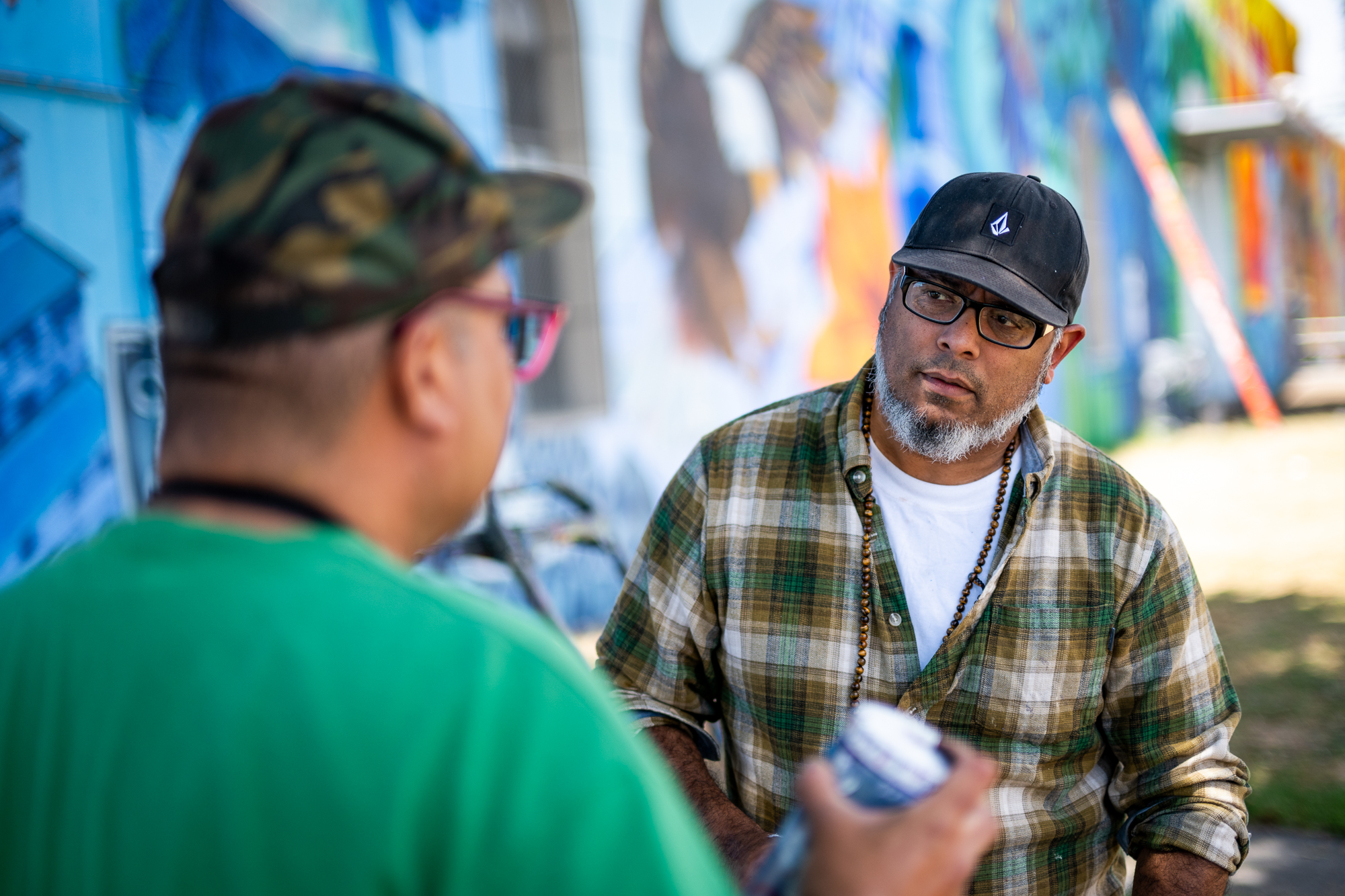
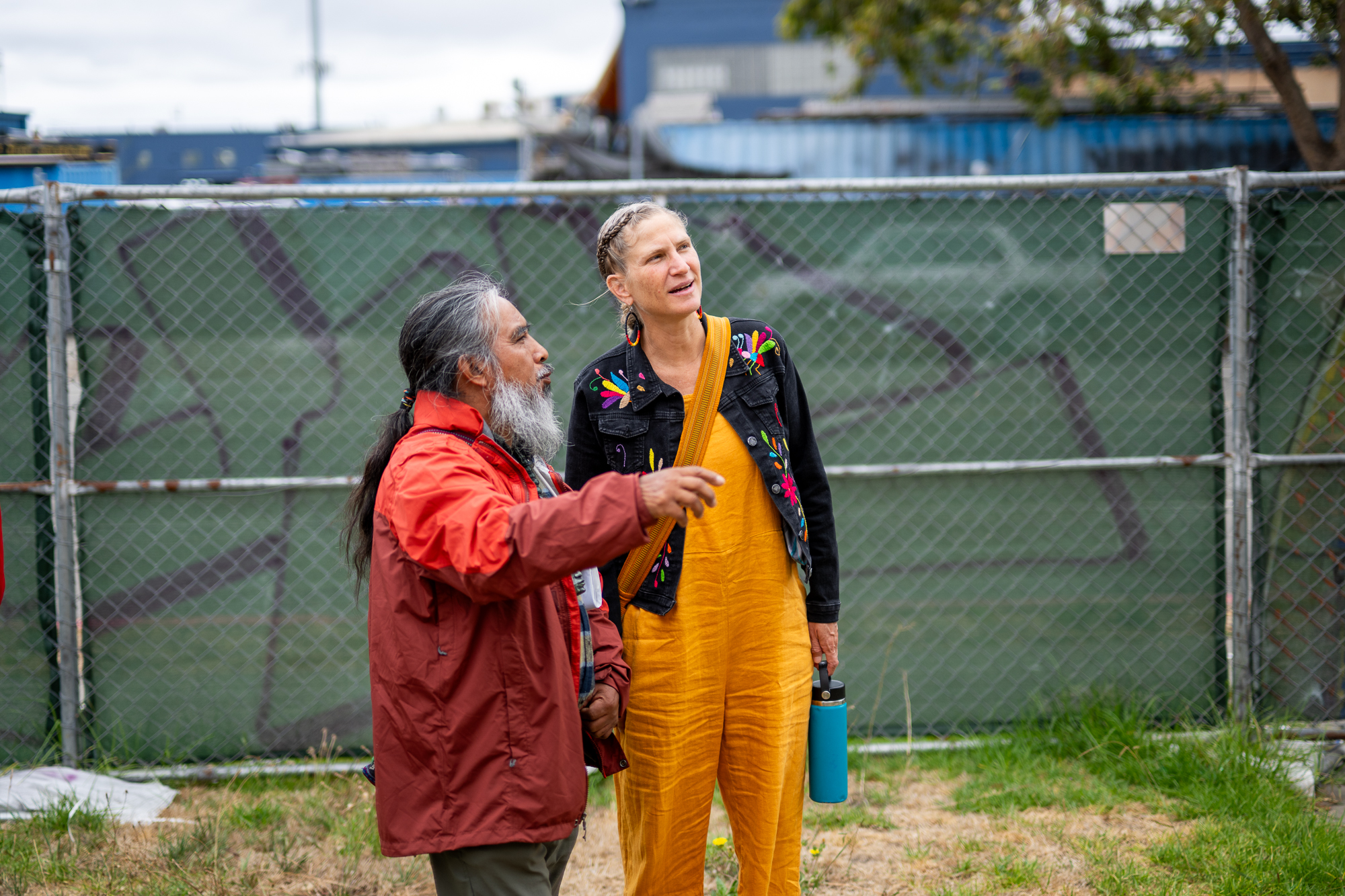 Ernesto Cortes speaks with fellow student Malena Mayorga from Laney College’s ART 129 summer mural course as they gather to see their completed mural.
Looking at the bigger picture, Mayorga professes, “We need to be changing the world [and moving] in the direction we want to see.” For her, the mural embodies that idea.
The artists had to first agree on what the mural would collectively depict, and then design their individual contributions before placing them on a wall. They made minor miscalculations and adjusted them along the way.
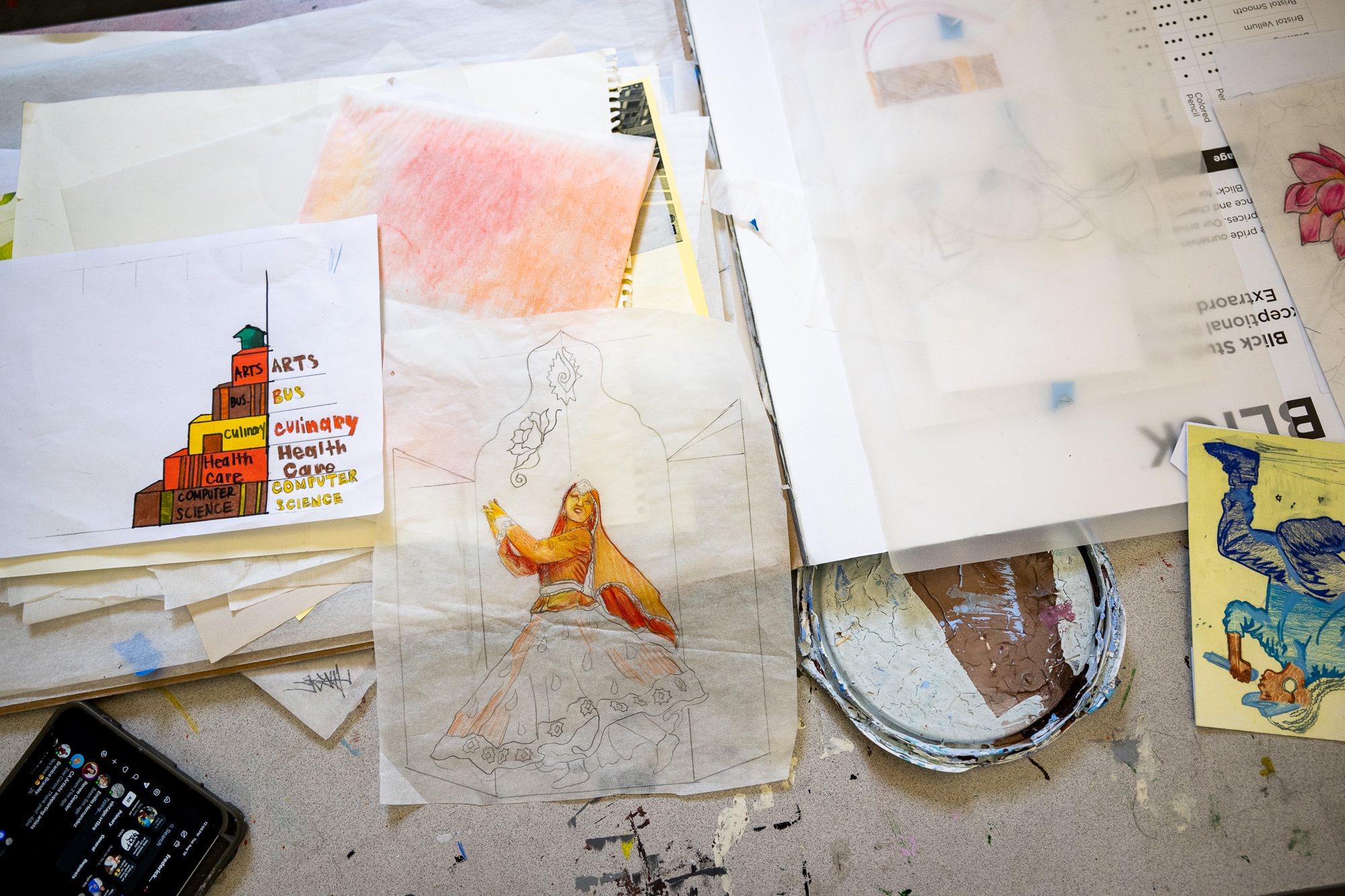 Sketches for a mural created during Laney College’s ART 129 course.
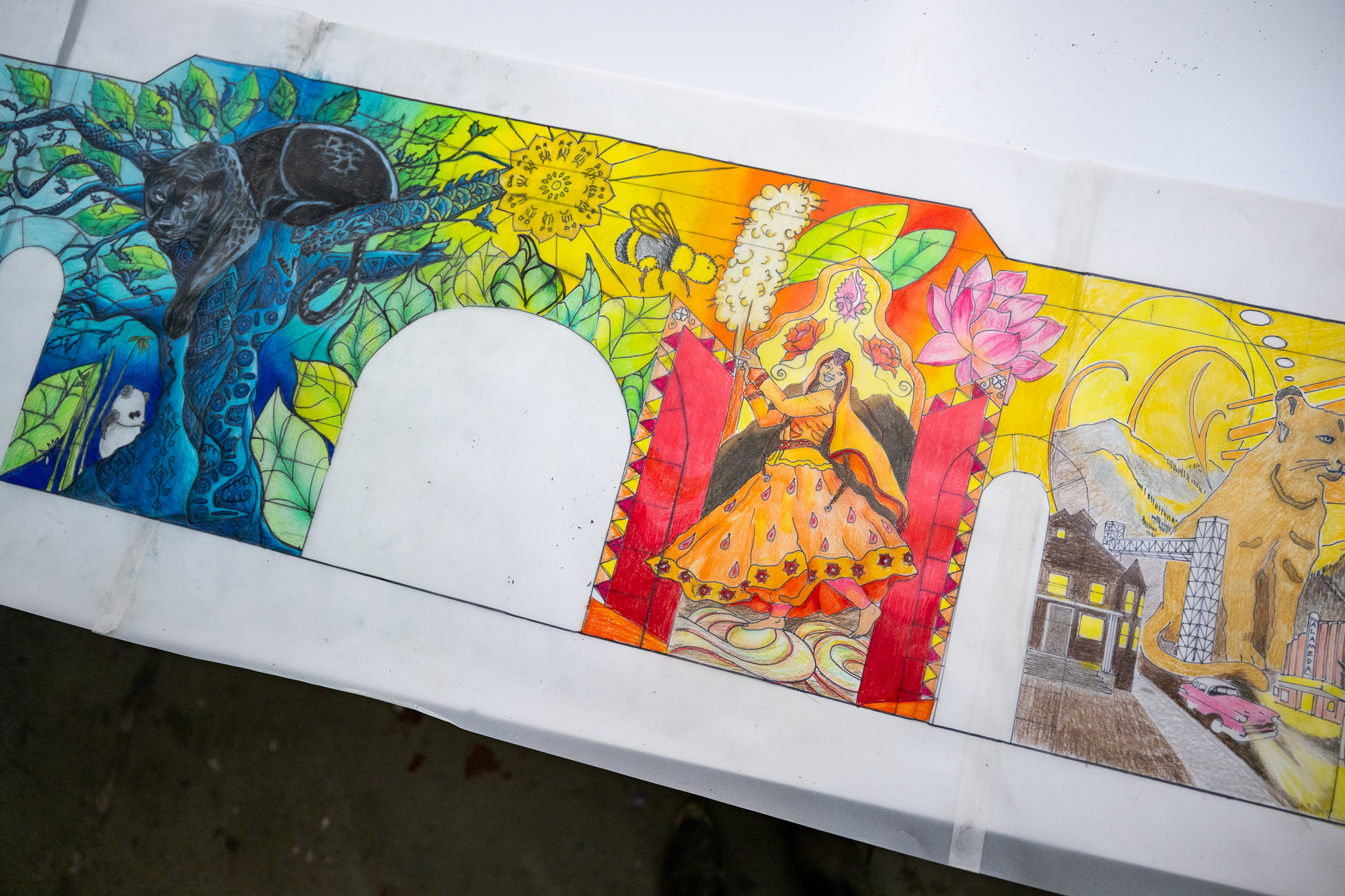 A completed sketch of the mural.
The end result is a towering community collage that illustrates the importance of community college. It stands about a paint bucket-toss from the Peralta District headquarters, a place that has recently dealt with a storm of budgetary issues.
Recently, California’s community colleges lost the support of a cost-of-living fund, and the Peralta School District dealt with a $11.8 million deficit by cutting numerous classes and over 60 positions. This past spring they began closing the Laney tower building, and in June they agreed to move forward with a plan to consolidate two schools — Merritt and Laney — under one umbrella, Oakland City College.
Despite the instability, this summer voters overwhelmingly approved a nine-year parcel tax to help fund the district, easing the tension and assuring students that the district plans on remaining affordable and accessible.
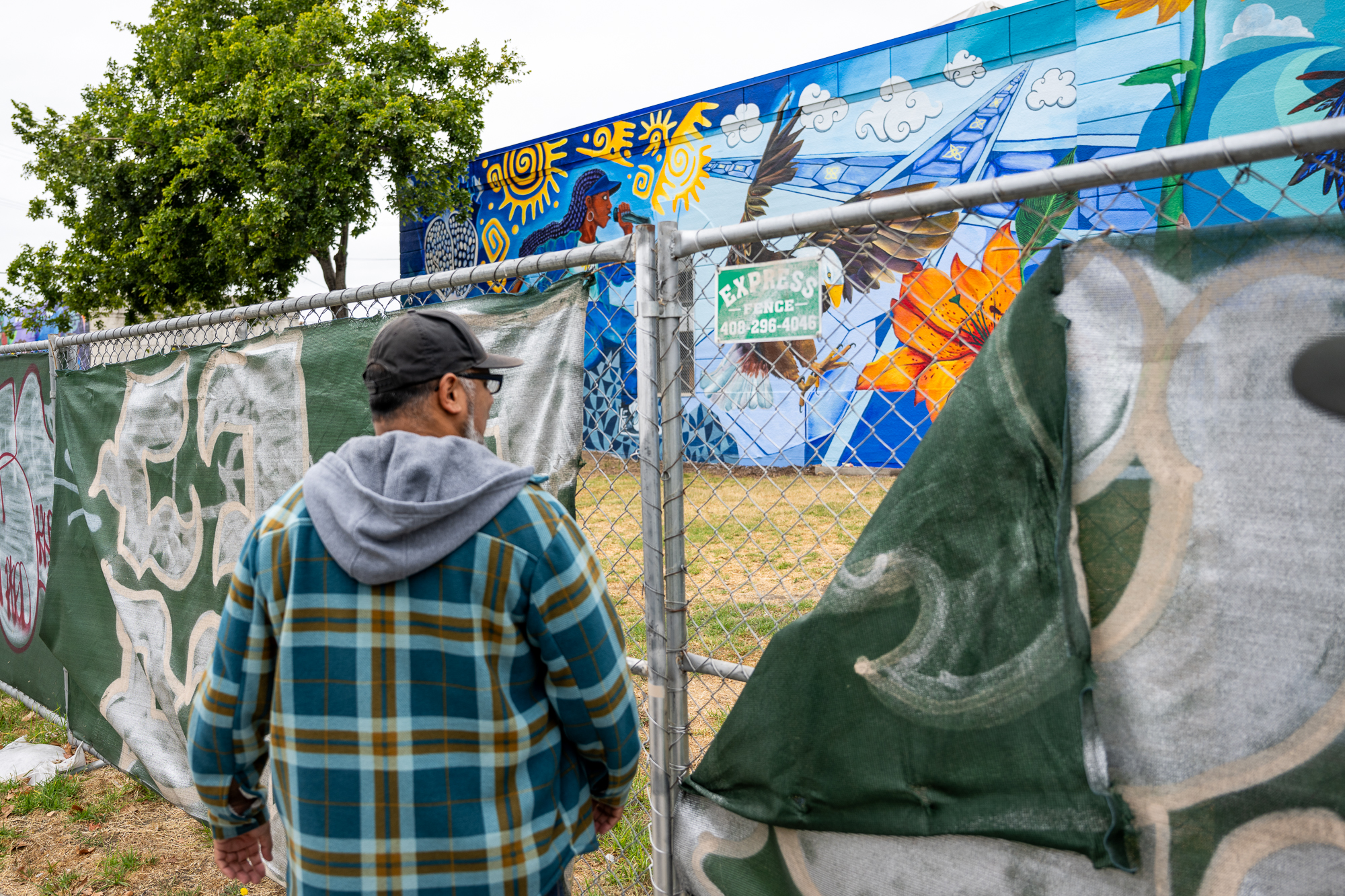 Emilio Hernandez looks at the mural he helped paint during Laney College’s ART 129 summer mural course.
The class of muralists reflects the wide array of reasons people choose to pursue their education at a community college. Some students are dealing with housing insecurity and physical health issues. Some are elders finally prioritizing art careers, and others are young students chasing their creative dreams.
Twenty-year-old Kiana Tondre, born and raised in Oakland, is a studio arts major at San Francisco State University. Partially inspired by her grandfather, a former California College of the Arts and Crafts professor, Tondre has long known that she’s an artist. And after taking this course at Laney over the past two summers, she honed in on murals as her preferred format.
“This is what I want to do with my life,” she says.
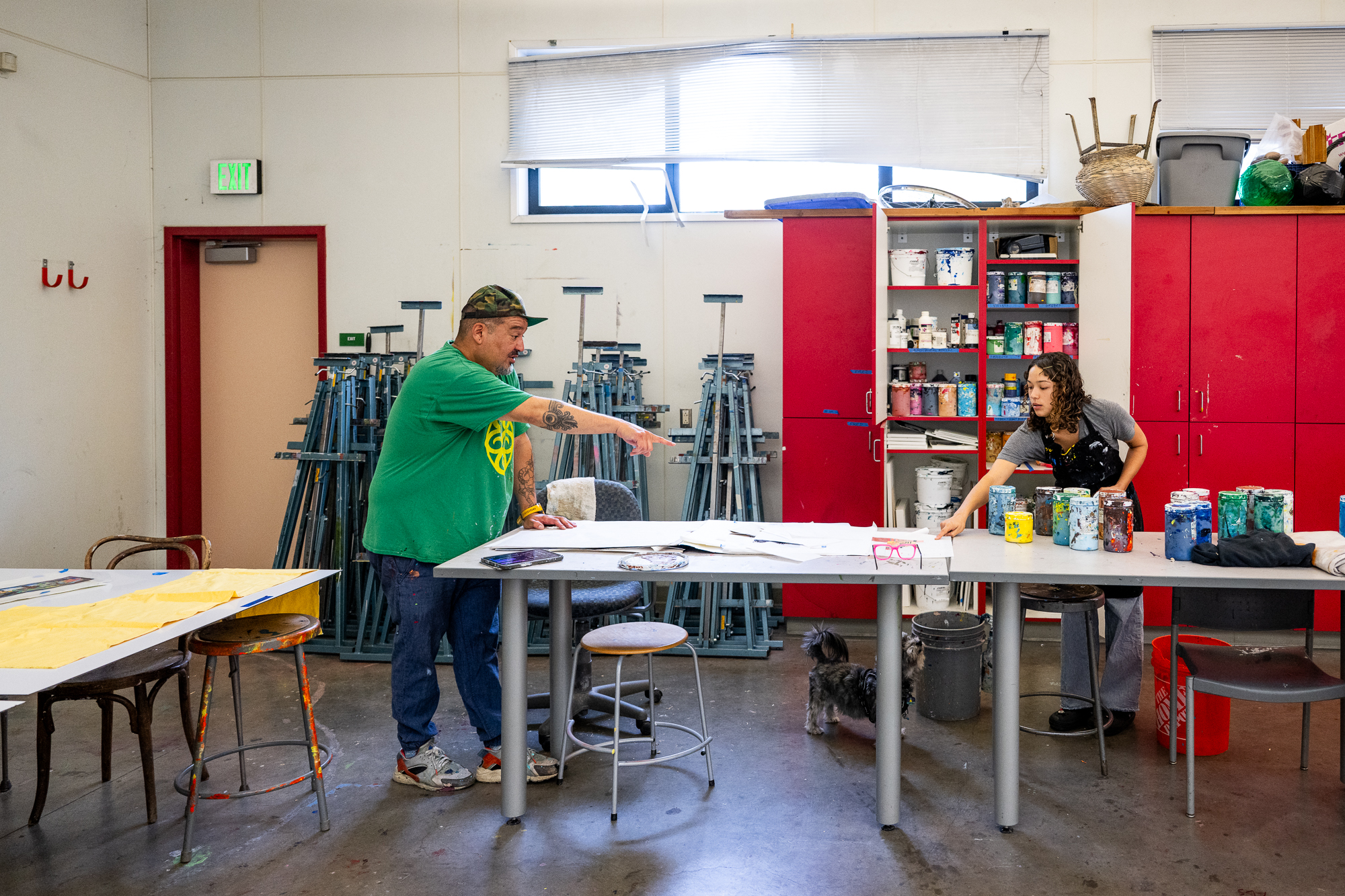
 Student Kiana Tondre and instructor Fredericko Alvarado prepare to touch up a mural created during Laney College’s ART 129 summer mural course.
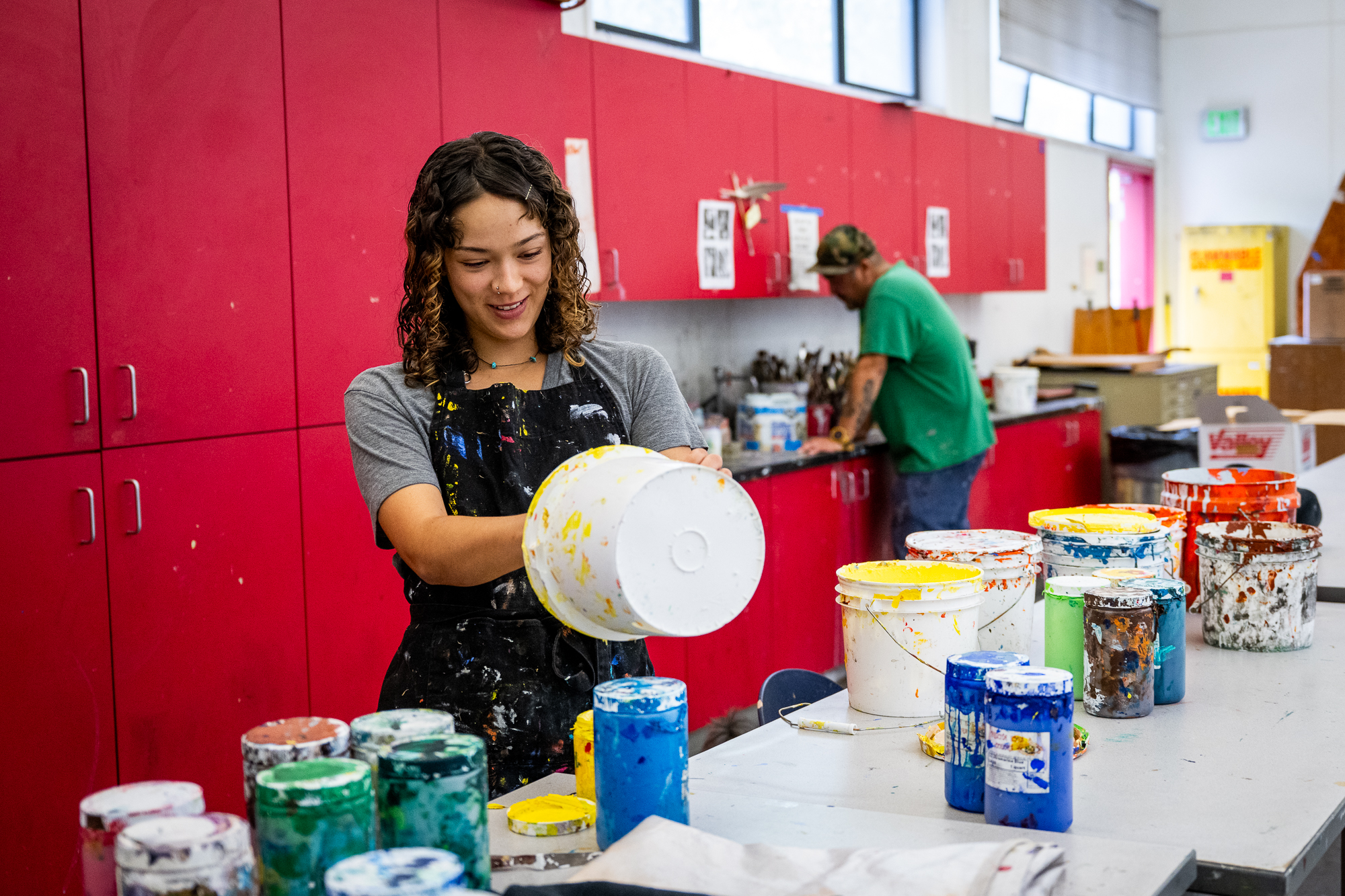
 Student Kiana Tondre and instructor Fredericko Alvarado prepare paint for a mural touch-up.
Through the class she got connected to the legendary community arts organization Precita Eyes, as well as a world of students she wouldn’t have met at her more expensive four-year college.
”In terms of community, I think Laney brings people together a lot more,” Tondre says.
Tondre painted a beautifully stoic Iranian dancer, an image that’s emblematic of a group of women who are “very misrepresented,” she explains. An Iranian woman herself, Tondre imagined the design as an homage to her grandmother. “She is kind of like one of the guardians to the mural,” Tondre says.
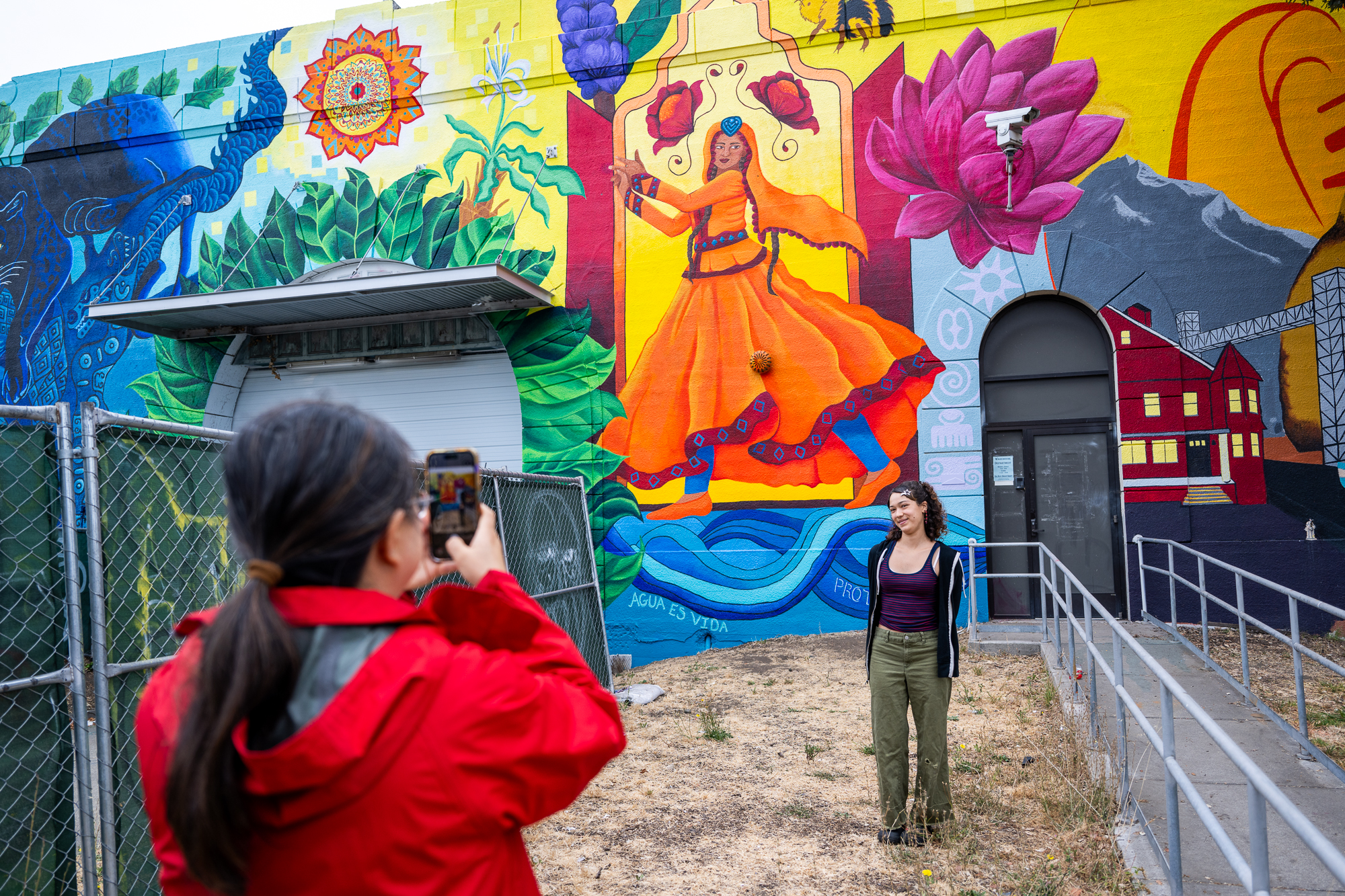 Qi Han takes a photo of Kiana Tondre in front of the section of the mural she created during Laney College’s ART 129 summer mural course in Oakland on Aug. 14, 2026.
On the other side of that stands Ernesto Cortes’ painting based on an old photo of his nephew, who began learning about traditional Aztec dances and culture at nine years old. Cortes tells KQED in Spanish that his nephew is now a young adult, and teaches cultural classes at the college level. Noting the importance of remaining steadfast in your calling and cultural pride, despite racism and other oppressive forces, Cortes says he had to honor his nephew’s vision.
Below Cortes’ dancing nephew, depicted in vibrant shades of green and blue, are the Ngíva words for grass and water. And to the righthand side of that image is a mocha-colored owl with spread wings and huge eyes, painted by traditionally trained fine artist Qi Han.
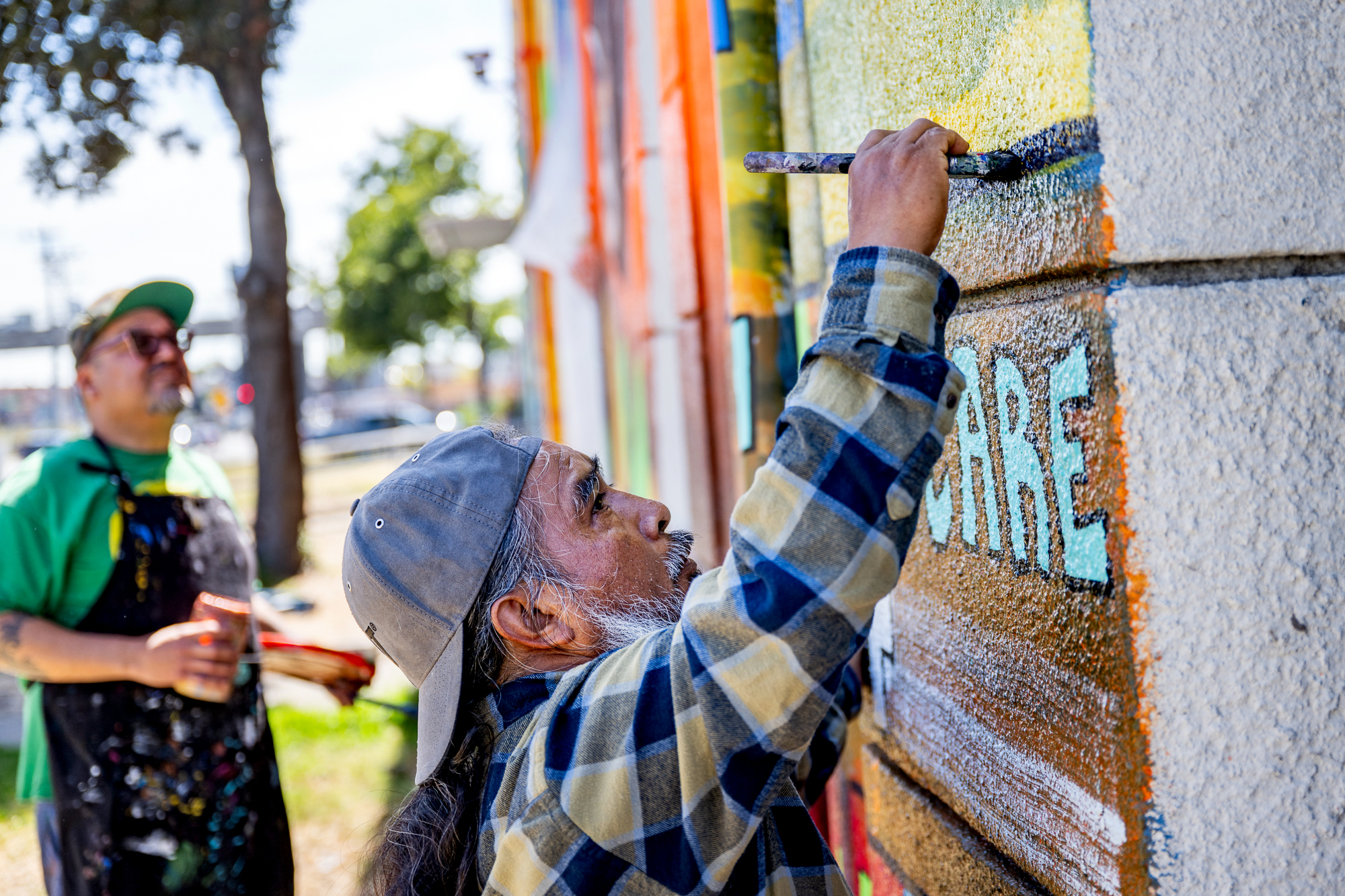 Ernesto Cortes touches up a section of the mural he created.
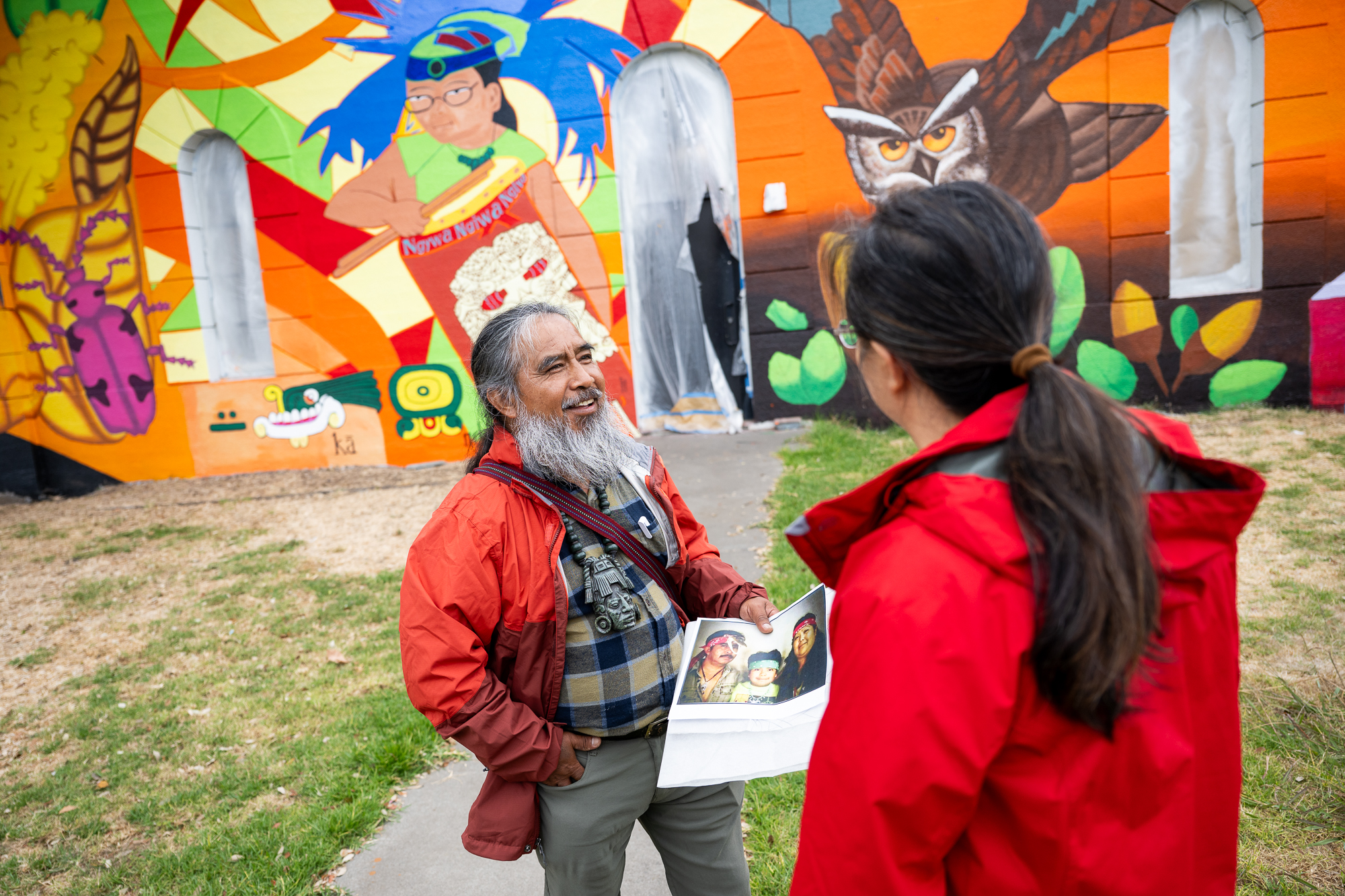 Ernesto Cortes speaks with fellow student Qi Han.
Before taking Alvarado’s class, Han had never painted a mural. Now, she’s already completed a second one through connections she made in the class. “Yeah, I think I’m hooked,” says Han.
“When you do a mural,” the Chinese-born artist reflects, “so many people can get to enjoy it. It’s just a different kind of art.”
It also takes more people to make it. “The project is very big, you cannot do it by yourself,” Han says. “So you really have to work with other people.”
Puerto Rican artist Emilio Hernandez says this is the most diverse group of people he’s ever worked with. Not just a variety of ethnicities, but ages, expertise and interests in the craft. “There are students who are there just to dip their toes in art,” he says, “then there are artists like myself, who’ve been doing it for a few years.”
Hernandez spent a decade working as a commercial painter, specializing in coating metal surfaces and scaling huge items. His second job was painting the cranes at the Port of Oakland.
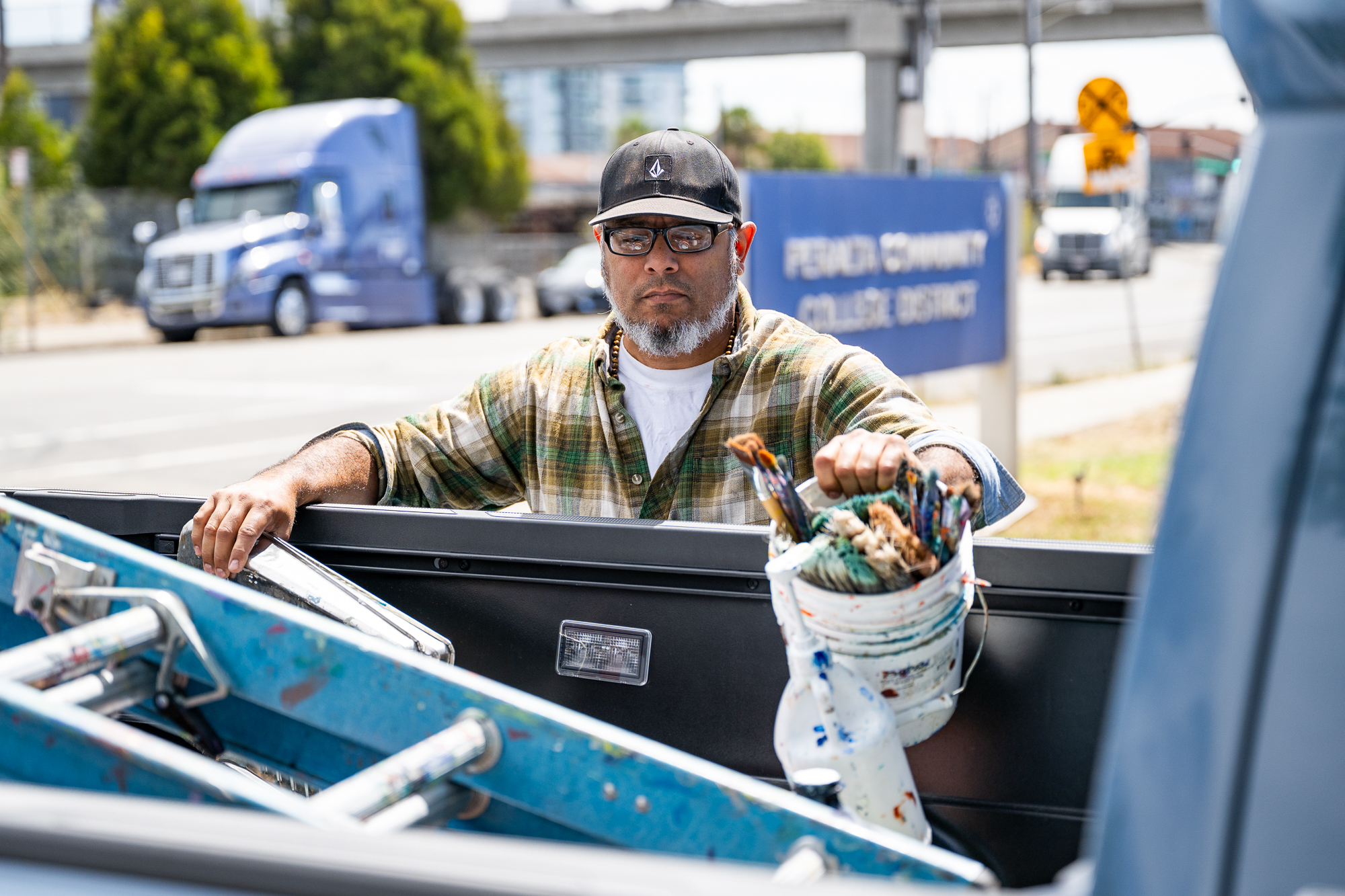 Emilio Hernandez prepares to touch up a mural created during Laney College’s ART 129 summer mural course.
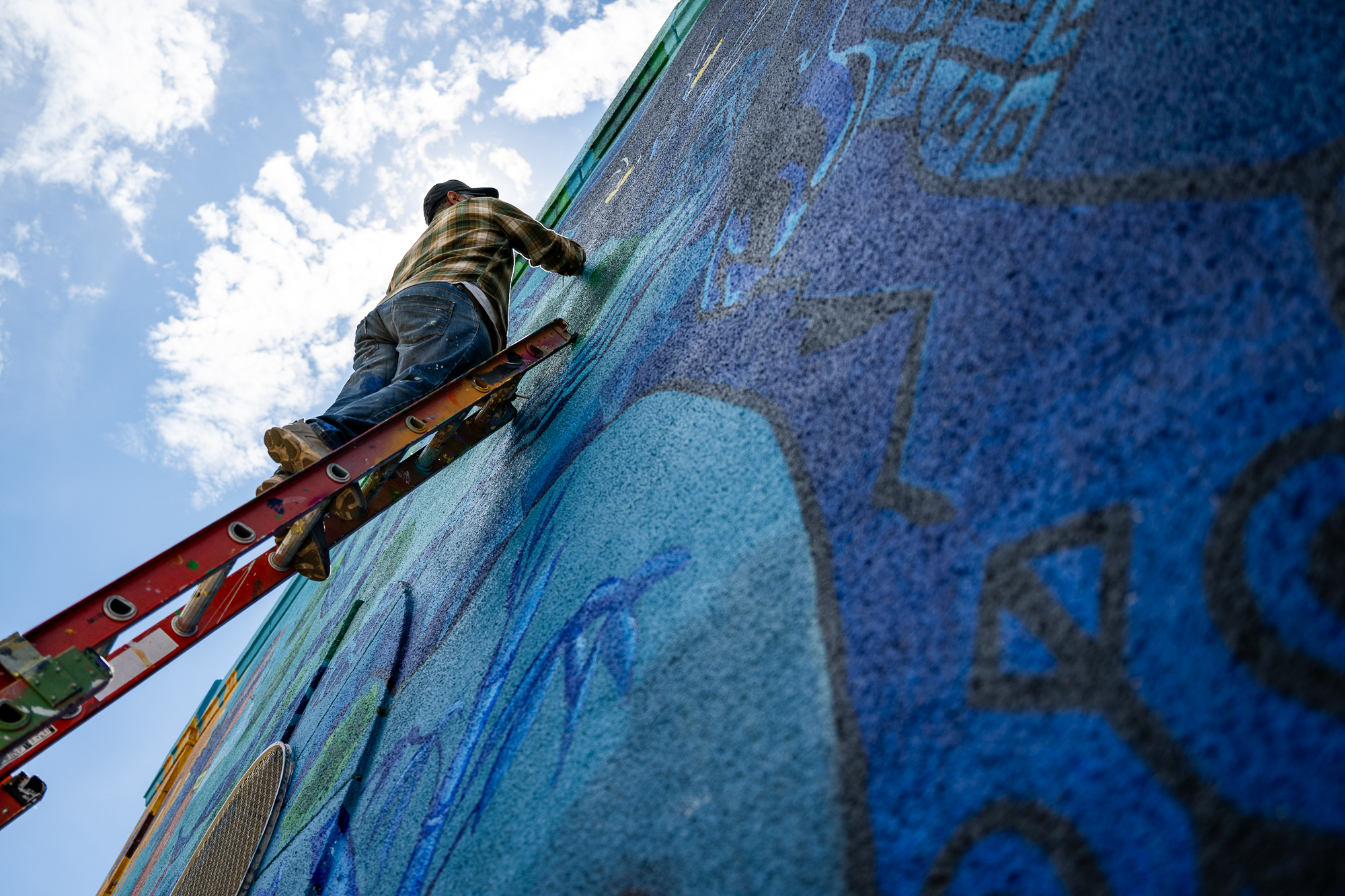 Emilio Hernandez works on a section of the mural he created.
He enjoyed the view from the towering machines, but the labor was rigorous, the schedule was stressful and racist interactions were pervasive. A lingering injury from a car accident years ago prompted him to save money, walk away from the job and return to art school.
Not easy for a married father of four, especially after he’d already gone through the Bay Area housing ringer. After facing a couple of eviction notices and multiple slumlords, he and his family ended up squatting in an abandoned apartment building. Hernandez used his painting abilities to renovate the spot with the help of a few others. Backed by the Bay Area Community Land Trust, he and the residents of the apartment building successfully earned the right to stay in their home on 12th Avenue, not far from the mural.
Hernandez wanted to paint the mural’s black panther “as close to the sun as possible” to uplift Black and brown people’s legacy of activism. “I don’t want the children to be raised and not know the history of where we came from and what got us to get to where we’re at today,” he explains.
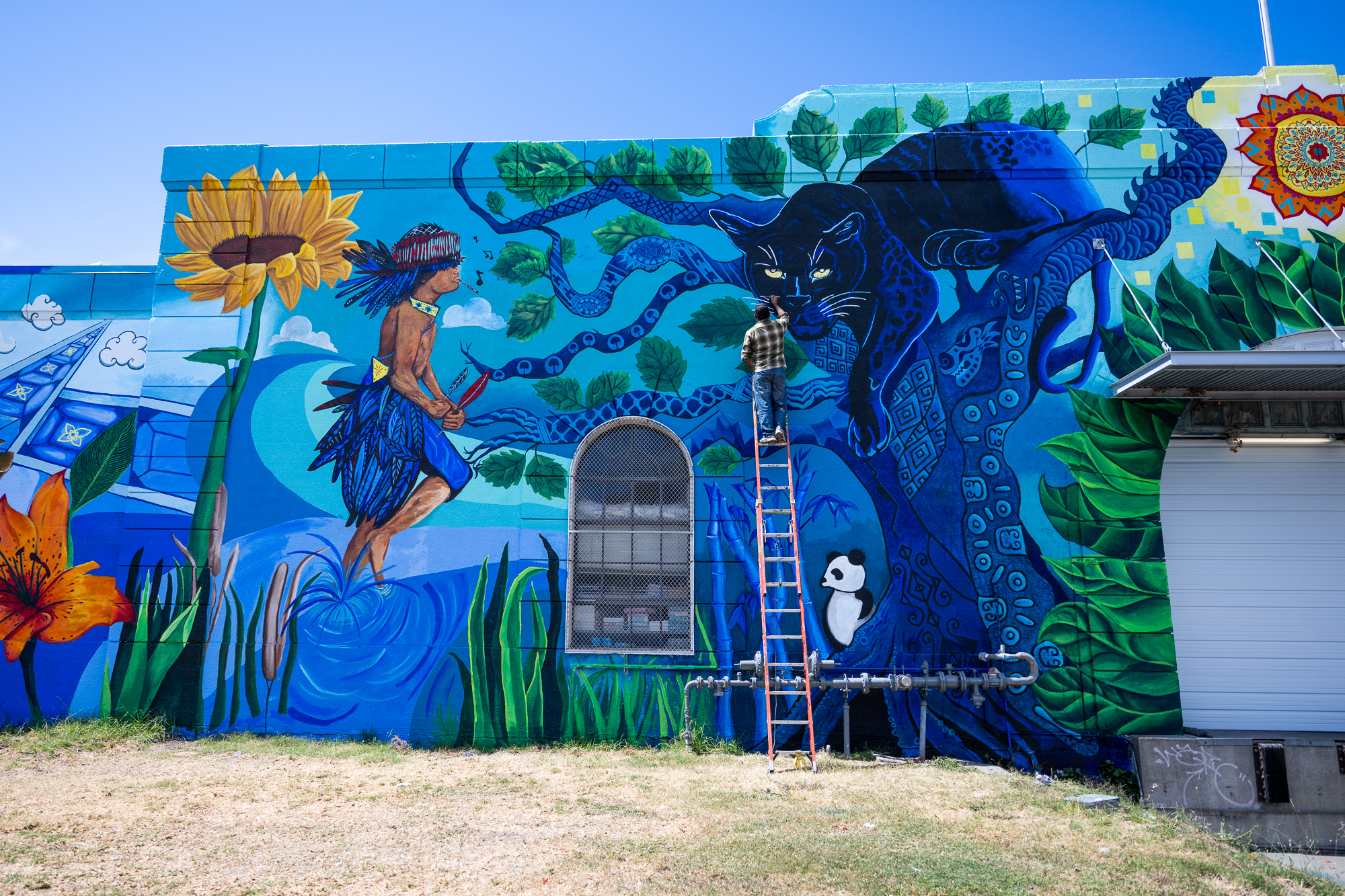 Emilio Hernandez touches up a section of the mural he created.
 Instructor Fredericko Alvarado (left) and student Emilio Hernandez prepare to touch up the mural.
When he shared his stance with the class early in the semester, the discussion resulted in a bit of friction among students. But the tough conversation paid dividends in the end. “I couldn’t believe that we were having a civil conversation with a lot of tension,” Hernandez reflects, “and we ended it at peace.”
Makina and Shi Shi, two mural-painting vets who volunteered with this summer’s class, agree that creating art with a collective is a surefire way to get artists in conversation and out of their silos. Shi Shi, who is also a dancer and tattoo artist from Berkeley, originally took the Peralta college class with late artist and professor Ray Patlán. Proud that Alvarado is continuing the class’ legacy, Shi Shi highlights how it contributes to the region’s larger artist ecosystem.
“When I took that class,” she says, “I met other artists, and also tapped in with other maestros and maestras here in the Bay Area.”
Makina concurs, noting that the class is a catalyst for creatives to “think bigger about the impact of your arts.” Public art can inspire “community dialogue around the visual landscape of your neighborhood, around the way your city is represented and the cultural equity that it offers,” she says.
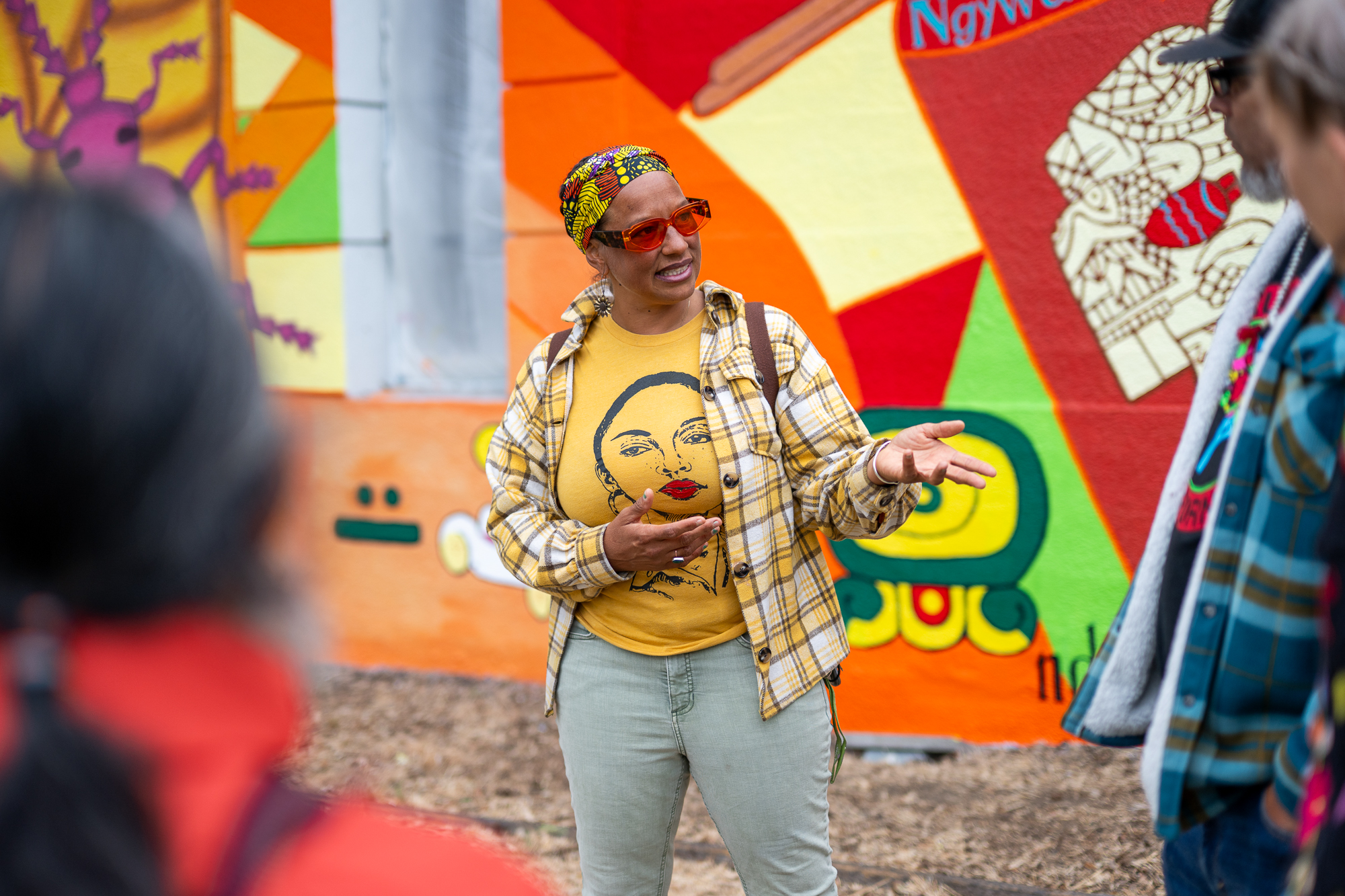 Mural advisor Makina speaks with students from Laney College’s ART 129 course.
Donald Diggs, a 72-year-old Monterey-raised returning student, says his life changed when he found the world of public art.
“I happened to be incarcerated for 43 years,” Diggs shares, explaining that he got bit by the creative bug while taking classes through the William James Association in prison. “I just focused on art and it was like my escape.” For four decades he sat behind bars, working mostly with ceramics. After his release he joined the Peralta college network, signing up for Alvarado’s class only a few months after his return.
He showed up and morally supported the group this year after helping paint last year’s piece — an adjacent mural that’s roughly a quarter of the size of this year’s mural. “Art school,” Diggs says with an exhale, “was probably the best choice I could have made. And God has been blessing me ever since, so I just keep doing it.”
Each semester, Alvarado, the instructor, designs the class slightly differently, but he keeps the “scaffolding” the same. It’s hard to fail, he admits, no matter your skill level. “Active engagement, being present, participating and just trying” are his grading criteria. “I don’t judge too much on aesthetics,” he says.
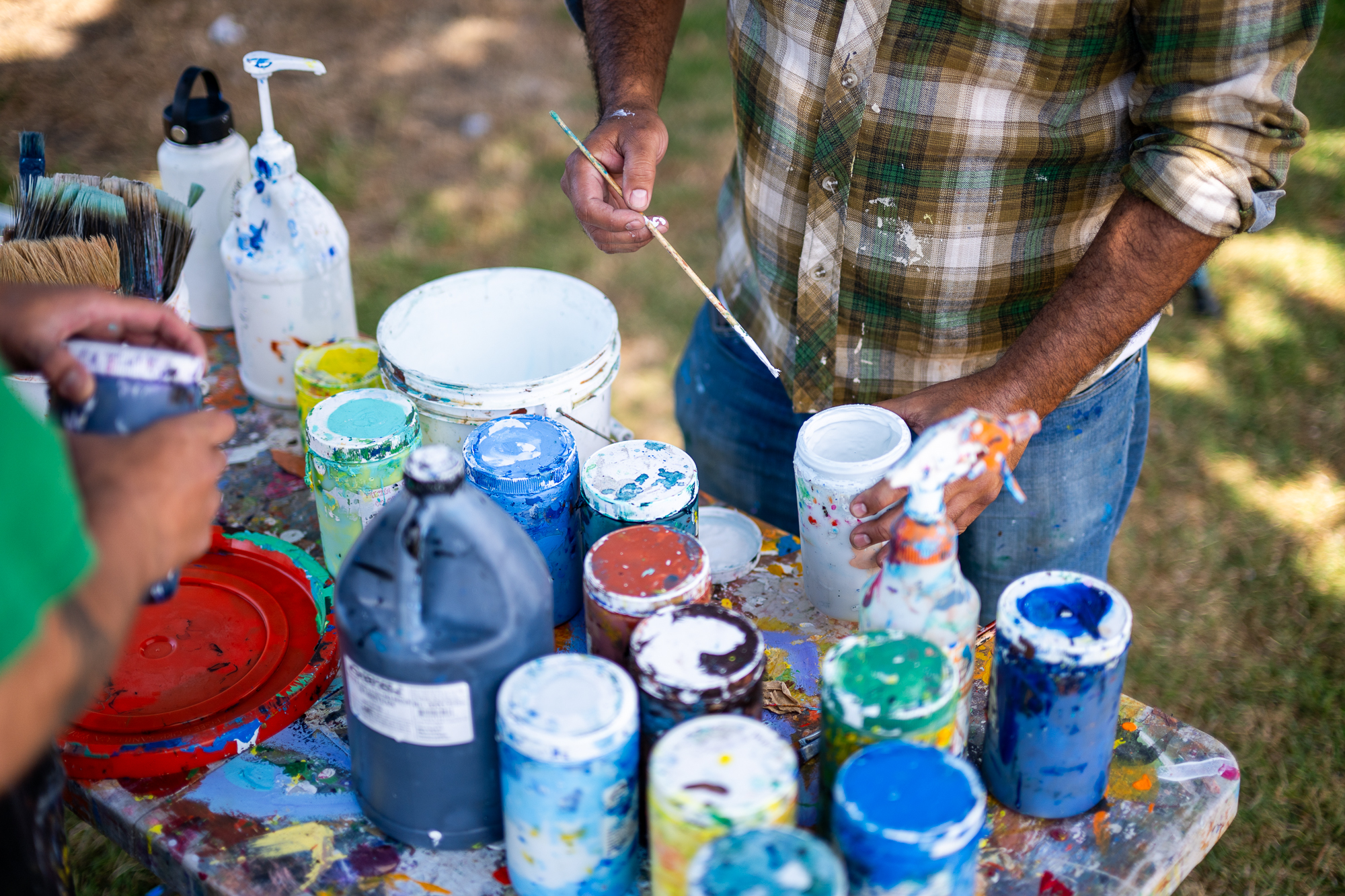 Instructor Fredericko Alvarado (left) and student Emilio Hernandez prepare paint.
Alvarado, who took over the class just as pandemic restrictions lifted, says he’s seen how the student artists have created their own community.
“Laney now has their own art club,” Alvarado says, referring to the newly-founded Society of Artists & Markers. With an email list of over 100 artists, the collective has already held two art openings since it began last spring, and a handful of Alvarado’s students are in the mix.
The beauty of the art club, much like his class, is the variety of work and different perspectives it offers.
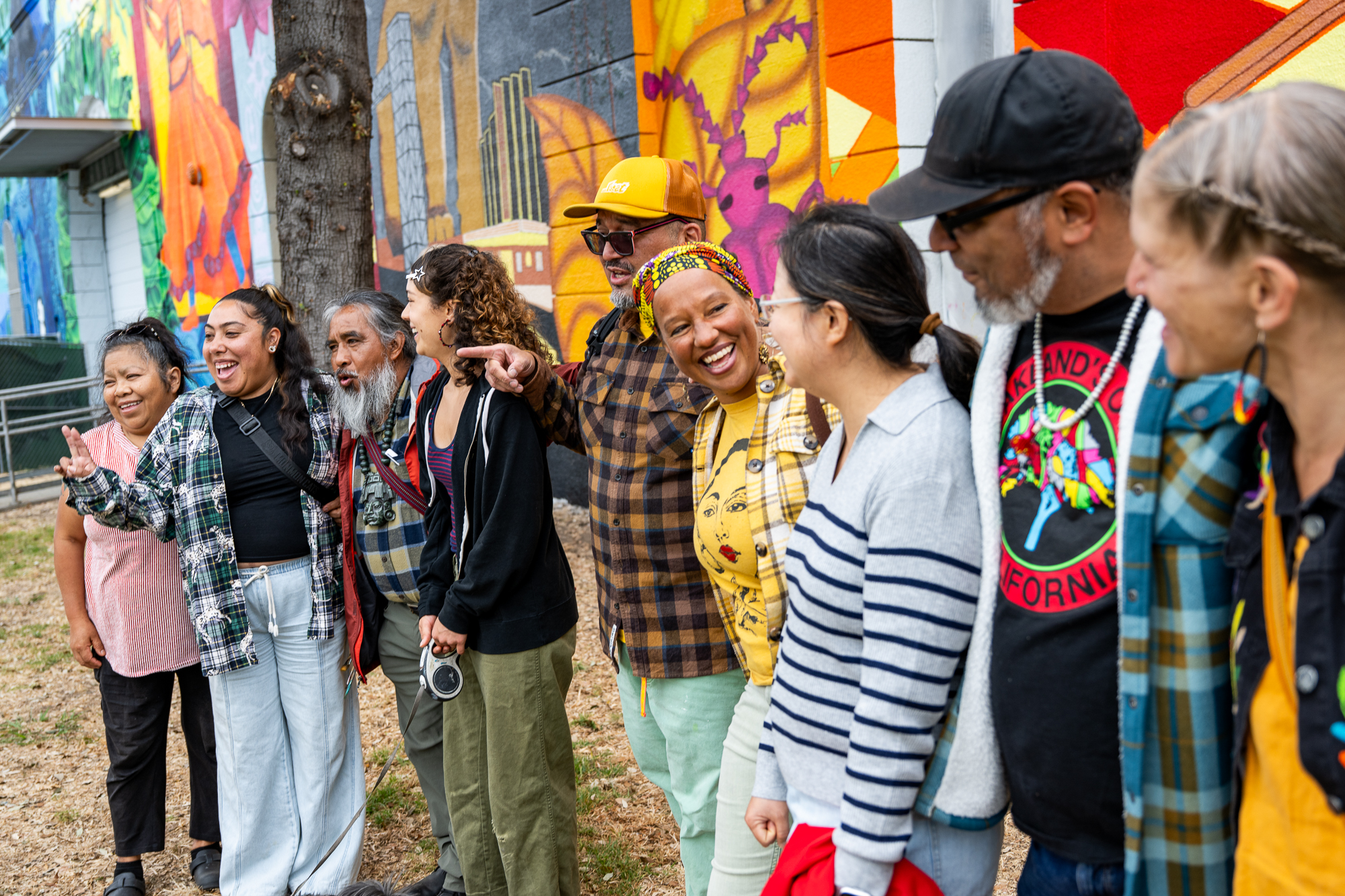 Students and volunteers from Laney College’s ART 129 mural summer course gather for a group photo in front of their completed mural.
“Our classes are always filled or overfilled,” Alvarado says, explaining that the art department is always thinking of new ways to leverage access to resources and studio space for students in the Peralta system.
“In reality,” Alvarado concludes, “the community college belongs to everybody, right? So it should always be available to folks in some sort of way.”