
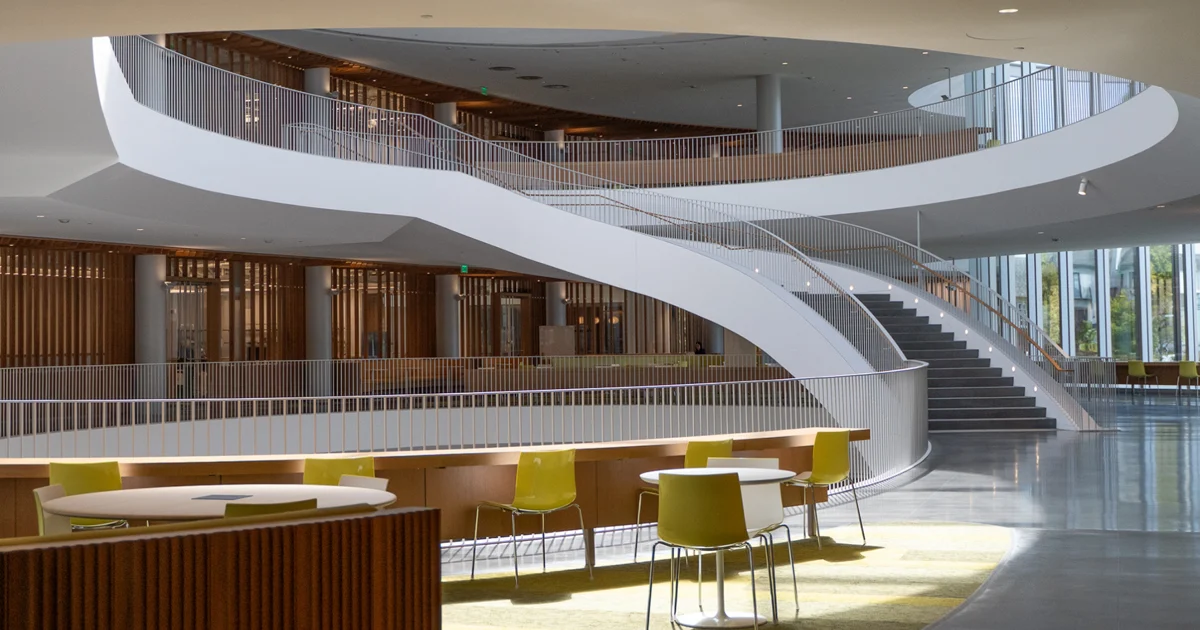
UC Berkeley’s turf for computer science, data science and statistics students just got 367,270 square feet bigger.
The Barbara and Gerson Bakar Gateway, which cost $557 million to build, is the new home for the College of Computing, Data Science, and Society, or CDSS. The building, lush with its own cafe, advising offices, labs and undergraduate spaces, will see its first wave of students this week when the fall semester begins.
Starting Monday, the first floor and the level below it, also called the lower level, will be open on weekdays from 7:30 a.m. to 6 p.m. The second through fifth floors are only accessible to graduate students and faculty.
The first floor houses CDSS Student Services offices for advisers and peer mentors, as well as two lecture halls — one that seats 250 students and another that seats 150. The lower level hallway is lined with nine other classrooms.
According to Tiffany Lohwater, assistant dean of communications for CDSS, populous prerequisite courses for computer science and EECS majors will not be held in the Gateway since these lecture halls cannot accommodate larger classes.

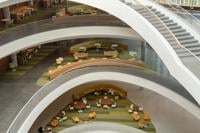
A quick glance up from tables lining each floor’s walkways will draw eyes to the Gateway’s skylight and its open, elliptical staircase — what CDSS facilities director Domenico Caramagno calls the “anchor point” of the building. The parabola-like staircase leads to the upper floors, three of which are dedicated to research labs and faculty. The fifth floor includes an open reception area, event spaces and conference rooms.
Lohwater said the upper floors were designed to encourage collaboration between innovative labs, such as the Sky Computing Lab and the Berkeley Artificial Intelligence Research, or BAIR, Lab.
“We’re trying to explore more possibilities from the AI research field. … (BAIR) focuses more on the advancements of AI, and we focus more on the systems approach,” said Uriah Tsai, a graduate student researcher in the Sky Computing Lab. “(We’re making sure) that the technology developed by BAIR is not going to be misused, is not going to be lethal and it could remain safe and secure.”
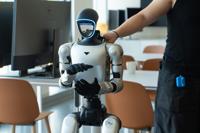
The Sky Computing Lab’s robot, for example, builds off of the BAIR Lab’s work on AI advancements.
The robot, named Tony, can perform simple movements such as waving and dancing. Students including Tsai are training it to perform daily tasks and recognize its surroundings.
“A lot of the research projects that we’re focusing on is to give (the robot) … ‘contextual safety’ — we want it to actually recognize what kind of environment it is (in) and then try to recognize possible hazards,” Tsai said.
The first through fifth levels also feature “social kitchens” that were designed as central communal spaces.
ASUC-registered student organizations can reserve the first floor social kitchen for events. Lohwater said research groups use the upper floors for meetings and presentations.
“This was intentionally made this way so that people collaborate between floors and between labs,” Lohwater said. “So some of the labs that had been in different buildings are now right next to each other.”
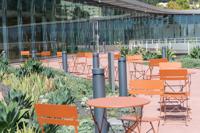
Once the last parts of construction are done on the top floor, the Gateway will be able to undergo final inspections for the highest LEED certification. LEED ratings are widely used to certify buildings’ environmental quality, water use and waste management, among other facets, according to the U.S. Green Building Council website.
For students, researchers and faculty in fast-evolving fields, the Gateway will follow them into the future.
“It’s very different for this campus in some ways, but it’s very modern (and) forward-looking, which makes sense in terms of what we’re trying to do at the college too,” Lohwater said.