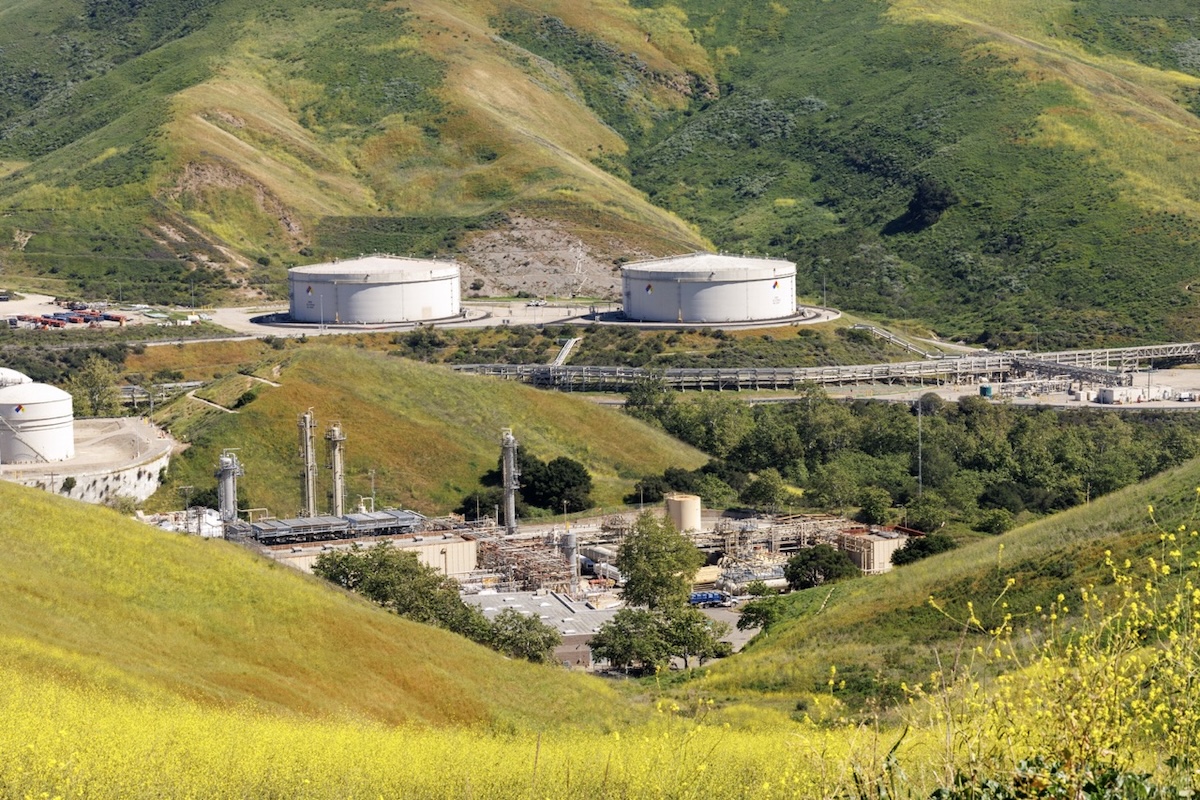
Federal Judge Steven Wilson issued a 45-page ruling last week declaring the Trump administration the winner of what’s been a protracted state’s rights battle pitting the Trump White House against the State of California over Sable Offshore’s right to begin production from its Santa Ynez Unit up the Gaviota Coast and to pump oil through pipelines that 10 years ago sprang a 142,000-gallon leak along the coast.
Specifically, Judge Wilson ruled that the Trump administration’s invocation of the Defense Production Act in December 2025 and the accompanying order that Sable Offshore begin production took legal precedence over a 2020 Court Order giving the State of California — the Office of the State Fire Marshal — sole and exclusive authority to determine whether 129 miles of Sable’s corrosion-susceptible pipeline had been rendered safe to transport oil.
Wilson also rejected arguments made by California Attorney General Rob Bonta that the Trump administration had not asserted facts sufficient to justify the deployment of the Defense Production Act — passed by Congress in 1950 during the Korean War empowering the president exceptional authority to intervene in the domestic economy on the grounds of national security.
Likewise, Judge Wilson cited that law is concluding the State Parks Department lacked the power to deny Sable a four-mile easement through Gaviota State Park necessary for pipeline repairs. That easement expired in 2016.
Lastly — and perhaps most critically — the judge cited the Defense Production Act as the basis for ruling that the federal Pipeline and Hazardous Materials Safety Administration (PHMSA) would be vested authority and responsibility for enforcing the terms of the 2020 consent decree instead of the Office of the State Fire Marshal.
Sparking this jurisdictional showdown, the State Fire Marshal rejected Sable’s application to restart the pipeline in October 2025, asserting that Sable had failed to complete all the necessary pipeline repairs required. Because the pipeline is inherently prone to corrosion — due to the steepness of the terrain, the viscosity of the oil, the heat required to move that oil, and the condensation all this generates along the bottom of the pipe — past corrosion-control efforts had failed. In response, the Fire Marshal had insisted upon a level of belts-and-suspenders, better-safe-than-sorry safeguards that Sable rebelled against.
Sable claimed the Fire Marshal had changed the rules and moved the goalposts when the company was under intense time deadlines to pay its chief creditor $750 million. The contested rules would have effectively required Sable to have repaired all stretches of pipeline with corrosion levels of 30 percent or more; Sable claims to have repaired all pipeline anomalies with corrosion levels of 40 percent or more.
That’s when Sable took its case to the federal government and the Trump White House. Late last December PHMSA, the federal pipeline safety agency, unilaterally announced it was taking jurisdiction over the pipeline away from the State Fire Marshal and then in short order issued Sable an emergency start-up permit and then a non-emergency start-up permit. It’s worth noting that in 2016, in the immediate wake of the Refugio Oil Spill, PHMSA signed a document renouncing all authority over the pipeline and ceding it to the Office of the State Fire Marshal. In 2020, PHMSA signed the court-ordered consent decree also imbuing the Office of the State Fire Marshall with ultimate authority for start-up approval and enforcement.
Judge Wilson stressed in his ruling that all the safety conditions imposed by that consent decree still stand, just that the PHMSA will now be charged with enforcing them and not the Fire Marshal.
“Developing national security interests and a coordinated federal effort to harness regional energy resources changed the circumstances to justify modifying the consent decree to shift regulatory from the state to the federal level,” Judge Wilson wrote. “Such a transfer helps avoid conflicts involving state courts and agencies and limits the ability of state agencies to unilaterally frustrate abiding federal interests.” He added, “When, as here, a directive based on a clear and present national security interest is in the balance, such discord risks dangerous delay.”
State officials have long argued that it should take more than merely asserting a national security emergency to invoke the Defense Production Act, noting that the United States produces more oil and gas than any nation in the world. Likewise, they have argued that there’s no evidence that Sable’s oil is being designated for any of the 32 military installations along the Pacific Coast, a geographical region that relies on foreign oil imports for 70 percent of its supply. Attorney General Bonta has indicated he fully intends to appeal the ruling to the federal Ninth Circuit Court of Appeal.
Judge Wilson fined Sable Offshore $1.45 million for violating the consent decree by pumping oil through the contested pipelines between March 14and December 2025 when the Defense Production Act was invoked. The Defense Production Act does not protect Sable with a retroactive shield.
“In all, Sable has violated the express provisions of the consent decree, without justification,” Judge Wilson wrote.