
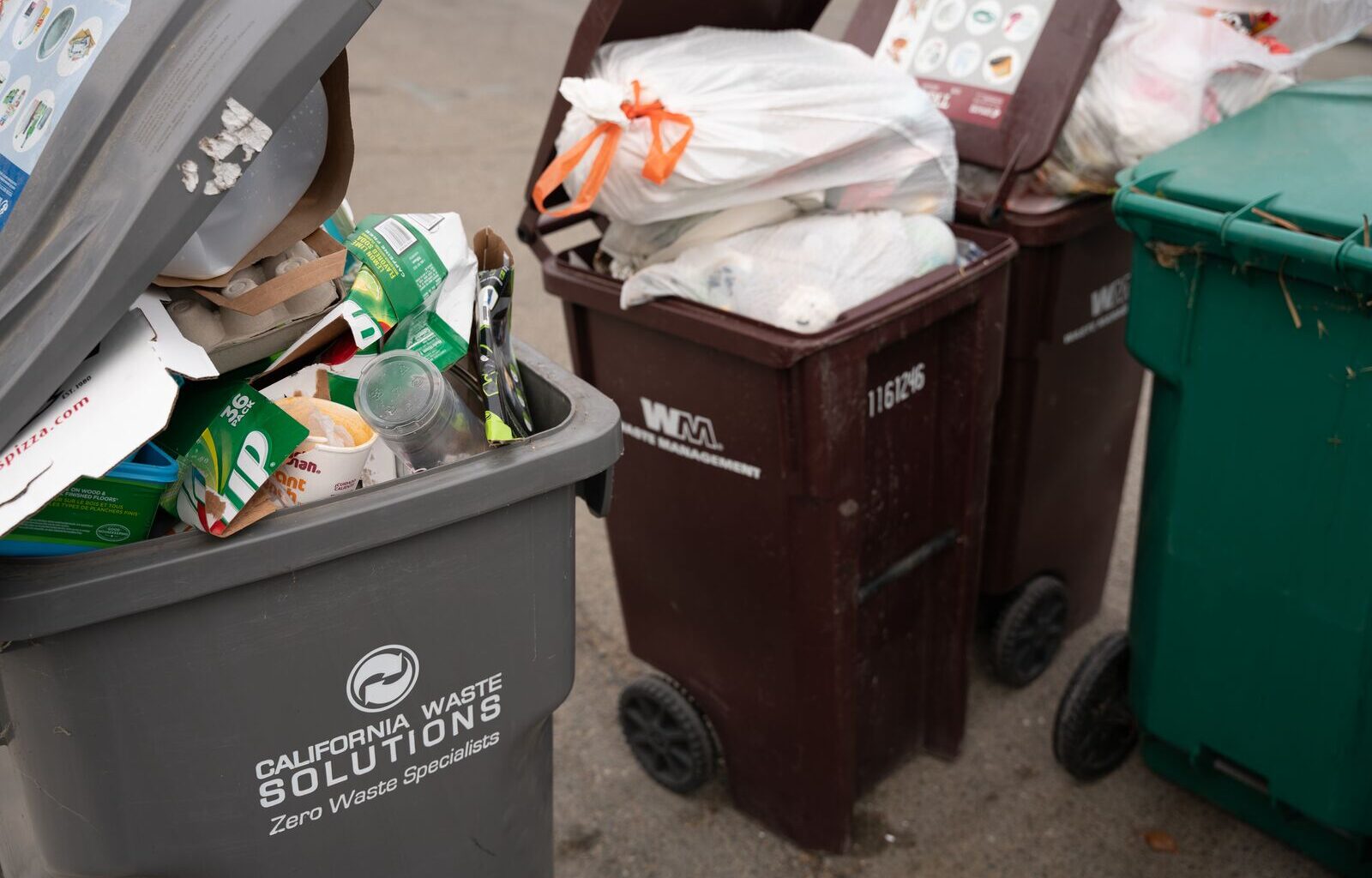
If you compost your food scraps in Oakland, there’s a decent chance you’ve been doing it wrong. Those green “compostable” bags sold in bulk at places like Costco, and given out for produce at stores like Farmer Joe’s and Berkeley Bowl, aren’t actually accepted in the city’s curbside compost bins — and neither is any other man-made item, according to Waste Management, Oakland’s curbside compost collector.
To find out how this works, and what to do instead, I spoke with our housing and City Hall reporter, Natalie Orenstein, who’s also been on the garbage beat lately. You can read it below, listen to our conversation above, or find it on Apple, YouTube, or anywhere you get podcasts.
— Tasneem Raja, editor-in-chief, The Oaklandside
Natalie, you wrote a surprising story about how people actually shouldn’t be putting those little green compost bags in their curbside compost bins. How did you find this out?
Natalie Orenstein, Oaklandside housing and City Hall reporter: I found out the hard way. I love to cook, and so I generate a lot of food scraps. Each week I’ve been diligently composting those food scraps. I put them in these green liners in my little kitchen compost pail.
You know the ones — they’re sold in bulk at places like Costco, and some grocery stores like Farmer Joe’s and Berkeley Bowl give them out for produce. They’re often advertised as being compostable. It often says so on the box or on the bag itself.
In my building, our neighbors take turns taking the bins out to the curb each week. One of my neighbors sent a text to the building casually saying, “Oh, by the way, Oakland doesn’t accept those green bags.”
This one text kind of rocked my world. I have to admit, I didn’t believe her at first; I thought she had the wrong information. But I looked into it a little bit more, and to my chagrin, it turned out to be true.
So what is going on with these green bags? Why can’t people put them in the bins?
The problem is that the city of Oakland and its curbside compost collector, Waste Management, don’t accept them, and in fact, no man-made items are allowed at all in those green bins. Waste Management’s processing plant in Altamont can’t process any type of plastic or bioplastic.
So there’s plastic, and then there’s bioplastic, and bioplastic is what these green food compost bags are supposedly made of.
Right, and I’m definitely not an expert here, but bioplastic generally means materials that can feel like plastic but are largely organic and, in theory, are able to break down.
Bioplastic bags require really specific environmental conditions to actually break down, and the plant here just isn’t built to handle that. In fact, only one facility in California can, it turns out, and that’s in SoCal.
If these bags are marketed as compostable and the packaging says they’re compostable, why aren’t they compostable?
A few different reasons. One is that bioplastic products — bags, but also cups, utensils, et cetera — can contain additives that aren’t actually biodegradable, and it can be really hard for the customer to realize that. There aren’t great rules across the board yet about how transparent the companies have to be. They can contain small amounts of plastic, for instance, and still be certified as compostable.
Now, I do want to clarify: some of these bags and other products are fully compostable, but the machines can’t distinguish between them and the more plastic-y bags, so they end up removing it all and sending it all to a landfill.
So what happens if someone does put one of these bags into their curbside bin?
This was a burning question for a lot of people. The ground-up bag itself typically gets sorted out during the processing and gets sent to the landfill, but the food inside of it still usually makes it into the compost.
Is everyone doing more harm than good with these bags?
Natalie: Unfortunately, that might be the case. And I think part of what’s confusing people is that different cities have different rules. Several in Alameda County do technically accept bioplastic bags in their compost, but these facilities are still just sorting out the bags and other contaminants and sending them to the landfill as Oakland does, according to the regional agency StopWaste.
Robin Plutchok, a program manager there, told us that in most cases, facilities still pre-process and remove the compostable bags along with the other contaminants, which she said is both challenging and costly. So even in cities that technically accept them — and I heard from a lot of people in Berkeley after this story — it doesn’t necessarily mean that they’re getting composted.
There is some legislation underway and recently passed to try to clarify labeling and regulations. This could eventually lead to a more standardized system in the Bay Area in the coming years.
You published the story last week. I know that there’s been a ton of response to this story. Tell us about that.
Yeah, the response to the first story was huge. I think every subject line in my inbox had the words “compost,” “green bag,” or “green bag, exclamation mark, question mark.”
Tens of thousands of people have now read it, and I heard directly from a lot of those readers. Some people were shocked, some were angry, and some were relieved to finally understand the rules and be able to spread awareness.
A lot of people said they had no idea green bags weren’t accepted, and they were frustrated that there hasn’t been clearer public information.
People have been buying these bags for a long time. As you said, they’re available at grocery stores everywhere you look. Why do you think so many people were just caught off guard by this?
I asked the city this. Oakland’s recycling manager, Rebecca Parnes, told us Oakland and its waste collectors do try to inform residents. They table at street fairs, they include information with bills, they actually mail residents annually, and post on social media.
But she said the city doesn’t have the staff or funding to raise as much awareness as it would like. And on top of that, the bioplastic products themselves don’t always have accurate information on the packaging.
So practically speaking, what should people be doing with their food scraps?
We actually crowdsourced this. I asked a bunch of people who subscribe to our Saturday newsletter, and we got a lot of suggestions.
A lot of people line their kitchen pails with paper, whether that’s shredded mail, those paper bags you get for lunches or with loaves of bread, cardboard pieces, even old newspaper — I was happy to see people still subscribe to newspapers! The city endorses these options.
Some people freeze or refrigerate their scraps to avoid leaks and fruit flies. Some skip the liner entirely and bring the scraps straight out to the bin, sometimes covering them with yard waste to keep the bugs away.
Some people reuse takeout containers — you have to make sure they’re completely made of paper or cardboard. And then there are also options for people who are really passionate about this and are willing to spend a little money.
One company, the Clean Composting Company, makes a product that’s kind of shaped like a flower pot, and it’s entirely made out of paper pulp. That runs about $20 a month, or $240 a year — significantly more than the green bags cost.
On the much higher end, there’s a company called Mill, which sells an at-home food recycler for about $1,000 that turns your scraps into dried grounds that can then be turned into compost without the smell or the liquid.
What should people do with the green bags they’ve already bought, or the green bags they’re getting from the grocery store?
I’m in this position, and I asked Parnes about this. She said to treat them like any other plastic bag. Use them if you need to, and then put them in the trash.
Some readers told us they’re repurposing them too, for things like bathroom trash liners or scooping kitty litter.
All of this is really surprising, and a little depressing, but it is what it is. At least we know more now thanks to your reporting. Natalie, I’m sure you’re going to continue getting emails. Maybe there’s a follow-up to the follow-up.
I think people want us to take on the recycling beat next.
This episode of Oaklandside 510 was produced by Mark Nieto and hosted by Tasneem Raja.
“*” indicates required fields