
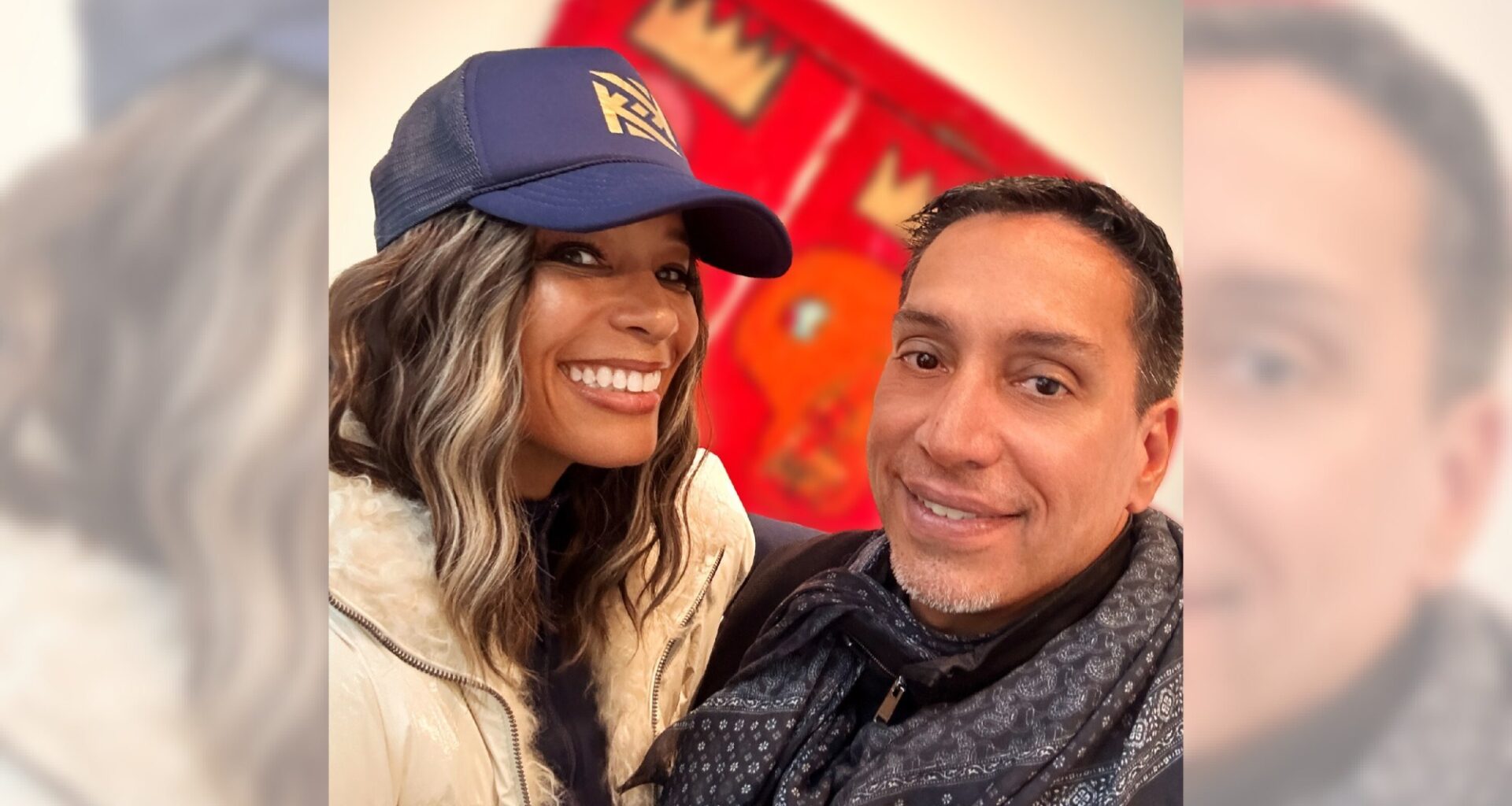
A law student and her boyfriend, a young man getting his start in investment banking and bound for business school, made a date for an afternoon in Central Park.
It was a long time ago. But it wasn’t that long ago for a woman who “dreams in decades.”
They could hardly afford to live in Manhattan, and they were in for some rough times ahead.
But they decided that day, at her urging, to sketch out their aspirations with a pen and a pad.
There were lots of ideas.
All this time and several tax brackets later, it is impossible to spend any time at all with José E. Feliciano and Kwanza Jones and not understand their overriding sense of purpose.
“We tried to map out some of the goals, the dreams; not in financial terms, but more as the things we wanted to achieve,” Feliciano recalled Saturday.
One of the ideas bounced around that day, loosely defined, was maybe one day owning a professional sports franchise.
So that makes Monday, when Feliciano and Jones are introduced as the new owners of the Padres, an astounding sort of full-circle moment.
But that is not the important part.
Said Jones: “We wanted to have an impact in our community in a way that was … big and outsized.”
Today, they speak of their pending stewardship of a city’s only major franchise in the same light as donating to a nonprofit and funding a building at their alma mater, Princeton.
“Sports is much more than a business,” Feliciano said. “At the end of the day, when you buy a team, you are contributing to society unlike almost any other organization. We were really intrigued about how much positive impact you can create, how a team can bring together a community, a town, a city.”
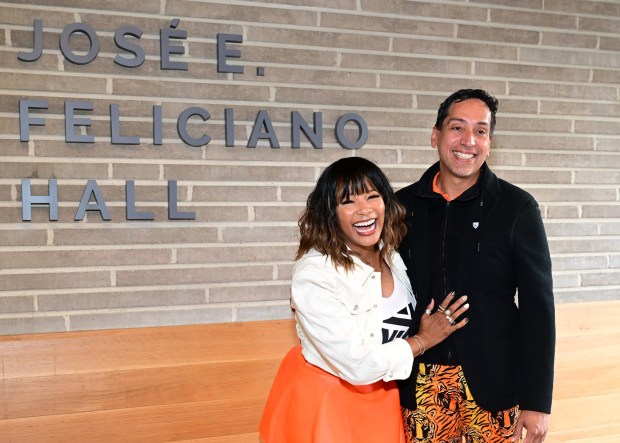 Kwanza Jones, SUPERCHARGED by Kwanza Jones Founder and CEO, and CEO and Co-Founder of Jones Feliciano Initiative and José E. Feliciano, Co-Founder and Managing Partner of Clearlake Capital, and CEO and Co-Founder of Jones Feliciano Initiative attend the Dedication of Kwanza Jones Hall & José E. Feliciano Hall at Princeton University on May 05, 2023 in Princeton, New Jersey. (Photo by Lisa Lake/Getty Images for the Kwanza Jones & José E. Feliciano Initiative)
All in the family
Two people will sit on a dais at Petco Park on Monday afternoon explaining why they committed nearly $2 billion of their fortune to become the lead investors in a baseball team — at a Major League Baseball-record valuation of $3.9 billion.
At some point, an answer to a question will go something like this response during a recent conversation:
“This is a long-term investment,” Feliciano said. “The equation is not what (Internal Rate of Return) or what multiple you are able to make.”
“It’s patient capital, measured in decades and hopefully generations,” Jones interjected.
“Really patient capital,” Feliciano continued after a laugh. “The thought here is, when you think 10 years, 20 years, 30 years from now, does baseball have a positive future? We believe the answer is absolutely ‘Yes.’ And we want to be a part of that future with the Padres family.”
That is to say, not only does the husband-and-wife team mention family a fair amount, but they conduct large swaths of communication with seamless interruptions and completion of each others’ sentences.
League rules require one “control person” for each team. Feliciano will initially assume that role. To MLB, that makes his voice the one that matters.
But to see them interact is to know there will not be only one voice speaking for the Padres.
They will run the team as a partnership.
And owning the Padres is their personal investment.
Feliciano, who co-founded Clearlake Capital in 2006, has a net worth estimated by Forbes to be $3.9 billion, which, according to the publication’s real-time tracker, makes him the world’s 1,115th richest person. Just three principal team owners in MLB are worth more, according to Forbes’ valuations.
(Feliciano and Jones purchased approximately 45% of the Padres, which is nearly double what Peter Seidler personally held.)
But it is important to Feliciano that there is clarity about the difference between the couple’s purchase of their stake in the Padres and Clearlake’s ownership stake in the Premier League club Chelsea.
A private equity firm buys entities with funds it manages for investors. Profit is the measure of success. The investment might be for several years, but it is finite.
“The time horizon here is measured in decades, not years,” Feliciano said of the Padres. “We’re thinking not just about today, but about the next generation and the one after that. That fundamentally changes how you make decisions.
“Sports is a business. But it is a business unlike almost any other. The connection to the community, the fans, and the city means you can’t make decisions based on a short-term financial outlook. You need to have a much broader, long-term view.”
 Kwanza Jones and José E. Feliciano. (Photo courtesy of the Kwanza Jones and José E. Feliciano Initiative).
The plan
The Padres are the biggest single investment in Jones and Feliciano’s vast portfolio.
It makes sense, then, that they plan to be highly engaged.
“Our job,” Feliciano said, “is to set a clear direction and then be involved in the key decisions that may come up.”
Feliciano’s involvement with Chelsea and the couple’s minority interest in the NBA’s Minnesota Timberwolves has given them a view of how they think some things should be handled and how others should not be.
Still, they know they have much to assess and learn.
“With the tremendous amount of research and due diligence we did as part of this investment, it was really, really important to make sure we got a good feel for the strength of the leadership that’s in place,” Jones said. “Erik (Greupner) and A.J. (Preller) and the rest of the team have done a phenomenal job. We’re not coming in to micromanage a successful organization. Instead, we’re here to be engaged, provide resources, and build on what’s working
“Being engaged means actively having a direct line of communication with the leadership, actively having our consistent and recurring process of checking in and making sure we are all aligned. When we’re involved in things, we’re committed. But being all in and committed doesn’t mean we’re sitting right there next to you looking over your shoulder. We have to give talented people room to do what they do best.”
It also follows, then, that they say they are committed to what Padres fans will care about more than any single thing Feliciano and/or Jones do in their roles as owners.
The value of the Padres lies in the location of the franchise, the ballpark and the team’s emergence as a perennial contender that has, in the words of MLB commissioner Rob Manfred, “energized one of baseball’s most passionate fanbases and strengthened the Club’s role as a cornerstone of the San Diego community.”
The Padres rank second in the major leagues in average tickets sold per game and are going to set a franchise attendance record for a fourth consecutive season. They are on pace to earn a playoff berth for the third consecutive season for the first time in the team’s 57-year history.
“Peter left a legacy that is incredibly important,” Feliciano said. “He did right by the city and left a team accustomed to winning, contending and dreaming big.”
One of Seidler’s most-used phrases was the “art of the possible.” He made fans of a forlorn franchise believe in it. And Seidler and the team’s minority owners put their money where his mouth was, increasing payroll significantly in the years he was the team’s chairman (2021-23).
And they did it with far less combined wealth than the ownership group led by Feliciano and Jones.
Multiple team sources pointed to Feliciano and Jones being aware of (and unofficially approving) the additions of starting pitchers Robbie Ray and Casey Mize at the trade deadline as indicative of how the new owners will operate the team.
“We’re going to be ambitious with our spending,” Feliciano said. “We are also going to be judicious and disciplined. We will be thoughtful how we deploy resources, but there should be no question about our ambition.”
Almost in unison, they said, “We want to win.”
 The sun sets during the fourth inning of the San Diego Padres game against the Milwaukee Brewers at Petco Park on Monday, Aug. 10, 2026 in San Diego, California. (Meg McLaughlin / The San Diego Union-Tribune)
Why San Diego?
Baseball is the first love of Feliciano, who grew up in Puerto Rico. Jones, born in Los Angeles and raised in Washington, D.C., recalls her father’s stories of the Negro Leagues and the importance of Jackie Robinson’s legacy.
They are looking for a house in San Diego in order to have a local base. They seem keenly aware of San Diegans’ provincial nature and disdain for Los Angeles, which is where their primary residence is.
But there is no real tie to the community in which Jones and Feliciano just sunk a huge portion of their wealth, other than the couple has visited America’s Finest City numerous times.
When the Padres became available, though, they immediately recognized the opportunity.
“San Diego is a global city with a strong sense of identity and community,” Jones said. “And Baja is right here, too. The fans and the community are extraordinarily diverse. It’s incredibly exciting and compelling because it’s a gateway to the world.”
And as they learned about the city, its history of major sports franchises leaving and its lack of championships, as well as the mindset of Padres fans, they felt a kinship.
“We share something important with San Diego — the willingness to dream big and the belief that the impossible can become possible,” Feliciano said.
They suggested that, back on that day in Central Park, few would probably have bet on the African American woman and Puerto Rican man with hardly enough money for rent one day owning a major sports franchise. Feliciano recounted his failed business venture before Clearlake. The couple recalled their adventures renting on a budget in West L.A. before the founding of Clearlake.
Never in a 90-minute conversation on Saturday were they more animated than when discussing the idea that San Diego is the right place for them to own a team.
“Both José and I coming from spaces and places — and what I like to say is, wrapped in the packages that we are wrapped in — we understand so well what it means to be underestimated,” Jones said. “San Diegans do, too. The Padres haven’t won a World Series championship yet. Bring on the challenge. We’re here for it. We’re committed. It doesn’t frighten us. In fact, it excites us. So why San Diego? Because it is an exciting opportunity to do what no one else has been able to do.”